49 works in this view — arrow keys or swipe to move between them.
Dance in Art
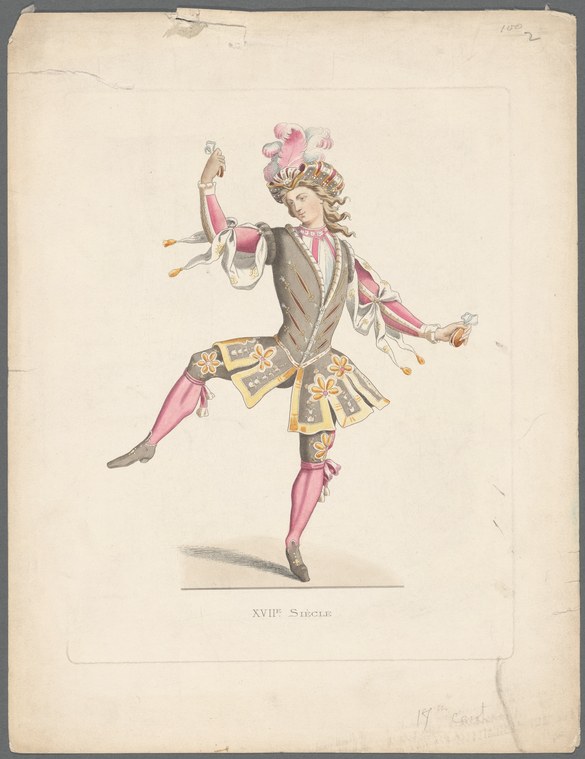
XVIIe siècle
Unknown artist
- Collection:
- Prints depicting dance
- Source:
- New York Public Library
- Rights:
- Public domain — free to use, share and adapt.
- Recorded as:
- Public Domain
This image is a primary source for understanding the physical vocabulary, costume, and theatrical presentation of male court dance in the 18th century. It captures not merely a static pose but a moment of energetic action, showing how the body was used to project joy, brilliance, and technical accomplishment in court entertainment. For dancers and historians, it demonstrates that male dancers of this era were acrobatic, expressive performers whose bodies occupied space dynamically and with considerable elevation.
What you are looking at
A single male dancer in 18th-century court dress is captured mid-leap or bound, his body suspended in an exuberant jumping pose. He wears a brown velvet coat with ornate gold embroidered trim, pink silk breeches, and gray stockings with dark shoes. His blonde hair is styled in period curls and topped with a pink feathered ornament. Both arms are raised and extended outward with bent elbows, his hands holding what appear to be small implements—possibly castanets or hand-held percussion—with orange or yellow accents. His right leg is extended upward while his left is bent, creating a dynamic diagonal line through the composition. The figure stands alone against a plain cream background with a subtle shadow beneath, suggesting a stage or performance space. The title inscription 'XVIIe siècle' (17th century) appears below, though the costume and style are unmistakably 18th century.
The dancing
A single dancer occupies the frame in what appears to be an elevated jump or bound. His upper body is open and expansive, with both arms raised to shoulder height and slightly back, elbows bent at roughly 90 degrees, holding what may be percussion implements. His weight is clearly lifted through a jumping action, with one leg extended upward and the other bent beneath him. The pose conveys lightness and buoyancy rather than grounded elevation, suggesting a quick, lively movement vocabulary.
The dance depicted
This figure represents a dancer from the 18th-century European court, most likely performing a theatrical court dance or ballet entertainment. The costume and pose are consistent with the theatrical dance tradition of the period—a male dancer in elaborate dress executing a showy jump or bound. The held implements and the exuberant carriage suggest a solo turn or divertissement, possibly from a court ballet or theatrical spectacle. Without additional context, the specific dance type cannot be determined with certainty, but the figure appears to exemplify the French or Italian court ballet vocabulary of the 1700s rather than the baroque period claimed by the title.
How it was made
This appears to be a hand-colored engraving or etching, executed in a delicate and precise technique typical of 18th-century dance documentation. The line work is fine and controlled, with watercolor or gouache applied to add the pink, gold, and flesh tones. The technique allows for both decorative detail—the elaborate embroidery and feathering—and clear definition of the dancer's form and gesture. Such images were typically circulated as single prints, serving as costume documentation, performance records, or entertainment for aristocratic audiences interested in theater and dance.
About this work
This is a single-figure study of an 18th-century male court dancer in a moment of elevated, buoyant movement. The figure wears elaborate theatrical costume with gold embroidery and feathered headdress, and holds implements in both raised hands while executing a jump or bound. The work documents both the visual splendor and the dynamic vocabulary of court ballet and theatrical dance entertainment during the ancien régime. It is a record of how male dancers of the period were dressed, how their bodies moved, and what moments of performance were considered worthy of preservation and circulation.
How to look at it
Notice the moment the artist has chosen: not a grounded position but a jump captured at its height, the body weightless and the limbs extended. This was the convention for male dance imagery of the period—to show brilliance, elevation, and technical command through the most spectacular moment of action. Observe how the hands are actively engaged with objects (possibly castanets or rattles), indicating that percussion and hand-work were part of male theatrical dance vocabulary. The extreme refinement of costume detail—every seam and ribbon of the coat, the precise curls of the wig, the feather arrangement—indicates that appearance and luxury were as central to the performance as physical skill.
The artist
Unknown. The work is a hand-colored engraving or etching in the style of 18th-century theatrical and costume documentation. Works of this type were produced across Europe by engravers specializing in theater, court life, and costume study, often distributed as individual prints or collected in series. The precise draftsmanship and delicate hand-coloring suggest professional production for a cultivated market.
The period
The 18th century saw the consolidation of ballet as a professional theatrical form separate from court dance, though court performances and court-trained dancers remained important. Male dancers of this era were virtuosic performers, known for brilliant jumping, turning, and traveling steps (petit allègement, grands jetés, pirouettes). The costume shown here—elaborate coat, breeches, feathered headdress—was typical of male court and theatrical dress in the century, and reflects the influence of both French and Italian traditions. Engravings of individual dancers and theatrical moments became popular in the early 18th century as a way to document and circulate knowledge of celebrated performers and fashionable dance entertainment.
Where it lives
From the New York Public Library's collection of prints depicting dance. The work is a single sheet, likely part of a larger series of costume or dancer studies from the 18th century, distributed as an educational or entertainment print for audiences interested in theater and court life.
Dance in this work
Questions about this work
Why does the title say 17th century when the clothes look 18th century?
The title 'XVIIe siècle' may be a cataloguing error, a later added inscription, or a shorthand reference to the tradition of French court dance in general (which the title-maker associated with the 1600s). The costume, style, and execution are unmistakably 18th century. This discrepancy is worth noting but does not resolve without additional documentation.
What is he holding in his hands?
He appears to hold small implements with orange or yellow accents, most likely castanets or hand-held percussion instruments. These were accessories to certain theatrical dances of the period, adding sound and movement to entertainment. They might also be decorative elements of costume design.
How high did male dancers actually jump in this period?
This image suggests substantial elevation. The artist has captured the body at the peak of a jump with one leg extended upward, implying that male dancers of the period trained intensively in jumping (petit allègement and grand allègement) as a mark of virtuosity. The height and buoyancy shown here were admired and expected of professional male dancers.
Was this a famous dancer or a generic example?
Without a signature, inscription, or documented provenance, it cannot be determined whether this represents a specific celebrated dancer or a generalized image of a fashionable male dancer type. The work may have been produced for educational purposes or as generic entertainment rather than as a portrait of an individual performer.
More dance artwork





