49 works in this view — arrow keys or swipe to move between them.
Dance in Art
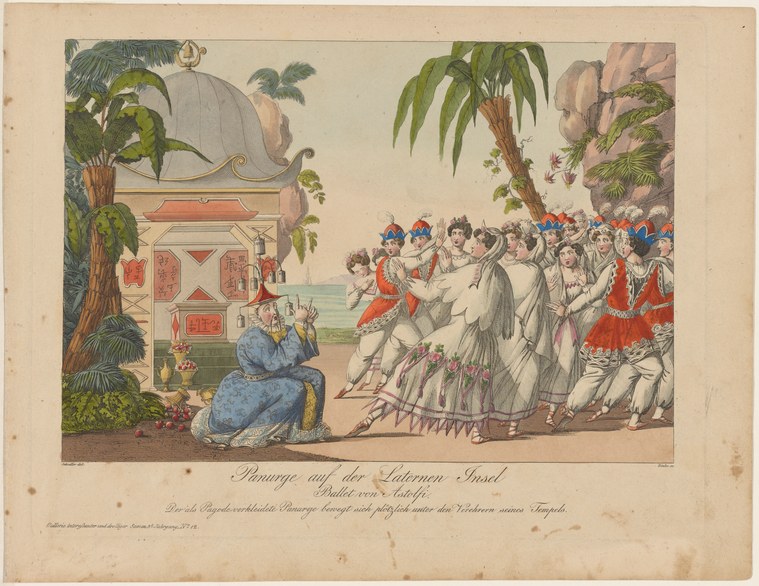
Panurge auf der Laternen Insel: Ballet von Astolfi
Unknown artist
- Collection:
- Prints depicting dance
- Source:
- New York Public Library
- Rights:
- Public domain — free to use, share and adapt.
- Recorded as:
- Public Domain
This image provides rare visual evidence of ensemble dancing in 18th-century court ballet outside the dominant French tradition, showing how exotic narratives and large-scale divertissements were choreographed and staged in Central European theatres. The engraving demonstrates the importance of print culture in promoting and documenting dance spectacles to a broader educated public.
What you are looking at
A theatrical scene depicting a moment from an elaborate court ballet or masque. In the foreground left, a kneeling figure in blue robes gestures toward an ornate pavilion or temple structure framed by exotic foliage—palm fronds and hanging vines suggest a fantastical or Oriental setting. To the right, a large ensemble of dancers in light-colored costumes, many wearing blue caps or headdresses and carrying what appear to be ribbons or fabric props, moves in animated formation. The dancers occupy the middle ground and recede into the distance, creating a sense of theatrical depth. The composition divides clearly: the solitary, reverent figure on the left observes or addresses the dancing ensemble on the right. The hand-coloring in greens, reds, and flesh tones shows skilled application typical of 18th-century theatrical prints.
The dancing
The dancers on the right are arranged in loose, naturalistic groupings rather than rigid formation, with arms raised, extended, or positioned to hold or manipulate fabric elements. Their bodies lean and turn in various directions, suggesting movement and animation rather than a single synchronized step. The kneeling figure on the left presents a contrasting pose of reverence or supplication, with an outstretched arm directed toward the ensemble. The costumes—light tunics and draped fabrics—permit free arm and leg movement, and the visible postures suggest neither the rigid codified positions of classical ballet nor complex partner holds, but rather a looser, more expressive mode of moving.
The dance depicted
The title indicates this depicts a ballet from *Panurge auf der Laternen Insel* (Panurge on Lantern Island), attributed to a choreographer or librettist named Astolfi. The work appears to be an 18th-century court or theatrical ballet, likely German-speaking given the title language. The ensemble character, the theatrical setting with exotic props and architecture, the ribbon or fabric elements the dancers carry, and the overall composition suggest a divertissement or grand finale scene typical of late Baroque or early 18th-century court ballet. The dress and the style of the ensemble work are consistent with German or Central European court theatre rather than French academic ballet.
How it was made
This is a hand-colored engraving or etching, likely produced in the early 18th century for circulation among the court, nobility, and theatre enthusiasts. The precision of the line work and the careful application of watercolor or gouache suggest a work of some cost and intended for an educated audience familiar with dance and theatre. The technique allowed both fine detail in costume and facial expression and the capacity to depict large ensemble scenes in a single composition, making it ideal for documenting or promoting theatrical productions.
About this work
This hand-colored engraving documents a scene from an 18th-century court ballet titled *Panurge auf der Laternen Insel*, associated with a choreographer or company called Astolfi. The work captures a moment of theatrical spectacle combining ensemble dance, exotic setting, and allegorical gesture—a kneeling figure addressing or observing a company of dancers in motion. It serves as both a document of how court ballet was staged and costumed in the German-speaking world and an artifact of the print culture that circulated images of theatrical performance to audiences beyond the theatre itself.
How to look at it
Notice the division of the composition: the solitary, static, kneeling figure on the left creates a point of stillness and observation, while the ensemble on the right is rendered in varied postures suggesting continuous, expressive movement. The artist has chosen to freeze a moment of theatrical spectacle in which action and stillness, individual and ensemble, address and response, coexist. Observe how the exotic setting—the ornate pavilion, the hanging plants, the theatrical props—frames the dancers and signals that this is a staged fantasy rather than a dance from daily life or ceremony.
The period
This work dates to the early 18th century, a period when court ballet in German-speaking territories was influenced by both Italian (especially Venice) and French models but developed distinctive regional characteristics. The title references Rabelais, reflecting the era's interest in fantastical and picaresque narratives as subjects for dance and theatre. Hand-colored theatrical engravings were a common and valued form of publicity and record-keeping for court productions, circulating images of spectacular performances to courts across Europe and contributing to the international exchange of theatrical ideas.
Where it lives
The work is held in the New York Public Library's collection of prints depicting dance. It is catalogued with minimal provenance information, but the style and production quality indicate it was a professional theatrical print likely distributed among courts and theatre circles in the 18th century.
Dance in this work
Questions about this work
What is Panurge auf der Laternen Insel?
The title refers to Panurge on Lantern Island, a narrative drawn from Rabelais's *Gargantua and Pantagruel*. This print documents a scene from a ballet based on that story, choreographed or produced by someone named or associated with Astolfi. The work is not well documented in modern sources, but the print itself is evidence that such ballets were performed in 18th-century German-speaking court theatres.
Is this classical ballet?
No. The costume, ensemble arrangement, and movement vocabulary suggest court ballet of the early 18th century, which predates and differs significantly from the codified classical ballet tradition that emerged later. The dancers wear light tunics and work in loose, expressive configurations, not the rigid positions and partner holds of Romantic or classical ballet.
Who created this print?
The artist is not recorded in the catalogue. The print is unsigned or the signature is not legible in this reproduction. It was likely produced by a professional theatrical printmaker attached to or serving a court, but without further documentation, the maker cannot be identified.
Why print a dance scene?
Hand-colored theatrical prints served multiple purposes: they documented and promoted expensive court spectacles to an elite audience, they circulated images of performances to other courts and patrons, and they preserved a visual record of ephemeral events. Prints were cheaper and more portable than attending a live performance and were prized by collectors of theatre and dance imagery.
More dance artwork





