49 works in this view — arrow keys or swipe to move between them.
Dance in Art
Pamone
Unknown artist
- Collection:
- Prints depicting dance
- Source:
- New York Public Library
- Rights:
- Public domain — free to use, share and adapt.
- Recorded as:
- Public Domain
Court ballet was the dominant form of European dance innovation in the 17th century, and prints like this are among the only surviving records of how it looked and was understood. For historians of dance and spectacle, this image is evidence of the aesthetic values, movement vocabulary, and theatrical conventions that shaped the development of ballet in its crucial early period.
What you are looking at
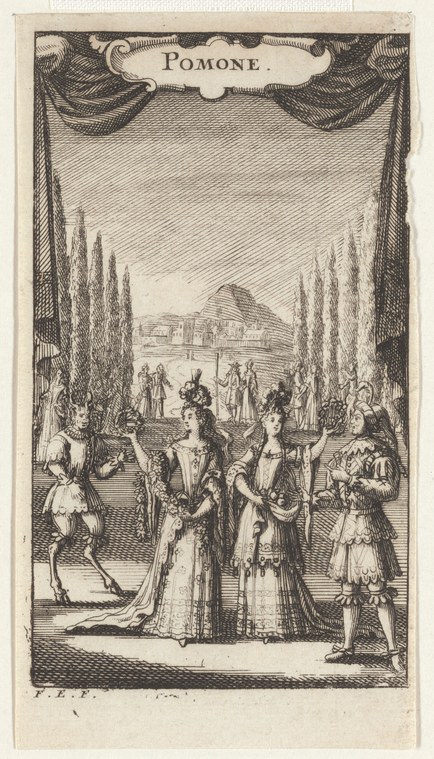
This engraving depicts a formal garden scene set between tall cypress trees lining both sides of a central perspective. In the middle distance, a figure in elaborate dress—identified by the title as Pomone (Pomona, goddess of fruit and gardens)—stands as the focal point, attended by courtiers and companions. The setting is classical and idealized, with a garden temple or building visible in the background. The composition is deeply theatrical: the cypresses create a stage-like space, the figures are arranged in a formal procession or gathering, and the entire scene is framed by swags of drapery at the top, as if we are viewing a court spectacle or ballet performance. The ground is carefully cross-hatched to suggest depth and recession. The figures wear the rich, voluminous dress of the 17th century—full skirts, elaborate sleeves, and formal court attire—and their postures are graceful and composed rather than vigorous. The lighting is suggested through fine parallel lines (hatching), creating a silvery, theatrical quality typical of copper engraving.
The dancing
The central figure stands in a dignified, frontal pose with arms held expressively but not in vigorous motion. Surrounding figures are distributed across the composition in attitudes of attendance and display rather than synchronized movement. The bodies are elongated and elegant in the manner of court art, with weight distributed in formal, upright stances. No locked ballroom holds or symmetrical couple formations are visible; instead, the arrangement suggests courtly presentation, procession, or the kind of stately, posed movement associated with court ballet. The gestures are controlled and aristocratic, without the earthbound vitality of folk or social dance.
The dance depicted
This is almost certainly a representation of a court ballet or ballet de cour scene, most likely from 17th-century France. Pomona as a classical subject was a favorite theme of court spectacles and intermezzos, typically danced by noblemen and court attendants. The image suggests a moment of formal presentation or entrée rather than a dynamic dance phrase. The movement implied is restrained, processional, and decorative—consistent with the conventions of Baroque court ballet, where dancers often held poses, processed, and performed figured patterns rather than continuous vigorous movement. The theatrical framing and garden setting suggest this may document or celebrate a specific court spectacle.
How it was made
This is a copper engraving, identifiable by the fine linear hatching used to create tone and shadow, the precise contour lines, and the characteristic crisp detail possible in the medium. Engraving was the dominant print medium for disseminating images of court spectacles across Europe in the 17th century: it was costly and prestigious, suited to recording important ceremonial events for a literate elite audience. The technique allowed for fine detail in costume and architectural setting, and the composition's theatrical framing suggests this may be a record or celebration of an actual court performance or a design for one. The skill of the engraver is evident in the handling of drapery, the recession of the garden, and the tonal variations across the plate.
About this work
This engraving preserves a moment from the world of 17th-century court ballet, a form in which French and Italian nobility danced in elaborate spectacles organized around classical and allegorical themes. The scene, labeled 'Pomone,' shows a garden setting organized as a stage, with the goddess Pomona as the central figure surrounded by attendants in formal court dress. It documents not a folk or social dance but the refined, theatrical, and essentially aristocratic world of ballet de cour—a precursor to professional ballet and a major arena for dance innovation in the early modern period. The engraving itself is an artifact of how courts disseminated images of their spectacles and taste across Europe: it transforms an ephemeral performance into a lasting print, available to collectors and readers who may never have witnessed the event.
How to look at it
Attend first to the theatrical framing: the drapery swag at top and the cypress alley create a stage, and the artist has chosen a moment of formal display rather than vigorous movement. Notice the careful arrangement of the figures—they are not randomly scattered but distributed in a composition that balances formality and grace. Look at the posture and dress of Pomona: the elegance, the restraint, the attention to the line of the silhouette and the folds of cloth. This is not an action photograph but a courtly ideal, a moment frozen in a formal geometry that was itself part of the beauty of court ballet. The engraving style—with its fine hatching and precision—reflects the aristocratic audience for whom such works were made: people who valued refinement, detail, and the ability to read complex allegorical meanings in costume and gesture.
The artist
The artist is not recorded in the catalogue, but the engraving's style, technique, and subject matter place it within the Baroque print tradition of the 17th century. The care and skill of the execution suggest a professional engraver trained in the major centers of print production—likely France, Italy, or the Low Countries. The image may be a record made after a court performance, or it may be a design or imaginative reconstruction. Without signature or attribution, the engraver remains anonymous, a common situation for prints of this period, which were often valued for their content and circulation rather than authorial recognition.
The period
Court ballet flourished in Europe from the late 16th century through the 17th century, peaking in France under Louis XIV. These spectacles combined music, poetry, elaborate costumes, and dance in hours-long performances that demonstrated the power, refinement, and generosity of the patron—usually the king or a great noble. Pomona and other classical figures were stock subjects, allowing dancers to embody virtue, abundance, and order. In the visual arts, engravings of court spectacles served as a form of documentation and propaganda: they fixed in print the memory of performances and broadcast the magnificence of the court to an international audience of collectors and scholars. This engraving dates from that golden age of court ballet and of the print culture that celebrated it.
Where it lives
The work is held in the New York Public Library's collection of prints depicting dance. It is catalogued with minimal information—no artist attribution, date, or medium recorded in the original record—but the engraving itself provides internal evidence of technique, period, and purpose.
Dance in this work
Questions about this work
What is Pomona, and why would she appear in a court ballet?
Pomona is the Roman goddess of fruit trees and gardens, a figure of abundance and fertility. Court ballets drew heavily on classical mythology, which allowed dancers to embody virtues and supernatural beings. An allegorical figure like Pomona would have appeared in a spectacle celebrating the abundance and order of the realm under its patron—usually the king. The classical reference elevated the spectacle and gave courtiers a role in a timeless, elevated narrative.
How is this engraving different from a photograph of a dance?
An engraving is not a photograph. It is an idealized record, shaped by the artist's skill, the patron's taste, and the conventions of the period. The image captures a moment, but that moment is composed and theatrical. The precise, fine-lined engraving technique creates an effect of polish and refinement that was itself part of the appeal—it transforms the ephemeral performance into a work of print art, suitable for framing and collecting.
Did people really dance in gardens like this?
Court ballets were often performed indoors in halls or galleries, though some spectacles did take place outdoors or in settings designed to evoke gardens. This engraving may represent an actual garden setting, a stage set designed to look like a garden, or an idealized vision of where such a dance might occur. The cypress alley is a classical motif associated with paradise and ideal landscapes, so it may be more about the allegorical meaning than literal geography.
What can we learn about movement from this image?
The image suggests controlled, upright, graceful movement—the opposite of folk dance or modern athletic dance. Court ballet emphasized elongated lines, formal posture, and measured gestures. Dancers processed, posed, and performed figured patterns on the floor rather than jumping or spinning. The restraint and formality visible here shaped early ballet technique and aesthetic values that persist today.
More dance artwork





