49 works in this view — arrow keys or swipe to move between them.
Dance in Art
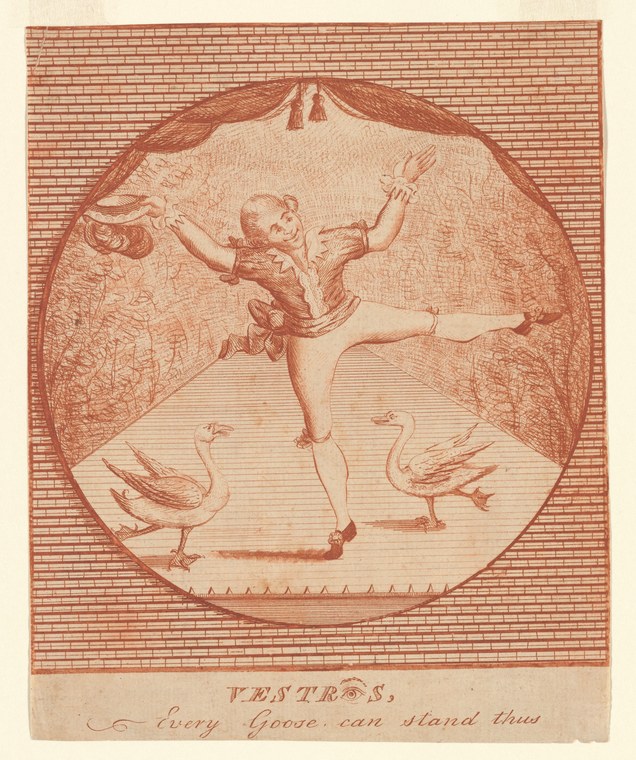
Vestr̲ s [an eye in place of i], every goose can stand thus
Unknown artist
- Collection:
- Prints depicting dance
- Source:
- New York Public Library
- Rights:
- Public domain — free to use, share and adapt.
- Recorded as:
- Public Domain
This work documents not just a dance pose but a cultural moment when ballet became associated with aristocratic refinement and artificiality—valuable testimony to how 18th-century audiences understood the pretensions and excesses of neoclassical dance. The inscription reveals that satirical printmaking used dance as a subject for intellectual critique, making this both a dance document and a window into period attitudes toward theatrical performance and social hierarchy.
What you are looking at
A single dancer stands at the center of a circular composition, poised on one leg in a striking pose. The figure wears draped classical costume and holds both arms raised expressively—one hand near the face, the other extended upward. The dancer's supporting leg is planted while the other extends behind at a sharp angle. The background is filled with fine horizontal hatching typical of engraving, and two geese occupy the lower portion of the composition, standing on what appears to be water or ground suggested by parallel lines. The circular frame creates an intimate, focused view of this moment of balance and elevation.
The dancing
The dancer stands in a classical attitude position—supporting leg straight, free leg extended high behind with a bent knee, creating a diagonal line through the torso. The arms are raised in an open, expressive port de bras suggesting classical or neoclassical training. The pose demands significant balance and flexibility; the dancer appears weightless despite the physical effort required. The extended leg and raised arms create a sense of buoyancy and control characteristic of trained classical dance technique.
The dance depicted
This appears to be a classical or neoclassical dance pose, most likely from the 18th or 19th century based on the composition and costume. The attitude position and elevated carriage suggest ballet training, though the theatrical context and the presence of the geese indicate this may be from a pantomime ballet or a satirical dance entertainment. The caption 'every goose can stand thus' suggests the artist is making a commentary on the pretension or artificiality of such refined dance poses—implying that even common barnyard birds could achieve this seemingly difficult stance. This points toward a work of wit or social satire rather than straightforward dance documentation.
How it was made
This is a copper engraving, executed in the fine line technique characteristic of 18th-century prints. The artist has achieved remarkable detail through parallel hatching in the background and careful rendering of the draped costume and muscular definition of the dancer's body. The medium allowed for wide circulation and satirical commentary; prints were affordable and portable, ideal for distributing witty social observation to a literate, educated audience. The delicate, precise line work suggests a skilled printmaker familiar with neoclassical aesthetic conventions.
About this work
This satirical engraving presents a classical ballet pose executed by a trained dancer, accompanied by two geese at the base of the composition. The work is a witty commentary on the refined artificiality of neoclassical dance—the caption claims that even geese could achieve such elevated stances, undermining the pretension of the technique on display. The print belongs to a tradition of 18th-century satirical imagery that used dance and ballet as vehicles for social and aesthetic critique. It captures a moment when ballet technique was becoming more specialized and formal, creating distance between the accomplished dancer and the ordinary viewer, and the artist responds by deflating that pretension through humor and comparison.
How to look at it
Notice the precision of the dancer's pose: the straight supporting leg, the sharply angled free leg, the carefully placed arms. This is not casual movement but deliberate technique, requiring training and physical control. The artist has captured the moment at the height of the pose's extension—the instant of maximum elevation and balance. Now observe the geese below, standing in the shallow water with their own angular, lifted postures: the comparison is the entire point. The satirist is asking you to see the dancer's 'unnatural' refinement reflected in the accidental geometry of the geese's stance, suggesting that the difference between art and nature, training and instinct, is smaller and more absurd than the ballet world would have us believe.
The period
The work dates to the 18th century, when ballet was transitioning from court entertainment to theater-based spectacle. This was the era of the professional ballet dancer and the refinement of technique into a codified system of positions and movements. However, as dance technique became more formalized and exclusive, it also became a target for satirists and social critics who saw in it an emblem of aristocratic pretension and distance from common life. Satirical prints were a major medium for such critique, circulating widely among educated urban audiences. The presence of geese—ordinary barnyard animals—invokes a long tradition of animal imagery used to mock human vanity and pretension.
Where it lives
The work is held in the New York Public Library's collection of prints depicting dance. It survives as part of the documentary record of 18th-century theatrical practices and social attitudes, catalogued among materials that used dance imagery to comment on period aesthetics and society.
Dance in this work
Questions about this work
Why are there geese in a picture of a dancer?
The geese are the point of the satire. The caption reads 'every goose can stand thus,' implying that the refined ballet pose on display is not the sign of extraordinary skill or refinement but something any creature might achieve by accident. The artist is mocking the pretension of neoclassical ballet technique by suggesting it is less impressive than the ballet world claims.
What dance position is this?
The dancer is posed in an attitude—a classical ballet position with one leg supporting while the other extends behind the body with the knee bent. It is a fundamental classical position that demonstrates balance, control, and line. The pose became iconic in neoclassical and romantic ballet.
Is this a real moment from a ballet, or is the artist inventing the scene?
The composition appears to be a fictional or imaginative scene created to make a satirical point rather than documentation of an actual performance. The circular frame, the perfectly composed pose, and the deliberate placement of the geese all suggest this is a constructed image designed to critique ballet's aesthetics and cultural pretensions, not a record of what happened on stage.
What period does this engraving come from?
Based on style, technique, and the subject matter—the refined neoclassical pose, the satire of ballet culture, and the engraving technique—this appears to be from the 18th century, when ballet was becoming a specialized, codified practice and social critics were responding by mocking its artificiality.
More dance artwork





