49 works in this view — arrow keys or swipe to move between them.
Dance in Art
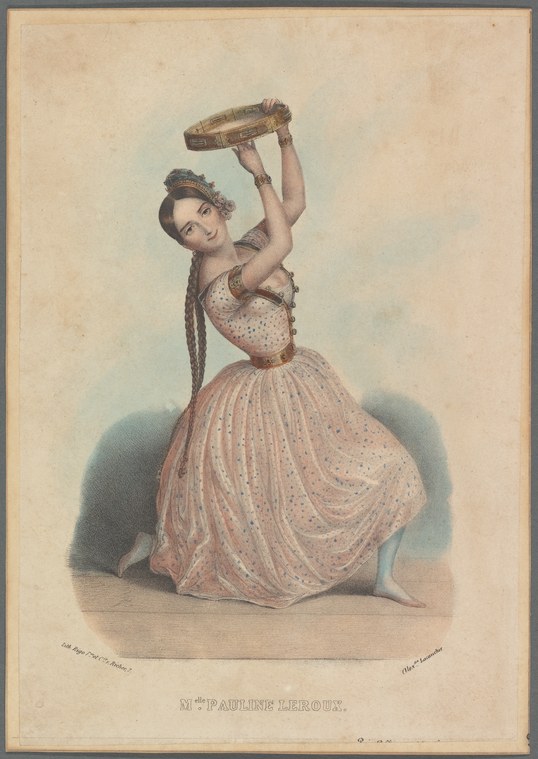
Melle. Pauline Leroux
Unknown artist
- Collection:
- Prints depicting dance
- Source:
- New York Public Library
- Rights:
- Public domain — free to use, share and adapt.
- Recorded as:
- Public Domain
This print preserves the memory of a performer whose fame rested on a specific, documented physical feat—a mode of theatrical celebrity that differs from narrative or group dance but remains central to performance history. It shows that Romantic-era stage dance encompassed not only story ballet but acrobatic virtuosity, novelty acts, and the cult of individual performer achievement. The combination of the named artist, precise costume detail, and impossible pose suggests a carefully constructed image designed to commemorate and promote a particular woman's unique talent.
What you are looking at
A young woman in a pale pink ball gown stands alone against a neutral background, her body arched in an exaggerated backward lean. She wears a fitted, heavily corseted bodice adorned with sequins or beading, and a voluminous skirt gathered into dramatic swags and festoons. Her dark hair is swept up in an elaborate coiffure typical of mid-19th-century fashion. Her right arm is raised high overhead, and she holds a large oval platter or tray aloft in one hand. Her left leg is extended and slightly raised behind her, suggesting dynamic movement. The pose is theatrical and physically extreme—her torso is thrust backward at an angle that would require considerable flexibility and core strength. The soft, muted color palette and careful shading create a sculptural quality to the figure. The composition places her centrally on the page with a subtle shadow cast beneath her, grounding the floating, impossible pose.
The dancing
The dancer's body forms a deep backward arch with the weight shifted onto her left leg while the right leg extends and lifts behind her. The raised right arm holds the platter high, requiring significant shoulder and spinal extension; her left arm appears to be positioned at her side or slightly extended for balance. This is not a supported partnered hold but rather a solo acrobatic feat that demands balletic training in flexibility and line, combined with considerable physical risk. The pose suggests a moment of climactic virtuosity rather than a sustained movement.
The dance depicted
This depicts a feat of theatrical acrobatics or extreme flexibility within a balletic or stage entertainment context, likely from the mid-19th-century tradition of specialty dancers and aerial performers in theatrical settings. The platter-balancing element suggests a novelty or trick act—perhaps a servant or spirit character in a pantomime or ballet divertissement. The inscription 'Melle. Pauline Leroux' indicates this was a named performer executing a specific, recognizable feat. Such acrobatic displays were common in Romantic-era theatrical entertainment, when dancers like Pauline Leroux became famous for particular technical stunts or illusions. The extreme arch and apparent weightlessness suggest the artist intended to capture an impossible, gravity-defying moment.
How it was made
This is a hand-colored lithograph or engraving, recognizable by the subtle tonal gradations achieved through careful layering of colored washes over a monochrome printed base. The technique allows for both precision of line in the figure's contours and atmospheric softness in the background. The delicate color palette—pale pink, warm flesh tones, subtle blue-gray shadow—was likely applied by hand in a print shop, suggesting this was a theater souvenir or promotional print intended for a broad paying audience. Prints of this quality and subject matter circulated in theatrical districts and were sold as mementos of celebrated performances.
About this work
This is a mid-19th-century promotional print of a named performer, Pauline Leroux, captured in an acrobatic moment that was either her signature feat or a notable scene from a theatrical production. The work documents the tradition of specialty acts and physical virtuosity in stage entertainment during the Romantic era, when dancers were celebrated for their flexibility, strength, and ability to perform seemingly impossible feats. It belongs in a gallery of dance imagery because it captures not balletic narrative but the apparatus of performance celebrity—the named body, the unique trick, the moment designed to astonish and be remembered. The figure is not moving through a recognized step vocabulary but rather executing a custom, individualized physical achievement.
How to look at it
Attend to the impossible geometry of the pose: the deep backward arch of the spine, the lifted leg, the raised arm holding weight overhead. The artist has chosen a moment of maximum extension and visual drama rather than a balanced, sustainable position—this is a peak moment, a climax. Notice how the costume itself is rendered with precision: the beading on the bodice, the gathered swags of the skirt, the weight and volume of the fabric. The careful attention to the body's extreme angle, combined with the formal naming and theatrical presentation, tells us this was a documented, repeatable, marketable feat—not an accidental pose but a prepared and celebrated trick.
The period
This print dates to the mid-19th century, during the height of the Romantic ballet era (c. 1830–1860), when theatrical dancing in Paris and London was dominated by the ethereal, otherworldly aesthetic of ballets like La Sylphide and Giselle. Yet theatrical entertainment was far broader than narrative ballet: specialty dancers, acrobats, and performers of novelty acts thrived in the same venues and attracted devoted audiences. Pauline Leroux appears to have been one such specialist, celebrated for physical feats rather than classical technique alone. The lithographic print technology allowed theaters to mass-produce souvenir images of stars, creating a market for performance ephemera that has preserved otherwise-forgotten names and acts.
Where it lives
The work is held in the New York Public Library's collection of prints depicting dance, catalogued as a hand-colored print from the 19th century. It is a theatrical souvenir or promotional print, typical of the ephemeral materials produced and distributed in theater districts to commemorate celebrated performances and named stars.
Dance in this work
Questions about this work
Is this depicting an actual ballet, or is it a specialty act?
The image suggests a specialty or novelty act—a particular performer executing a distinctive feat rather than a scene from a named ballet. The platter-balancing element and the explicit naming of the performer suggest this was a recurring, marketable trick that Pauline Leroux performed as part of theatrical entertainment. Such acts were often woven into pantomimes, divertissements, or variety shows rather than staged as independent ballets.
Would a trained ballet dancer be able to hold this position?
The extreme backward arch combined with weight on a single raised leg would require exceptional core strength, spinal flexibility, and balance—skills that some trained dancers possess but that are not standard ballet technique. The feat appears designed to demonstrate and astonish rather than to execute recognized steps. It is closer to contortion or acrobatics than to classical dance vocabulary.
How do we know this was actually performed?
The naming of the performer (Pauline Leroux) on the print, combined with the precision of the rendering and the evidence that such prints were created as promotional souvenirs for theatergoers, suggests this was a documented, repeatable act that audiences paid to see. The theatrical context and production quality of the print indicate this was not a caricature or fantasy but a record of real performance.
More dance artwork





