49 works in this view — arrow keys or swipe to move between them.
Dance in Art
Incas
Unknown artist
- Collection:
- Prints depicting dance
- Source:
- New York Public Library
- Rights:
- Public domain — free to use, share and adapt.
- Recorded as:
- Public Domain
This print documents a category of historical performance that shaped European dance for centuries: the exotic character dance, in which elaborate costume and imaginative ethnographic styling became the primary content. It shows how dance and visual art were inseparable in the theatrical world of the court, and how representations of distant places were constructed through spectacle rather than knowledge. For historians of both dance and visual culture, it is evidence of the aesthetic and political assumptions embedded in European aristocratic entertainment.
What you are looking at
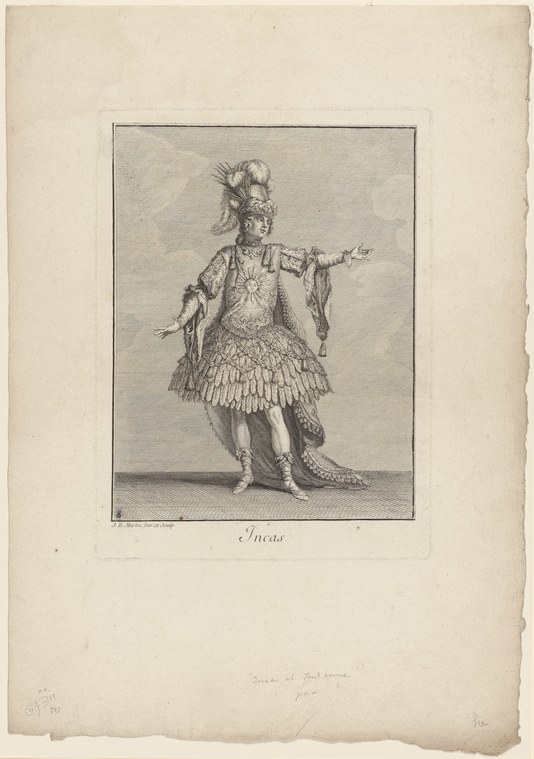
A single figure stands in theatrical pose against a plain background, wearing an elaborate costume that conflates European Baroque court dress with imagined "exotic" elements associated with Incan or Andean dress. The figure wears a full skirt or tutu in a feathered or scalloped pattern (possibly representing featherwork), a fitted bodice with ornamental detail, and draped sleeves or wings that extend outward. The headdress is tall and feathered, rising vertically from the crown. The figure's weight is balanced on one leg while the other is extended, and the arms are held open in an expansive, welcoming gesture—the body angled in three-quarter view to display the full costume. The composition is that of a theatrical costume study: the figure isolated and centered, posed to show the silhouette and ornamentation from the most flattering angle. The engraving technique creates fine linear detail throughout the costume while leaving the stage floor and background bare and austere.
The dancing
A single dancer or performer stands in a confident contrapposto pose, weight on the back foot, front leg extended in a gentle stride or slight elevation. Both arms are raised and spread wide in an open, presentational frame—neither arm connected to a partner, neither in a ballroom hold. The gesture is one of display and address: the body opens toward the viewer. The posture is upright and dignified, with no indication of footwork complexity or virtuosity; the pose emphasizes costume and presence rather than technical difficulty.
The dance depicted
This is a theatrical costume study, likely from the 17th or 18th century, depicting a character from a European court ballet or masquerade entertainment. The title "Incas" and the costume details suggest this represents a performer playing an exotic or foreign character—a common practice in European aristocratic entertainment of the period, where performers adopted stylized versions of costume from conquered or distant lands. The dance itself appears to be a processional or presentational court form, in which the performer's primary task was to display costume and deportment rather than execute complex steps. The open, generous arm position and balanced stance are consistent with the stately movement vocabulary of Baroque court dance, though the figure could equally well be frozen in a moment of ceremonial entrance or formal address rather than active dancing.
How it was made
This is a line engraving on paper, executed with fine parallel hatching and cross-hatching to create tone and shadow, particularly in the folds of fabric and the articulation of the feathered ornaments. The technique allows precise rendering of costume detail and the shallow space of theatrical presentation. The inscription "Incas" in script below the figure is hand-written or engraved as text. The print's small size, the refined technique, and the subject matter (a single theatrical costume figure) suggest this was one of a series of costume studies, possibly from a printed collection circulated among court entertainers, designers, or patrons interested in theatrical spectacle. Such prints were often made after performances or from designs, and served both as documentation and as inspiration for future productions.
About this work
This is a theatrical costume study in engraving, depicting a performer in an imaginative Incan-inspired costume for a European court entertainment, likely from the 17th or early 18th century. The figure embodies a key genre of the era: the exotic character dance or ballet de cour, in which European performers in stylized "foreign" dress enacted fantasies of conquest, exploration, and cultural encounter. The work documents not a dance itself but the theatrical presentation of the performer—the costume, the pose, the moment of display that framed dance performance in aristocratic contexts. It is a window into how European courts understood and staged the non-European world, and into the close relationship between costume design, theatrical spectacle, and dance in Baroque culture.
How to look at it
Look at the costume first: the feathered headdress, the scalloped or feathered skirt, the draped sleeves, the ornamental bodice. These elements combine European court dress (the fitted bodice, the formal silhouette) with imagined and stylized references to Andean dress (the featherwork, the tall headdress). The pose is theatrical and presentational: the figure is not in motion but rather paused in a moment of display, as though inviting the spectator to admire the costume and the wearer. The open arm position and balanced weight suggest a stately, dignified carriage appropriate to court performance. The engraver has rendered every fold and ornament with precision, indicating that this was a valuable and carefully made record of a specific costume design—evidence that in courtly dance, what the performer wore was as important as how the performer moved.
The artist
The artist is not recorded. The print style, inscription method, and subject matter are consistent with early 18th-century European theatrical print production, possibly from Paris, Vienna, or Venice—all centers of court ballet and masked entertainments. Such costume studies were often produced as suites, sometimes in collaboration between artists and theatrical impresarios. The print may have been made after a live performance, or from a design held in the archives of a court or theatrical company.
The period
This work dates to the era of the European ballet de cour and the masked entertainment or *intermedio*, when spectacle, music, dance, and visual display were synthesized into a unified courtly art form. The late 17th and 18th centuries saw intense European interest in colonization, exploration, and the representation of newly encountered or imagined peoples. Court entertainments frequently featured "exotic" characters—Persians, Africans, Americans, and Asians—portrayed through imaginative costume and stylized movement. These representations were not attempts at ethnographic accuracy but rather fantasy projections that reinforced European courtly values while exoticizing the non-European world. At the same time, the prints themselves were instruments of cultural circulation: they spread designs and ideas across the European aristocracy and among professional entertainers and designers.
Where it lives
The work is held in the New York Public Library's collection of prints depicting dance. It is catalogued simply as "Incas" with no artist, date, or publication information recorded, suggesting it was preserved as a dance-related print in a general collection without full archival documentation.
Dance in this work
Questions about this work
What is this figure actually dancing?
Nothing specific: the pose is presentational rather than active. This is a theatrical entrance or display pose rather than a frozen moment of complex footwork. In court ballet of this era, much of the performer's task was to move stately and processionally while wearing magnificent costume. The open arms and balanced stance fit the measured, dignified movement vocabulary of Baroque court dance.
Is this costume actually Incan?
No. This is a European fantasy version of exoticness, combining imagined Andean elements (the tall feathered headdress, the featherwork) with European court dress conventions (the fitted bodice, the formal silhouette). It reflects how European courts imagined and performed "otherness" rather than how Incan or Andean people actually dressed or moved.
Who made this print and when?
The artist and date are not recorded. The style, technique, and subject matter are consistent with early 18th-century European theatrical print production, probably from a court or theatrical center such as Paris or Vienna. It may have been made after a specific performance, or from a design held in an institutional archive.
Why does this belong in a gallery of dance?
Because it documents the performance context in which dance took place in the aristocratic world: the costume, the theatrical framing, the moment of presentation. In court entertainment, dance was inseparable from spectacle and visual design. This print shows how a performer in a specific costume would have been seen and understood by courtly audiences.
More dance artwork





