49 works in this view — arrow keys or swipe to move between them.
Dance in Art
Partie de la masquerade
Unknown artist
- Collection:
- Prints depicting dance
- Source:
- New York Public Library
- Rights:
- Public domain — free to use, share and adapt.
- Recorded as:
- Public Domain
Masquerade entertainments were central to aristocratic cultural life and to the development of theatrical dance in the 17th century. This engraving is one of the primary visual documents of how such events were structured, costumed, and performed, and it shows dancing not as a social activity but as a spectacular courtly art form.
What you are looking at
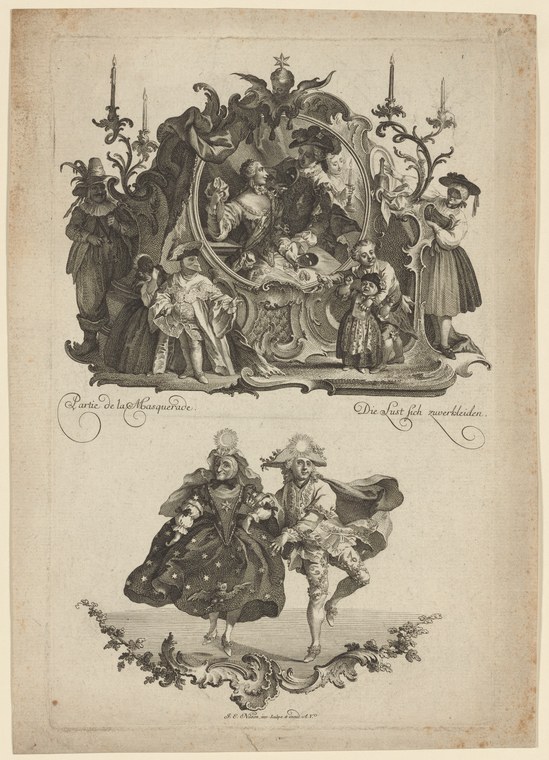
This is a two-part engraving depicting masquerade entertainments. The upper register shows an elaborate allegorical or mythological scene framed by ornamental scrollwork and flanked by standing figures in rich costume—a woman in flowing robes and plumed headdress on the left, a man in decorated coat and feathered hat on the right. The central panel contains multiple figures arranged in a theatrical tableau: cherubs and putti surround elegantly dressed dancers and courtiers in a scene of aristocratic revelry, with architectural elements and drapery suggesting an indoor court setting. The lower register shows a more intimate pair: a woman in an elaborately patterned gown with train and a man in ornate dress striking dynamic poses together, positioned above a decorative cartouche. The figures throughout display the exaggerated proportions, flowing fabrics, and theatrical gestures characteristic of 17th-century court entertainment. The entire composition is rendered in fine black engraving lines on a cream ground, with masterful use of cross-hatching to create depth and texture.
The dancing
The dancers throughout display formal, lifted posture typical of courtly performance. In the lower register, the pair are captured in an animated interaction—the woman's body arches with one arm extended, her skirts billowing, while the man leans toward her with theatrical flair, both figures oriented to show their silhouettes to advantage. Neither maintains a closed ballroom hold; instead their gestures are open, presentational, and oriented toward an audience. The standing figures flanking the upper scene hold themselves in aristocratic poses with one arm raised or extended, displaying their costumes. The figures within the central tableau are variously posed—some standing, some in motion—creating a scene of courtly interaction rather than unified partnered dancing.
The dance depicted
This engraving depicts masquerade entertainment, a courtly theatrical tradition of the 17th and possibly early 18th century combining dance, music, costume, and spectacle. The title 'Partie de la masquerade' (Part of a Masquerade) suggests this is a scene from an actual or imagined masquerade event or its printed documentation. The costumes, the allegorical framing, the presence of putti, and the formality of composition all point to the baroque court tradition. The lower register pair seem to be performing a 'dancing' demonstration—their poses are too theatrical and exaggerated for social dancing and are clearly meant to be admired as performance by onlookers. The upper scene, with its mythological references and formal arrangement, represents the kind of elaborate court spectacle that masquerades provided.
How it was made
This is a finely executed line engraving, likely on copper, from the 17th or early 18th century. The technique allows for precise delineation of costume detail, architectural ornament, and figural anatomy, and the artist has used skillful cross-hatching to suggest volume, shadow, and the texture of fabrics. The formal boundaries and allegorical framing suggest this may be a title page or a documented record of an actual court entertainment, printed for circulation among the aristocratic patrons who participated in or witnessed such events. The quality of execution and the elaborateness of the composition indicate this was a prestigious production, not a popular or commercial print.
About this work
This engraving documents a 'partie de la masquerade'—a scene from a courtly masquerade entertainment combining dance, costume, music, and theatrical spectacle. The upper register presents an allegorical or mythological tableau surrounded by standing figures in aristocratic dress, while the lower register isolates a more intimate dancing pair in exaggerated, theatrical postures. The work is a formal, finely wrought line engraving that served to record and circulate knowledge of a specific court entertainment among an elite audience. It belongs in a dance gallery as evidence of how baroque courtly dancing was performed, costumed, and understood—not as social partner dancing but as elaborate theatrical performance designed for visual admiration.
How to look at it
Observe first the elaborate framing and allegorical elements—the putti, the scrollwork, the mythological references—which place this dancing within a hierarchy of courtly arts. Then look at the postures of the figures: they are not dancing together as partners but performing for an audience, their bodies arranged to display costume and gesture. The lower pair are frozen in a moment of theatrical interplay, their exaggerated poses suggesting trained performance rather than social movement. Compare the formality of the upper scene with the more intimate theatricality of the lower pair to see how the same entertainment tradition could be presented both as grand allegory and as intimate performance.
The artist
The artist is not recorded. The quality of the engraving and the sophistication of the allegorical composition suggest a skilled professional printmaker working within court or patronage circles, likely in France or the Low Countries given the French text on the inscription.
The period
Masquerades were at their height of fashion in European courts during the 17th and early 18th centuries, particularly in France under Louis XIV and afterward. These entertainments combined elements of Italian commedia dell'arte, ballet de cour, and aristocratic social dancing into elaborate spectacles in which courtiers danced, sang, and paraded in costly costumes and masks. The tradition of documenting court entertainments through engraving allowed such events to circulate beyond the court itself and to be preserved for posterity. Engraved records of dances and masquerades were often issued as prestigious publications for collectors and as records of court magnificence.
Where it lives
The work is held in the New York Public Library's collection of prints depicting dance. It was likely created as a loose engraving intended to document and circulate knowledge of a specific court entertainment among aristocratic collectors and patrons.
Dance in this work
Questions about this work
What is a masquerade entertainment?
A masquerade was an elaborate courtly theatrical event combining music, dance, costume, and spectacle. Aristocratic participants wore masks and rich costumes, often representing allegorical or mythological figures, and both danced and paraded as part of an organized entertainment. Such events were central to court culture in 17th-century Europe and were often documented through engravings so that the event could be recorded and shared with those who had not attended.
Are these people dancing together?
The lower pair appear to be dancing together, but their poses are highly theatrical and exaggerated—they are performing a dance for spectators rather than dancing as a social activity. The upper scene is more clearly a tableau or procession than a dance, though some of the figures may be moving. Both registers show dance as courtly performance rather than as social participation.
What does the text say?
The visible inscriptions are in French. The title appears to be 'Partie de la masquerade' (Part of a Masquerade) and there are short phrases flanking the upper scene, though these are not fully legible in this reproduction.
More dance artwork





