49 works in this view — arrow keys or swipe to move between them.
Dance in Art
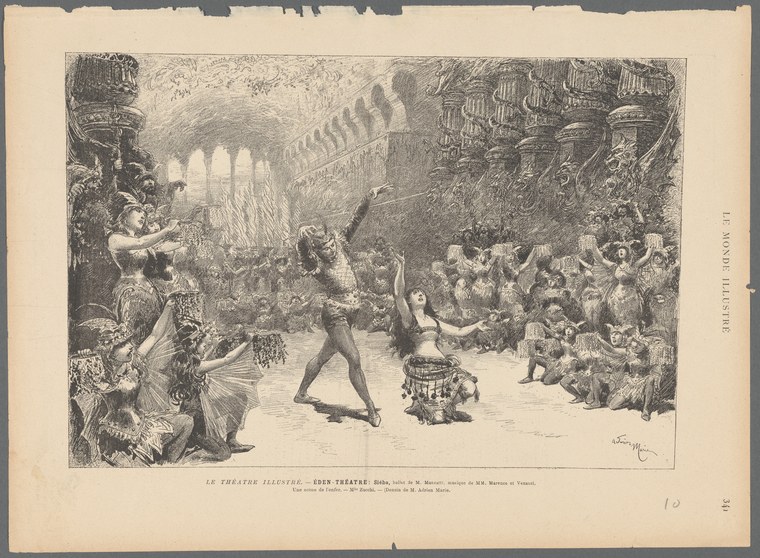
Éden-Théâtre. Siéba, ballet de M. Manzatti [sic], musique de MM. Marenco et Venanzi. Une scène de l'enfer. Mlle Zucchi
Unknown artist
- Collection:
- Prints depicting dance
- Source:
- New York Public Library
- Rights:
- Public domain — free to use, share and adapt.
- Recorded as:
- Public Domain
This print preserves the only visual record of a work and a performance context that would otherwise be lost to history. It documents the technical and aesthetic standard of professional ballet at a key transitional moment—late 19th-century Paris—when ballet was evolving from Romantic narrative toward modern theatrical forms, incorporating acrobatic and character elements drawn from music hall and pantomime. For dance historians, it offers direct evidence of body position, costume, staging, and the scale of theatrical ambition in this era.
What you are looking at
A spectacular theatrical scene set in a classical colonnade—rows of tall arches recede into luminous distance, creating a stage of architectural grandeur. The scene depicts a moment of ecstatic, carnivalesque performance in what the inscription identifies as a scene from Hell (Une scène de l'enfer). The stage is crowded with figures in exotic and fantastical dress: in the foreground, a nearly nude male dancer dominates the composition, his body in an extravagant contrapposto pose, one leg extended dramatically, the other bent, his arms raised in a gesture of abandon or invocation. He is surrounded by a diverse crowd of onlookers and performers—women in elaborate costume with feathers, fans, and rich fabrics; figures in oriental dress; cherubs or putti clustered at the right; and layered crowds receding into the shadowed colonnade. The light is theatrical: bright on the central figures and architecture, falling away into mysterious shadow. The overall impression is of a dream or infernal vision of pleasure and spectacle, drawn with the meticulous cross-hatching technique of 19th-century engraving.
The dancing
The central male dancer displays an acrobatic, balletic frame with deliberate artifice: weight poised on one leg in a near-turnout position, the other leg extended high, torso arched backward, arms lifted in a classical but exaggerated extension. This is not naturalistic gesture but performance virtuosity—a display of elevation, flexibility, and control. The surrounding figures are less formally posed; women lean, gesture with fans, recline, or stand in attitudes of spectacle and observation. The composition suggests the dancer is the focus of attention, with the crowd arranged in loose groupings around him, creating a hierarchy of performance and audience that is itself part of the spectacle.
The dance depicted
This is a scene from the ballet *Siéba*, with choreography by M. Manzatti, music by Marenco and Venanzi, performed at the Éden-Théâtre (a music hall in Paris). The work appears to be a late 19th-century spectacular ballet or pantomime, likely from the 1880s based on the style of the engraving. The inscription specifies this is a scene from 'Hell' (l'enfer)—suggesting a narrative balletic descent or infernal episode. The male soloist's virtuoso pose and the theatrical crowd composition are consistent with the 'character' or 'national' dances that became popular in late Romantic and early modern ballet, often featuring exotic or fantastical settings. The nearly nude male figure is noteworthy: this suggests either a character role (perhaps a demon or infernal spirit) or a scene of daring contemporary theatricality. The woman identified as Mlle Zucchi was a major Italian ballerina of the era, famous for her technical brilliance, though it is unclear from the image alone whether she is the central figure or elsewhere in the composition.
How it was made
This is an engraving—identifiable by the fine cross-hatching throughout, the varied line weights creating tonal gradation, and the precise architectural detail. The technique is likely wood engraving or steel engraving, which allowed for fine detail and large print runs, making this a mass-circulation theatrical document rather than a unique artwork. The engraver has employed considerable skill in rendering depth through atmospheric perspective (the colonnade receding into shadow) and in differentiating textures: the sheen of silk, the soft weight of feathers, the solidity of stone. This medium was standard for theatrical illustration in 19th-century France, enabling the documentation and promotion of spectacular stage productions to a wide public audience.
About this work
This engraving documents a moment from *Siéba*, a late 19th-century ballet or spectacular pantomime performed at the Éden-Théâtre in Paris, an important music hall and venue for new theatrical forms. The work is significant as a record of an otherwise ephemeral performance, capturing both the virtuosity of contemporary ballet (the acrobatic male solo) and the broader theatrical context of spectacle, exoticism, and narrative fantasy that defined late Romantic and early modern stage dance. The engraving's circulation as a commercial print means it reached audiences far beyond the theatre, serving as promotional material and documentation of innovations in dance and stagecraft. It exemplifies the period's fascination with infernal and exotic subjects rendered through balletic virtuosity and lavish visual spectacle.
How to look at it
Attend to the central dancer's body and the composition's architecture simultaneously. The engraver has chosen a moment of maximum theatrical effect—the soloist's arched back and lifted leg, caught mid-movement, create a dynamic diagonal that contrasts with the stable, receding colonnade. Notice how the crowd recedes with the architecture, creating a visual funnel that directs all attention to the soloist. The cross-hatching technique allows subtle tonal gradation that suggests gas or early electric stage lighting. The detail of costume (the feathers, fabrics, ornament) versus the nudity of the principal dancer creates visual and thematic tension—spectacle and transgression coexisting on the stage.
The period
The Éden-Théâtre was a Parisian music hall (1887–1893) that hosted a mix of ballet, pantomime, and spectacular theatrical productions, sitting at the intersection of opera ballet tradition and the emerging forms of popular theatre and variety. Late 19th-century Paris was experiencing rapid innovation in theatrical spectacle: the success of works like *Excelsior* (1881) and *Les Mystères du Rhin* demonstrated appetite for large-scale narrative ballets with exotic or fantastical settings. The nude or semi-nude male dancer in a featured role was unusual by classical ballet standards but consistent with the theatrical eclecticism and risk-taking of music hall and spectacular pantomime. Engraving remained the primary medium for theatrical documentation and publicity in this period, only gradually displaced by photography in the 1890s.
Where it lives
This engraving is held in the New York Public Library's Prints collection, which specializes in theatrical documentation. It is one of many commercial prints and engravings produced to publicize performances at Parisian theatres in the late 19th century, intended for distribution as souvenirs, promotional material, and newspaper illustration.
Dance in this work
Questions about this work
Who was Mlle Zucchi?
Virginia Zucchi (1849–1930) was an Italian prima ballerina of major international reputation, famous for her technical brilliance and dramatic presence. She performed extensively in Russia and across Europe in the 1880s and 1890s, and was known for her roles in character ballets and contemporary spectacles as well as classical repertory.
What was the Éden-Théâtre?
The Éden-Théâtre was a Parisian music hall and theatre that operated from 1887 to 1893, located on the Boulevard de Strasbourg. It was known for spectacular productions that mixed ballet, pantomime, acrobatics, and variety entertainment, and was one of several venues competing for audiences with innovative theatrical forms.
What does 'Une scène de l'enfer' mean?
It means 'A scene from Hell.' Infernal and diabolical scenes were popular in 19th-century theatrical spectacle, often providing opportunities for exotic costume, supernatural effects, and dramatic choreography. This suggests *Siéba* had a narrative involving descent or transgression.
Is this a unique print or a mass-produced image?
This is a mass-produced commercial engraving, one of many copies printed and distributed to promote the performance, sell as souvenirs, or illustrate theatrical reviews in newspapers and magazines. The technique of engraving allowed for large print runs at relatively low cost per copy.
More dance artwork





