49 works in this view — arrow keys or swipe to move between them.
Dance in Art
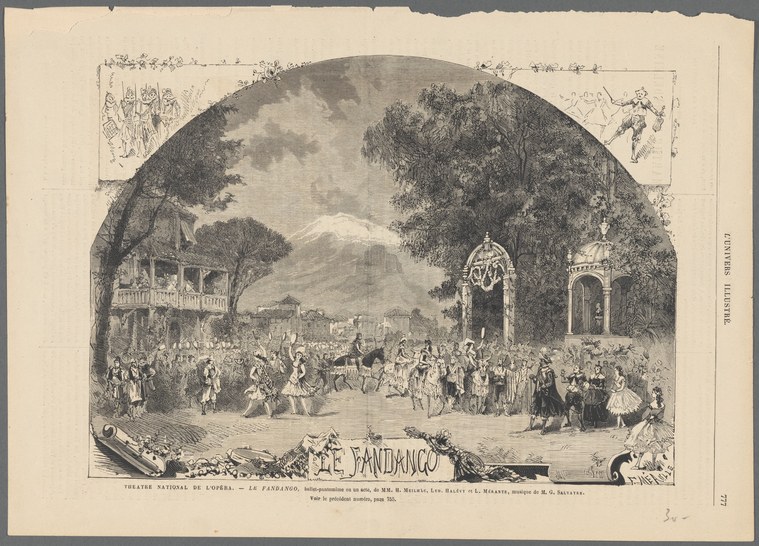
Théâtre National de l'Opéra. Le fandango, ballet-pantomime en un acte, de MM. H. Meilhac, Lud. Halévy et L. Mérante, musique de M.G. Salvatore
Unknown artist
- Collection:
- Prints depicting dance
- Source:
- New York Public Library
- Rights:
- Public domain — free to use, share and adapt.
- Recorded as:
- Public Domain
This image captures a crucial moment in the history of the fandango on the European stage: its transformation from folk dance into theatrical fantasy. The design reveals how 19th-century ballet companies understood and adapted non-European dances, prioritizing spectacle, courtship, and visual exoticism over ethnographic accuracy or technical authenticity.
What you are looking at
A théâtre design depicting an expansive outdoor plaza or garden setting framed by dense foliage and architectural features. The composition shows a festive gathering of dozens of figures in period dress—mid-19th century clothing with full skirts, tailcoats, and bonnets—spread across an open space. In the center-middle distance stands a pavilion or kiosk structure with ornamental detailing. The scene is lit with theatrical clarity: bright sky above, trees creating a natural proscenium arch, and strong definition between foreground (closer figures) and background (the gathering deepens toward the pavilion). The gathering has the energy of a celebration or public entertainment rather than a formal court dance, with figures clustered in conversational groups, some standing, some in motion. The engraving's fine line work creates texture in the foliage and clothing, suggesting movement through the interplay of light and shadow across the crowd.
The dancing
The dancers and participants are shown in varied positions rather than a unified formation. Most are upright and at ease, dressed in fashionable civilian clothes of the 1860s, not formal dance costumes. A few figures in the middle distance appear to be engaged in actual dancing—upright posture, some with arms extended or raised—but the majority occupy the roles of onlookers and revelers. The composition shows individual bodies and pairs rather than the precise geometric lines of a ballroom dance; the grouping is naturalistic and scattered across the space. Visible are the full skirts characteristic of the crinoline era, which would restrict movement to an upright carriage and emphasize swaying motion from the hips down.
The dance depicted
This is a theatrical design for *Le Fandango*, a ballet-pantomime created for the Opéra Nationale (Palais Garnier) in Paris. The fandango is a Spanish courtship dance characterized by rapid footwork, percussive rhythms, and flirtation between partners, typically accompanied by castanets or guitar. The image shows the fandango reimagined for the mid-19th century Parisian stage not as an intimate duet but as a public festivity—a garden party or fair where the Spanish dance has become an occasion for social gathering. The title credits the libretto to Meilhac and Halévy (known for comedy and spectacle) and the score to Salvatore, suggesting this was a lighter theatrical entertainment than grand ballet, one that blended Spanish exoticism with Parisian leisure culture. The setting and costume choices indicate the creators were interested in the fandango as a marker of national difference and romance rather than as an exercise in classical technique.
How it was made
This is an engraving or wood-engraved illustration, printed from a metal or wood block. The fine parallel lines and cross-hatching visible throughout—particularly in the foliage, sky, and fabric textures—are characteristic of 19th-century engraving technique. The image shows the high finish expected of theatrical designs for publication: it was meant to advertise the production and to be distributed to audiences, critics, and the press. The precision of the line work and the legibility of detail across dozens of figures suggests this was a major publication, likely from a theatrical journal or a deluxe playbill. The technique allowed the artist to render complex spatial recession and atmospheric perspective while maintaining the flat decorative quality necessary for stage design.
About this work
This is a theatrical design for *Le Fandango*, a ballet-pantomime mounted at the Paris Opéra in the mid-19th century, depicting the fandango not as an intimate folk dance but as a setting for public spectacle and courtship ritual in a fashionable garden. The engraving records the visual world of the production—its costumes, setting, and social tone—and serves as documentation of how the Spanish fandango was adapted and reimagined for Parisian theatrical audiences.
The work sits at the intersection of several 19th-century theatrical and cultural interests: the appetite for exotic and national dances (the fandango as Spanish import), the rising dominance of ballet as entertainment at the Opéra, and the fashion for outdoor social scenes as sites of drama. The design emphasizes spectacle and gathering rather than technical virtuosity, suggesting an audience fascinated by the fandango's social and romantic dimensions.
How to look at it
Note how the artist has chosen a moment of gathering and sociability rather than a peak of technical dance. The pavilion in the center functions as a focal point and locus of authority, drawing the eye inward from the framing trees. The scattered arrangement of figures across the foreground and middle distance creates a sense of movement through space—the crowd is animated but not frozen in a single formation. Look at the silhouettes of the skirts: even at rest, their volume and weight suggest the physical constraint and upright carriage that defined women's movement in this period, and how that constraint shaped what the fandango could become on stage.
The period
The mid-19th century saw an explosion of interest in national and exotic dances as material for ballet and theatrical entertainment. Following the success of works like *La Esmeralda* (1844) and *Le Corsaire* (1856), which featured Spanish and Oriental settings respectively, European opera houses sought to capitalize on the appetite for 'foreign' subjects. The fandango had been a fixture of Spanish cultural identity and popular print since the 18th century; its appearance on the Parisian stage signals both genuine aesthetic interest and the imperialist appetite for 'authentic' non-European culture, repackaged for metropolitan audiences. The reign of Napoleon III (1852–1870) coincided with an expansion of the Opéra's repertoire and budget, enabling ambitious scenic productions like this one. At the same time, the crinoline silhouette shown in the engraving was at the height of fashion (1850s–1860s), anchoring the theatrical fantasy in contemporary Paris rather than in Spain.
Where it lives
This is from the NYPL's collection of prints depicting dance, which documents theatrical production design, costume studies, and performance moments across centuries and cultures. The image likely comes from a theatrical publication or archive related to the Paris Opéra.
Dance in this work
Questions about this work
Was the fandango really danced this way in Spain?
No. The fandango performed in Spain was typically a duet for two dancers (often male and female) with rapid footwork, hip and arm movement, and castanets, danced in a much more intimate space. This design shows the fandango as reimagined for the Parisian stage: translated into an occasion for public spectacle, a garden party attended by dozens, with the dance as background to a broader social scene rather than as the focus of virtuosity.
Who were Meilhac and Halévy?
Ludovic Halévy (1834–1908) and Henri Meilhac (1831–1897) were celebrated French librettists and playwrights known for witty, fast-paced comedies and operettas. They collaborated on *Orphée aux enfers* (1858) and later *La Grande-Duchesse de Gérolstein* (1867), establishing themselves as the voices of Parisian theatrical comedy. For *Le Fandango*, they provided a text designed to be entertaining and scenic rather than dramatically complex.
What kind of venue was the Opéra Nationale?
The Palais Garnier (officially the Académie Nationale de Musique, or National Opera House) opened in 1875. If *Le Fandango* predates this, it was performed at an earlier opera house in Paris (possibly the Salle Le Peletier or the Opéra Comique). The Palais Garnier was architecturally and socially the temple of Parisian spectacle—a vast stage designed to accommodate elaborate scenery, crowds of dancers, and advanced stagecraft.
Why are there so many people standing around?
The composition shows a 'scene' rather than a dance sequence: the fandango is embedded in a narrative moment of arrival, gathering, or celebration. This reflects the 19th-century ballet convention of mixing technical dance with pantomime and spectacle; the crowd functions as chorus, witness, and dramatic context for the principals' movement.
More dance artwork





