49 works in this view — arrow keys or swipe to move between them.
Dance in Art
Zingara
Unknown artist
- Collection:
- Prints depicting dance
- Source:
- New York Public Library
- Rights:
- Public domain — free to use, share and adapt.
- Recorded as:
- Public Domain
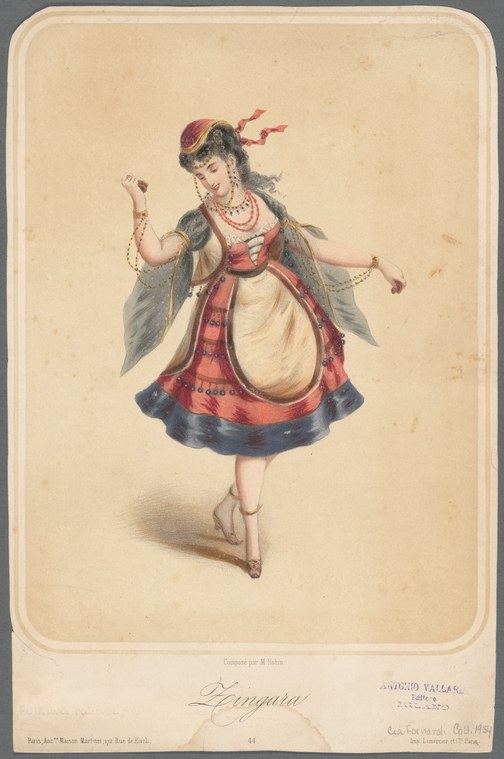
The *zíngara* was a defining role type of Romantic ballet—accessible to corps dancers as a character part, yet requiring classical training and expressive maturity. This print documents the precise costume and the vocabulary of arm and body positioning that defined how a specific European theatre house understood the role. For dance historians and performers, it offers concrete evidence of how Romantic character technique was actually embodied and presented to the public.
What you are looking at
A single female dancer in Romantic-era costume occupies the center of a pale cream background. She wears a deep red bodice with a white chemise front, a layered skirt of red and white with dark blue or navy hem, and a dark grey or slate-blue shawl draped across her shoulders. A red ribbon or headpiece adorns her dark hair. She stands in a dynamic, turning pose with her weight on her right leg and her left leg extended or lifting; her arms are raised and spread, one higher than the other, in a gesture of abandon or flourish. The pose suggests mid-movement—caught in a twirl or traveling step. The figure is rendered in soft color with careful shading that gives volume and form to the drapery. At the base of the image, faint text reads "Zingara" in an elegant script, with what appears to be a publisher's mark ("Antonio Vallés") and a Paris address, indicating this is a printed theatrical or dance ephemera from the mid-19th century.
The dancing
The dancer is depicted in a single, weightily distributed contrapposto stance tilted into motion. Her torso is upright and twisted; one arm is raised at shoulder height with the palm open, the other lower and extended. The legs suggest a traveling or turning step rather than a static pose—the supporting leg appears straight and firm, while the other seems to lift or pass through the movement. The posture and arm carriage suggest trained classical technique adapted to a more expressive, character mode. There is no partner; the focus is entirely on the individual dancer's silhouette and the rhythm implied by her asymmetrical stance.
The dance depicted
This is almost certainly a *zíngara* (gypsy) character dance from the Romantic ballet repertory of the 1840s–1860s, a genre-painting role that became standard in European theatres during the period when *La Esmeralda*, *Carmen*, and similar works brought the exotic or marginalized "other" onto the ballet stage. The Romantic zíngara combined classical technique with looser, more emphatic arm gestures and a character vocabulary that suggested freedom, sensuality, and otherness. The costume—red skirt with white chemise, dark shawl, folk-inspired headpiece—is the canonical dress for this role across European ballet companies. The print's publication in Paris, combined with the Italian publisher credit, suggests this represents a role as performed in one of the major Continental houses, probably in the 1850s.
How it was made
This is a hand-colored lithographic print, a technique well suited to theatrical ephemera and dance publicity in the mid-19th century. The soft, luminous palette and the precise delineation of costume detail—especially the draping of the shawl and the texture of the layered skirt—are characteristic of lithography applied to dance imagery. The colored lithograph allowed for rapid, inexpensive reproduction of theatrical imagery for publicity, souvenirs, or instruction, reaching dancers, patrons, and theatregoers. The technique's capacity for subtle tonal gradation is evident in the modeled form of the dancer's body and the careful rendering of fabric weight.
About this work
This is a mid-19th-century hand-colored lithographic print documenting a *zíngara* character role from the Romantic ballet repertory. The print survives as theatrical ephemera—a souvenir or promotional image associated with a specific dancer's interpretation of a role that had become standard in European ballet by the 1850s. The work captures the Romantic ballet's embrace of character dances drawn from exoticized or folk sources, and it documents both the costume and the physical vocabulary of a role that occupied the boundary between classical technique and character expression. The image is valuable as a record of how this role was costumed and what bodily expressiveness was expected of its performers.
How to look at it
Look at how the artist has caught the dancer mid-gesture: the asymmetry of the raised and lowered arms, the twist of the torso, the lift of the supporting leg all convey forward motion and emotional expressiveness rather than static display. The costume details—the shawl draped across the back, the layered red and white skirt, the folk-inspired headpiece—establish character and geographic otherness as Romanticism understood it. Note how the figure is isolated against the neutral ground, making her body language and costume the sole focus; this compositional choice is typical of theatrical prints meant to circulate as performance documentation and as models for other dancers in the role.
The period
This print dates to the golden age of the Romantic ballet (c. 1830–1870), when character dances and exotic subject matter became central to the ballet repertory. The *zíngara* emerged as a stock character around the 1840s, associated with works like *La Esmeralda* (1844, after Victor Hugo) and adapted into dozens of divertissements and full-length ballets. The role combined the technical vocabulary of classical ballet with elements drawn from (often stereotyped) representations of Romani people, offering dancers a vehicle for gestural freedom while remaining within the bounds of theatrical convention. Lithographic prints of dancers in character roles were a standard form of theatrical publicity and souvenir in Paris and other European cities during this period, circulating to document notable performances, singers, and dancers.
Where it lives
This print is held in the NYPL's collection of prints depicting dance. It bears a publisher's imprint (Antonio Vallés, Paris) and catalogue or lot numbers, indicating it was a commercial theatrical print, likely produced for sale to theatregoers, dancers, or dance enthusiasts. Such prints served as both souvenirs and instructional references.
Dance in this work
Questions about this work
What does 'zingara' mean?
Zingara (or zíngara in Italian) is the feminine form of the Italian/Spanish word for a Romani or gypsy person. In 19th-century ballet, the zíngara became a stock character role—a woman of exoticized or folk otherness, typically costumed in a red skirt, white chemise, dark shawl, and folk jewelry. The role combined classical technique with looser, more expansive arm gestures and a character vocabulary that suggested freedom and sensuality.
Where did this role come from?
The zíngara rose to prominence in the 1840s as Romantic ballet embraced exotic and marginalized subjects, often drawn from popular literature. Victor Hugo's *Notre-Dame de Paris* (1831) inspired *La Esmeralda* (1844, choreographed by Jules Perrot), in which the Romani title character became one of the most famous zíngara roles. The character type then spread to dozens of other ballets and divertissements across European theatres.
Is this a record of a real performance?
Very likely. The print bears a publisher's name and a Paris address, suggesting it was produced as part of theatrical publicity or as a souvenir following a specific production. The publisher may have been documenting a particular dancer's interpretation of the role, though without further documentation we cannot identify which theatre, dancer, or production this represents.
Why is the dancer's pose so asymmetrical?
The asymmetry conveys movement and emotion rather than stillness. The raised and lowered arms, the twist of the torso, and the lift of the leg suggest the dancer caught mid-turn or mid-travel—a moment of expressive gesture. This dynamism was central to Romantic choreography and character dance, which prized emotional expression and the appearance of spontaneity over geometric symmetry.
More dance artwork





