49 works in this view — arrow keys or swipe to move between them.
Dance in Art
Lutin
Unknown artist
- Collection:
- Prints depicting dance
- Source:
- New York Public Library
- Rights:
- Public domain — free to use, share and adapt.
- Recorded as:
- Public Domain
Character roles and pantomime were essential to 19th-century ballet spectacle, yet they are often overshadowed by focus on classical technique and Romantic ballets. This print documents the visual conventions and costume practice of character dancing, and shows how a performer's body was posed and composed for theatrical impact. The survival of such prints is crucial evidence for understanding what late 19th-century dance actually looked like on stage.
What you are looking at
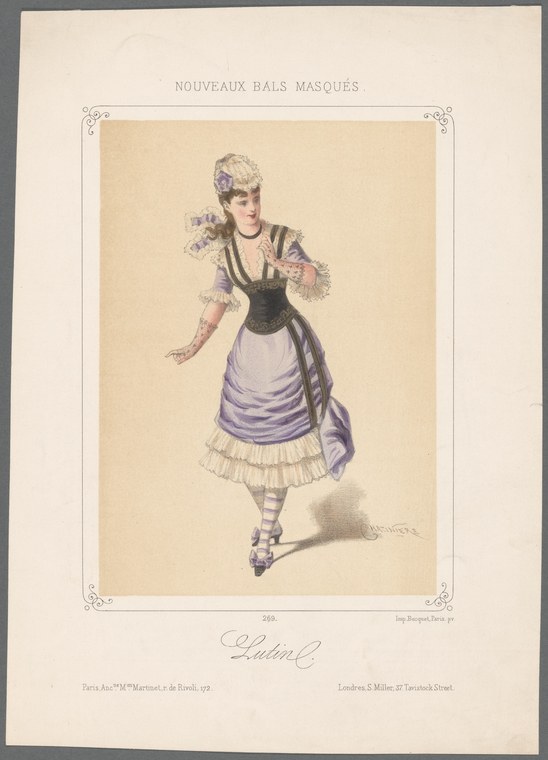
A single female dancer stands against a pale cream background, caught mid-movement in a pose of elegant restraint. She wears a black corset or bodice cinched tightly at the waist, over a layered skirt in shades of lavender and white with horizontal pleating at the hem. Her blonde hair is styled high on her head in the fashion of the 1880s–90s. She extends one arm gracefully forward and to the side, while the other rests near her body; her posture suggests a moment of suspended elegance rather than vigorous movement. Her legs are shown in striped stockings—a fashionable detail—and her feet are positioned in heeled shoes. The composition is formal and centered, with decorative corner flourishes framing the figure as if on a theatre playbill or fashion print. The title 'Lutin' appears below the image in a flowing script.
The dancing
A single dancer occupies the frame, her weight balanced and her frame upright but fluid. Her arms are not in a classical closed position but rather in an open, expressive gesture—one extended into space, the other held closer to the body—suggesting a moment of pantomime or character movement rather than balletic technique. Her posture and the angle of her head convey a sense of theatrical persona or narrative intention. The overall effect is one of refined, restrained movement: she does not appear to be mid-leap or executing technical footwork, but rather presenting a moment of dramatic bearing suited to a character role.
The dance depicted
This appears to be a character or pantomime dance, most likely from a theatrical production of the Romantic or post-Romantic ballet era (roughly 1870s–1890s). The figure's dress and styling are consistent with stage costume of that period, and the title 'Lutin'—French for 'sprite' or 'imp'—suggests a supernatural or mischievous character role. The pose and gesture are more aligned with dramatic narrative than with classical ballet technique; the dancer appears to be embodying a character rather than demonstrating pure dance vocabulary. The work sits at the intersection of ballet theatre and character pantomime, which were inseparable in late 19th-century stage practice.
How it was made
This is a hand-colored engraving or lithograph, printed in the second half of the 19th century. The delicate line work, the subtle tonal gradation achieved through printing, and the careful hand-coloring of fabrics and skin tones are characteristic of theatrical illustration and dance prints of the period. The decorative border and formal composition indicate this was a commercial print, likely published as part of a series documenting notable dancers or roles—a common practice in European theatrical culture. The technique allowed for rapid circulation of images of celebrated performers and roles, making this a document of both visual culture and theatre history.
About this work
This is a theatrical dance print from the late 19th century depicting a character dancer in the role of 'Lutin' (a mischievous sprite or imp). The figure's costume, styling, and pose are consistent with ballet theatre of the 1870s–1890s, a period when pantomime and character roles were integral to stage dancing. The work is unsigned, but its professional execution and commercial format—with decorative border and playbill-like composition—indicate it was produced for theatrical publicity or fan distribution. It offers a snapshot of late Romantic stage practice, when a female dancer's role encompassed both technical virtuosity and dramatic characterization.
How to look at it
Look at the dancer's arm position and the angle of her upper body: she is not in a classical ballet pose, but in a gesture of dramatic address or invitation. Note the careful rendering of fabric—the pleating of the skirt, the texture of the lace or gauze on her shoulders—which tells us this is stage costume, not a street dress. The styling of her hair and the height of her heels are period details that place the image precisely in the 1880s–90s. The overall impression is of a performer presenting a character to an audience, not a technician demonstrating skill.
The period
In the 1870s–1890s, ballet was transitioning from the Romantic era toward the grand imperial style of the St. Petersburg and Moscow theatres. Character dances—roles like sprites, peasants, and nationalized characters—remained a staple of mixed-bill programming and full-length ballets. Paris remained a major centre of theatrical dance and print production, and these hand-colored theatrical prints were produced in significant numbers for sale to dancers, patrons, and theatre enthusiasts. The figure's costume and pose align with the aesthetic of the Gilded Age in theatre, when elaborately staged fairy-tale ballets and character dances were at peak popularity.
Where it lives
This print is held in the New York Public Library's collection of prints depicting dance. It was published in Paris (imprint visible at lower left: 'Paris Auberge de la Boule d'Or') and is one of a numbered series of theatrical and dance prints. It represents a common category of late 19th-century theatrical merchandise.
Dance in this work
Questions about this work
Who was the dancer who performed this role?
The catalogue record does not identify the performer. However, the professional quality and commercial publication of the print suggest it documented a well-known dancer of the 1870s–1890s. Further research in Paris theatrical archives or dance histories of the period might identify her.
What is a 'Lutin' in ballet?
Lutin is French for sprite or imp—a supernatural or mischievous character common to Romantic and post-Romantic ballets. Such roles typically combined pantomime, character dancing (often with folk or national flavour), and moments of virtuoso technique. They allowed dancers to demonstrate dramatic range as well as technical skill.
How was this print made and distributed?
This is a hand-colored engraving or lithograph, a standard method for theatrical prints in the 19th century. Prints were sold individually at theatres, by subscription, or through print dealers, and were collected by dancers, patrons, and enthusiasts as souvenirs and costume references. They were much cheaper than paintings and allowed images of celebrated performances to circulate widely.
More dance artwork





