49 works in this view — arrow keys or swipe to move between them.
Dance in Art
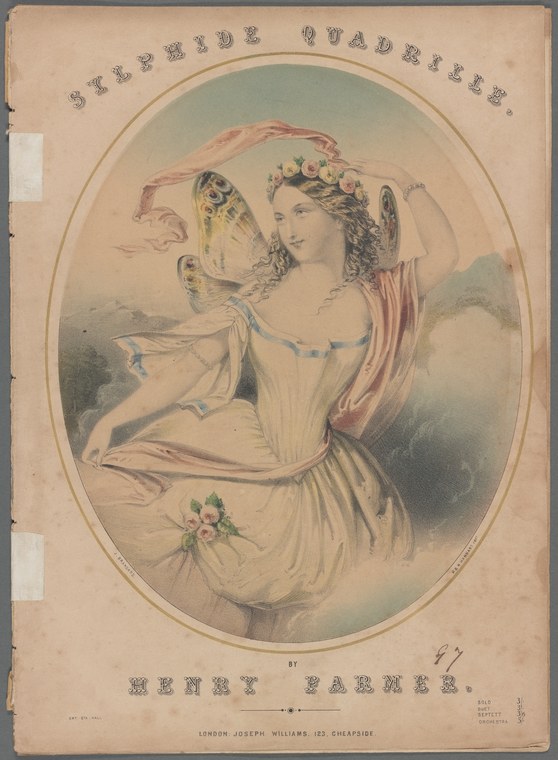
Sylphide quadrille
Unknown artist
- Collection:
- Prints depicting dance
- Source:
- New York Public Library
- Rights:
- Public domain — free to use, share and adapt.
- Recorded as:
- Public Domain
The print captures the Romantic ballet's cultural dominance and the blending of stage imagery with popular social dance in the early 19th century. It shows how *La Sylphide* inspired not only ballet performances but also quadrilles, cotillions, and other social dances performed in ballrooms—making theatrical dance a model for everyday recreation.
What you are looking at
A young woman in a high-waisted white muslin dress sits in a graceful pose, gazing toward a large butterfly she holds in her raised right hand. She wears a wreath of flowers in her hair and a pink-red shawl drapes across her shoulders and lap. Behind her, a mountainous landscape recedes into soft greens and blues. A small nosegay of flowers rests in her lap. The composition is framed by an oval border, and the whole effect—the delicate dress, the naturalistic setting, the ethereal quality of the line work—speaks to the Romantic era's fascination with nature, beauty, and the feminine ideal. The print is colored by hand, with subtle gradations creating depth and atmosphere.
The dancing
The figure is stationary rather than in motion—seated, with her body angled three-quarters to the viewer. Her right arm is raised and extended to display the butterfly; her left hand rests in her lap near the flowers. The pose is one of contemplation and grace rather than active dance movement. The posture suggests the trained carriage of a ballet dancer: an upright torso, elongated neck, and delicate hand positions that emphasize line and extension.
The dance depicted
This is not a depiction of dance in motion, but rather a theatrical or balletic figure posed in a moment of stillness. The title 'Sylphide quadrille' refers to the Romantic ballet *La Sylphide* (1832) and the quadrille dance form—but the print shows a portrait of a sylph (spirit dancer) rather than a scene of a quadrille being danced. The figure embodies the sylph archetype of Romantic ballet: ethereal, nature-connected, and feminine. The quadrille was a popular social dance of the period, often depicted and danced by both professionals and amateurs, and this print likely commemorated a quadrille inspired by or derived from the famous ballet.
How it was made
This is a hand-colored engraving or lithograph, printed in London by Joseph Williams of 122 Cheapside (as noted at the bottom of the print). The medium allowed for wide circulation and affordable reproduction, making theatrical imagery accessible to a middle-class public eager to own souvenirs of performances and fashionable dances. The soft modeling, achieved through careful tonal gradation, creates the ethereal, dreamlike quality appropriate to its subject. The title and artist credit 'by Benet Farmer' appear at the base.
About this work
This is a hand-colored theatrical print from the Romantic era, likely created in the 1830s–1840s following the triumph of *La Sylphide*. It depicts a sylph—the spirit dancer type that captivated European audiences—in a moment of poised stillness, holding a butterfly and gazing with wonder. Rather than showing a quadrille in progress, it commemorates the balletic ideal of the Romantic sylph and likely served as a souvenir or advertisement for quadrille dances inspired by or named after the famous ballet. The print was produced by a London publisher for a broad audience of dance enthusiasts and fashion-conscious consumers.
How to look at it
Observe the pose of the figure: seated, not dancing, but arranged with the grace and line-consciousness of ballet training. The raised arm and extended gaze direct attention upward and outward, embodying the ethereal aspiration of Romantic ballet. The print's soft, dreamy coloring and the naturalistic setting (mountains, flowers) anchor the figure in the Romantic sensibility—the sylph belongs not to the ballroom but to nature and dream. Note how the frame of the oval border isolates the figure as an object of contemplation rather than as part of a narrative scene.
The artist
Benet Farmer was a Romantic-era artist working in London, producing theatrical and fashion prints for the mass market. Little detailed biographical information survives, but his work appears in collections of theatrical imagery and fashion prints of the 1830s–1840s, when hand-colored engraving and lithography were the primary means of circulating images of stage performers and fashionable figures.
The period
This print was created during the height of the Romantic ballet movement in Europe. *La Sylphide* premiered at the Paris Opéra in 1832 and became an immediate sensation, establishing the sylph as the quintessential Romantic heroine—a supernatural, weightless, nature-connected spirit dancer. The image reflects the era's aesthetic values: the cult of the ethereal and the feminine, the celebration of nature, and the fusion of high theatrical art with popular social culture. In this period, quadrilles and other ballroom dances were often named after famous stage works or fashionable dancers, and prints like this one advertised and celebrated both the professional stage and the ballroom craze they inspired.
Where it lives
This is a hand-colored print from the New York Public Library's collection of theatrical and dance imagery. It is catalogued as part of the Prints depicting dance collection at NYPL, a resource for theatrical and social dance ephemera from the 18th–20th centuries.
Dance in this work
Questions about this work
Is this a scene from the ballet *La Sylphide*?
Not exactly. The title references the ballet, and the figure is dressed and posed as a sylph—the spirit dancer character that *La Sylphide* made famous. But the print shows a portrait of a sylph rather than a scene of ballet dancing. It likely represents a quadrille (a ballroom dance) that was inspired by or named after the famous ballet.
What is a sylphide quadrille?
A quadrille was a structured group dance popular in 19th-century ballrooms, usually performed by four couples. In the Romantic era, many quadrilles were given names derived from famous ballets or theatrical works. A 'Sylphide quadrille' was a quadrille named after the sylph archetype popularized by *La Sylphide*—it allowed amateur dancers in ballrooms to participate in a dance inspired by the professional stage.
Why is she holding a butterfly?
The butterfly is part of the Romantic iconography of nature and the ethereal. In Romantic art and ballet, sylphs and spirits are associated with natural beauty, delicacy, and the supernatural. The butterfly—fragile, beautiful, and tied to nature—reinforces the sylph's otherworldly character and her connection to the natural world rather than to human society.
Who was Benet Farmer?
Benet Farmer was a 19th-century printmaker and artist working in London. He specialized in theatrical and fashion prints aimed at a broad middle-class audience. Little is known about his life beyond his work, which circulated as affordable hand-colored engravings and lithographs.
More dance artwork





