49 works in this view — arrow keys or swipe to move between them.
Dance in Art
European folk dancing in prints
Unknown artist
- Collection:
- Prints depicting dance
- Source:
- New York Public Library
- Rights:
- Public domain — free to use, share and adapt.
- Recorded as:
- Public Domain
This image reveals that Renaissance artists and patrons understood dance as an abstract virtue worthy of allegorical representation alongside music and the other liberal arts, embedding dance within a humanist intellectual framework. The way the artist has chosen to represent motion — through open gesture, forward stance, and billowing drapery — established visual conventions that would persist in European art for centuries. It is a foundational example of how dance has been visualized in Western art when the goal is not documentation but idealization.
What you are looking at
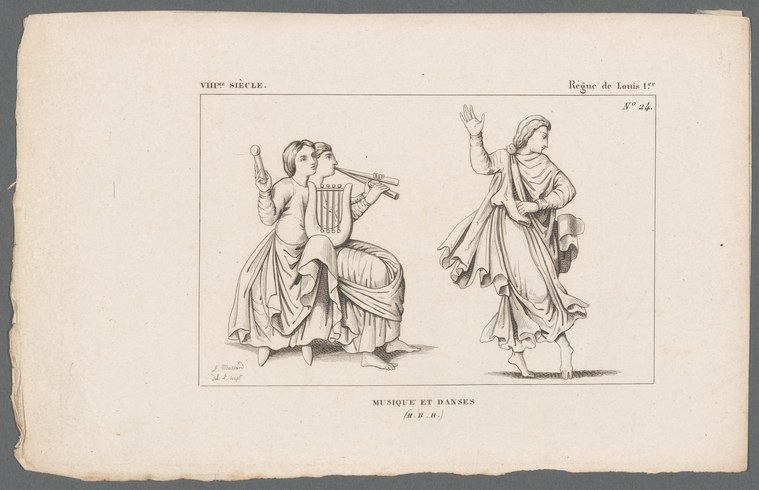
This engraving presents two allegorical female figures representing Music and Dance, labeled at bottom as 'MUSIQUE ET DANSE / (16 S.)' — indicating a 16th-century subject. On the left, a winged putto or young allegorical figure plays a pipe or flute while seated or reclining, associated with a standing woman in flowing classical drapery who gestures expressively with raised arm. On the right, a second woman in similar classical dress is captured mid-stride, her body angled forward with one arm raised and the other extended, her drapery swept around her in movement. Both figures wear the loose, high-waisted gowns typical of Renaissance allegorical art. The composition is set against a plain background, emphasizing the figures themselves. The engraving employs fine crosshatching and line work to model the figures and suggest texture and volume in the fabric.
The dancing
The right-hand figure embodies active dance posture: her weight appears to shift forward onto one leg, her torso leans into the direction of travel, and her arms frame an open, expansive gesture — one arm raised and slightly back, the other extended forward. The left figure's stance is more contained and frontal, with a classical contrapposto weight distribution. Both women are rendered with idealized, elegant proportions and their gestures are theatrical rather than naturalistic, typical of 16th-century allegorical representation. There is no closed partnering; each figure inhabits her own space and moment.
The dance depicted
These are allegorical personifications of abstract concepts — Music and Dance as paired Renaissance virtues — rather than a depiction of a specific dance or technique. The artist has chosen to show Dance through forward motion, open arm positions, and the sweep of fabric around the body, visual shorthand for the idea of movement rather than documentation of a particular style or step. The piping figure suggests the musical accompaniment that would attend courtly dance, establishing the inseparable pairing of these arts in Renaissance thought and practice. This is a work about the concept of dance rather than the practice of it.
How it was made
This is an engraving, executed in the fine linear style characteristic of 16th-century printmaking. The artist has used careful parallel lines and controlled crosshatching to create volume, shadow, and the texture of fabric — a technique that required skill in both design and the physical act of incising the copperplate. Engravings of this quality and subject matter circulated widely among educated patrons and artists, serving both as commodities in themselves and as reference material for other artists. The formal composition and classical references suggest this was made for a cultivated audience familiar with Renaissance iconography.
About this work
This is a 16th-century engraving representing the abstract concepts of Music and Dance as paired allegorical figures in classical dress. Rather than documenting an actual dance or technique, the artist conveys the idea of dance through dynamic posture, gestural openness, and the visual effect of movement in drapery. The work sits within a long Renaissance tradition of personifying human virtues and arts as female figures, a mode of representing abstract thought that dominated courtly and learned art of the period. It belongs in a gallery of dance in art because it shows how dance was understood and visualized in Renaissance culture — not primarily as a physical practice to be recorded, but as an intellectual and courtly ideal to be celebrated alongside music and beauty.
How to look at it
Notice first the two different registers of motion in the composition: the left figure is associated with musical production (the pipe) and is more static or contained, while the right figure is fully engaged in the act of dancing, her body angled forward and her gestures expansive. The artist has conveyed the idea of dance not through specific steps or positions but through openness, forward momentum, and the visual drama of fabric in motion — a shorthand that communicates 'dancing' without requiring knowledge of any particular technique. The classical drapery and idealized bodies link dance to ideas of beauty and virtue drawn from antiquity.
The period
In the 16th century, dance occupied an elevated place in courtly culture and was increasingly seen as worthy of artistic and intellectual attention. It had become a central activity in court life, a mark of refinement, and a subject for humanist writing. The allegorical mode was the dominant way Renaissance artists represented abstract ideas, and the pairing of Music and Dance reflects their inseparability in practice and in thought — music did not merely accompany dance, but was understood as its essential twin. Prints such as this one, circulating beyond court contexts, helped disseminate both the ideal of courtly dance and the visual language for representing it.
Where it lives
The holding collection is recorded as prints depicting dance, held by the New York Public Library. This work is part of a broader collection of dance imagery spanning centuries and media, and was likely acquired as a document of how dance has been represented in Western visual culture.
Dance in this work
Questions about this work
Who are these two figures?
They are allegorical personifications of Music (left, associated with the piping putto) and Dance (right). They represent these arts as abstract concepts and courtly virtues, not as specific people or a particular performance. This mode of representation was standard in Renaissance art, which expressed ideas through idealized female figures in classical dress.
What dance is being shown?
No specific dance is being shown. This is an allegorical image about the concept of dance in Renaissance thought, not a documentation of a particular style or step. It conveys 'dancing' through visual shorthand — open posture, forward motion, and billowing fabric — that would be immediately recognizable to a Renaissance viewer without requiring knowledge of courtly dance technique.
Why is this engraved?
Engravings were the primary medium for disseminating sophisticated imagery in the 16th century. They could be printed repeatedly and circulated widely, making them ideal for spreading ideas about courtly culture and taste to an educated audience beyond the court itself. The fine craftsmanship of this example indicates it was made for patrons of considerable sophistication.
What does the piping figure on the left represent?
The winged putto (or young allegorical figure) playing a pipe represents musical accompaniment. It emphasizes the Renaissance understanding that music and dance were inseparable — music did not merely accompany dancing but was its essential counterpart. The two figures together express a unified ideal of courtly refinement.
More dance artwork





