49 works in this view — arrow keys or swipe to move between them.
Dance in Art
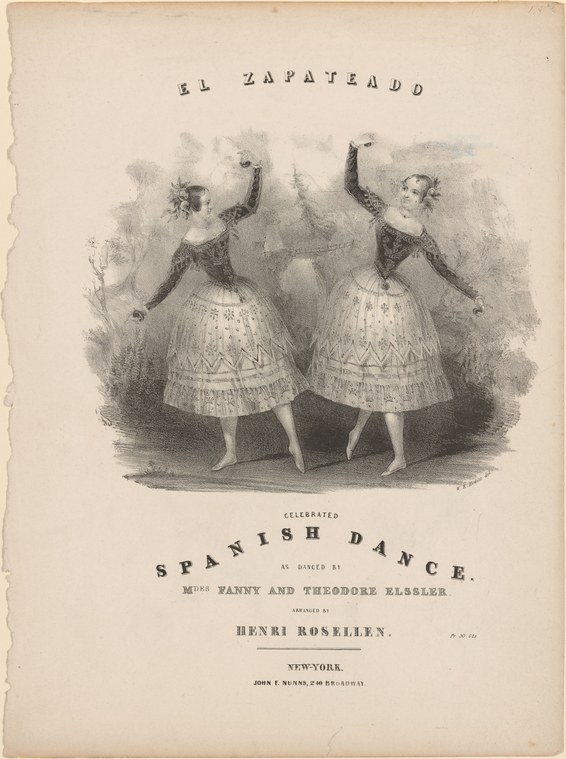
El zapateado, celebrated Spanish dance. As danced by Mdes. Fanny and Théodore [Thérèse] Elssler.: Arranged by Henri Rosellen
Unknown artist
- Collection:
- Prints depicting dance
- Source:
- New York Public Library
- Rights:
- Public domain — free to use, share and adapt.
- Recorded as:
- Public Domain
For historians of theatrical dance, this print is primary evidence of how Spanish dance entered European and North American ballet repertory in the 1830s–1840s, and how the Elssler sisters—rivals to Marie Taglioni—shaped that entry. For dancers and choreographers, the spirited posture and energetic arm work visible here offer a glimpse of how romantic-era performers understood Spanish movement, distinct from both authentic folk practice and twentieth-century flamenco codification.
What you are looking at
Two women in matching white skirts face each other in a dynamic pose, their upper bodies energetically twisted and their arms raised in mirror-image gestures. Both wear fitted dark bodices above voluminous skirts decorated with geometric patterns at the hem. The composition is tightly framed around the dancers against a soft, hazy background that suggests theatrical lighting or stage setting. Their posture captures an exuberant moment mid-movement, with weight shifted onto the balls of their feet and spines arched in an attitude of spirited abandon. The engraving is rendered in delicate stippled tones that create volume and movement in the fabric.
The dancing
Both dancers are in an upright, spirited stance with spines extended and arms raised in symmetrical positions—each woman's right arm lifted high while the left is also elevated. Their torsos show active rotation away from the vertical axis, creating a sense of swirling motion. The weight appears to be on the balls of the feet, suggesting rapid footwork. The mirrored positioning and matching costumes indicate this is a duet rather than a partnered hold, with each dancer occupying her own space while maintaining visual dialogue.
The dance depicted
This is a *zapateado*—a Spanish dance defined by rhythmic footwork and percussive heel-striking—as performed in the theatrical context of the 19th century. The title confirms it was danced by the Elssler sisters (Fanny and Thérèse), celebrated European ballet dancers of the 1830s–1840s, for whom composers and arrangers like Henri Rosellen created popular concert pieces. The visible energy and spinal articulation, combined with the skirt design that allows us to see the feet in motion, are characteristic of how Spanish and Latin dances were adapted for European theatrical presentation. This is not flamenco proper but rather its romantic-era theatrical cousin.
How it was made
This is a lithographic print with hand toning or watercolor—established from the soft modeling, the tonal gradations, and the technique's suitability for theatrical publicity. The process allowed for rapid reproduction and distribution of sheet-music covers and theatrical souvenirs, making this a commercial object designed for a broad middle-class audience. The delicate stippling and wash create an illusion of movement and theatrical atmosphere that would have been impossible in line engraving alone. As a printed sheet-music cover from the New York publisher John E. Nunns on Broadway, it represents the intersection of dance performance, musical composition, and popular entertainment.
About this work
This print documents a specific theatrical interpretation of Spanish dance performed by two of the nineteenth century's most celebrated dancers. The Elssler sisters' *zapateado* represents a moment when European ballet companies were eagerly adopting exoticized, nationally-inflected character dances as vehicles for virtuosity and novelty. The arrangement by Rosellen—presumably for solo piano—indicates that such pieces circulated as domestic music-making as well as stage spectacle, allowing amateur musicians to recreate the flavor of professional performance. The image captures not just a dance step but a whole aesthetic: the romantic era's fascination with Spanish and Latin culture filtered through the conventions of European theatrical dance.
How to look at it
Notice the frozen moment the artist has chosen: not a still pose but a captured split-second of whirling energy, with both women's bodies mid-turn and their arms actively engaged in the movement vocabulary. The mirrored symmetry is itself a sign of theatrical artifice—actual *zapateado* is not typically symmetrical, but the doubling here creates visual harmony and spectacle. Look at the skirts: their volume and the decorative borders at the hem are not incidental; they were essential to the visual effect of Spanish dance as performed on European stages, allowing the footwork to be seen and the silhouette to expand dynamically with movement.
The artist
The lithographic artist is not recorded in the catalogue. The composition was arranged as a musical piece by Henri Rosellen, a pianist and composer active in mid-nineteenth-century Paris and London, who specialized in salon pieces and character dances. The sheet music was published in New York by John E. Nunns, a Broadway music publisher, indicating this was part of an active transatlantic trade in entertainment materials.
The period
The 1830s–1840s saw European ballet companies in a fever of curiosity about non-European dance, particularly Spanish and Italian forms. The Romantic ballet aesthetic celebrated exotic locations and national character—what was called the *ballet d'action*—and dancers like Fanny Elssler built their international fame partly on their willingness to perform such character pieces. Simultaneously, sheet music and lithographic prints were becoming major distribution channels for entertainment culture, allowing middle-class households to consume theatrical spectacle in domestic space. This print sits at the intersection of all three phenomena: theatrical innovation, nationalist exoticism, and the emerging mass media of the period.
Where it lives
This print is held in the New York Public Library's collection of prints depicting dance. It is a published sheet-music cover, part of the commercial circulation of theatrical entertainment materials in nineteenth-century North America.
Dance in this work
Questions about this work
Who were the Elssler sisters?
Fanny and Thérèse Elssler were Austrian-born dancers who dominated European and North American ballet stages in the 1830s–1840s. Fanny especially was famous for her dramatic presence and her signature character dances, including Spanish and Italian pieces that rivaled the more ethereal romanticism of her contemporary Marie Taglioni. They appeared in New York, London, Paris, and Vienna.
What is zapateado?
Zapateado is a Spanish dance form defined by rapid, percussive footwork—the name comes from *zapato*, shoe. In its folk form it is associated with Andalusian tradition; in the nineteenth-century theatre, it was stylized and incorporated into ballet as a character dance. It typically features a rhythmic dialogue between the dancer's feet and percussion or piano accompaniment.
Is this the same as flamenco?
Not quite. Flamenco as a codified form developed later and has its own emotional and technical vocabulary. What we see here is a romantic-era European interpretation of Spanish dance, adapted for theatrical performance by ballet-trained dancers. It shares the emphasis on footwork with flamenco but differs in posture, gesture, and cultural context.
Why was this published as sheet music?
Henri Rosellen's piano arrangement allowed the piece to circulate among amateur musicians and domestic music-makers, extending its reach far beyond the theatre. A middle-class family with a piano could now own and perform a piece connected to a famous theatrical spectacle, bringing the glamour of international dance into the home.
More dance artwork





