49 works in this view — arrow keys or swipe to move between them.
Dance in Art
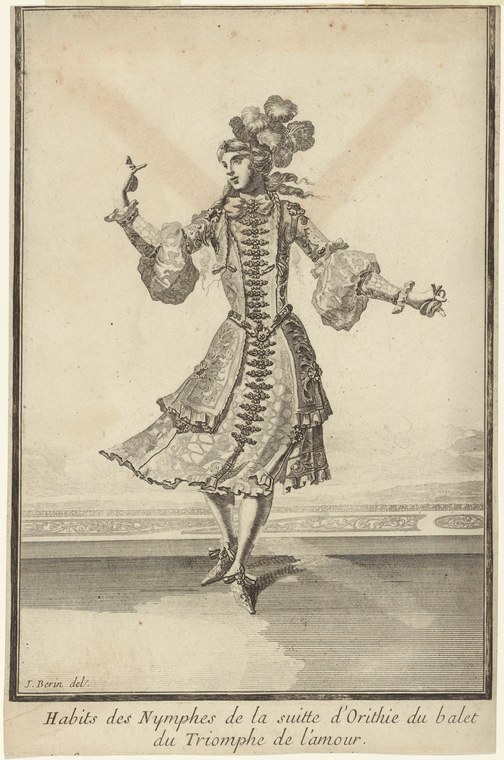
Habits des nymphes de la suitte d'Orithie du balet du Triomphe de l'amour
Unknown artist
- Collection:
- Prints depicting dance
- Source:
- New York Public Library
- Rights:
- Public domain — free to use, share and adapt.
- Recorded as:
- Public Domain
This engraving is documentary evidence of early professional ballet costume and stage presence. It records not a specific moment of choreography but the look and bearing of a trained performer in the emerging institution of court ballet, making it essential for anyone studying the visual history of early ballet or the material culture of 17th-century theatrical dance.
What you are looking at
A single female dancer stands in an elegant contrapposto pose against a plain background with a shallow stage platform. She wears an ornate early 18th-century costume: a heavily decorated jacket or bodice with elaborate embroidered or patterned panels, a full skirt with scalloped hem, and puffed sleeves with delicate lace cuffs. Her hair is styled high with curled loops atop her head in the fashion of the period. She holds her arms in an open, welcoming position—one raised with hand extended, the other lower and similarly extended—suggesting a moment of graceful display or invitation. Her posture is upright and dignified, with weight distributed evenly, her gaze directed outward toward the viewer. The engraving technique renders fine detail in the costume's surface patterns while keeping the background austere, focusing all attention on the figure and her dress.
The dancing
A single dancer in a standing pose with arms held away from the body in an open frame, neither in close relationship nor in any conventional ballroom hold. The weight appears evenly distributed, with no indication of elevation or the turn-out associated with later ballet. The arm position—raised and extended with relaxed hands—suggests a declarative or presentational gesture rather than the structured ports de bras of formal technique. The posture is erect but not rigidly geometric, with a natural grace suited to courtly movement.
The dance depicted
This is a nymph from the court ballet *Le Triomphe de l'amour* (1681), one of the earliest French court ballets to include professional dancers on stage. The costume and figure style are entirely consistent with the ornate, narrative court ballet tradition of Louis XIV's reign. The figure represents not a named character but one of the corps of attendant nymphs in a mythological suite—allegorical female attendants whose role was to frame the action through graceful, decorative movement. The open arm position and upright stance reflect the balletic language of the period: a blend of courtly deportment, theatrical display, and early ballet vocabulary, predating the codified technique of the 18th century. The work documents the visual record of how these performers dressed and posed.
How it was made
This is an engraving, recognizable from the fine parallel line-work (hatching) used to render shadow and texture, the sharp outlines, and the even tone. Engravings of this period were made by hand-incising a copperplate and printing from it, which allowed for wide circulation and made them the primary means of documenting court spectacles and theatrical costume for audiences who could not attend. The technical precision of the engraving—evident in the delicate rendering of lace, embroidery detail, and the subtle gradations of the pleated skirt—indicates a skilled printmaker working from a preparatory design or stage record. The presence of a signature at lower left ('T. Borell del.' or similar) suggests this was made by or after a named artist.
About this work
This engraving documents a performer in a court ballet of the reign of Louis XIV, capturing both the lavish costume and the aesthetic of early theatrical dance. It belongs in a dance history because it is a primary record of how dancers dressed, held their bodies, and were presented to the court and to the engraving-buying public. The work sits at a crucial moment: the transition from court dance as an amateur courtly pastime to court ballet as a professional theatrical form with trained performers. It is neither a narrative scene nor a group choreography but a figure study—a way of showing a single dancer in her costume and characteristic pose, the visual equivalent of a character description in a libretto.
How to look at it
Attend to the costume first: the scalloped hem, the patterned surfaces, the puffed sleeves, and the elaborate coiffure all speak to the expense and visual spectacle of court ballet. Then note the pose—neither stiff nor dynamic, but a poised standing position that suggests decorum and display rather than athletic movement. The figure is not caught mid-leap or turn, but offered to the eye as a complete and elegant form. This was the artistic purpose: to present the dancer as a figure in a decorative and allegorical tableau, not to suggest the effort or technical virtuosity of movement.
The artist
The signature reads 'T. Borell del.' or 'J. Berain del.'; this is likely Jean Berain (1640–1711) or a printmaker after a Berain design. Berain was the preeminent designer of court ballets and operatic spectacles under Louis XIV, responsible for costume, set, and machine design. His drawings and the engravings made from them were circulated widely and became the canonical visual record of court ballet. This work is part of the extensive Berain documentation of *Le Triomphe de l'amour*.
The period
*Le Triomphe de l'amour* (1681) marked a watershed: it was the first court ballet to share the stage with professional male and female dancers from the Paris Opéra, alongside courtiers. By this date, ballet technique was developing rapidly in the hands of the Opéra's ballet masters (notably Beauchamp), yet court ballet costume remained ornate, heavy, and richly symbolic. The engraving medium allowed designs to circulate across Europe and into the archives of courts, scholars, and collectors. Court ballet itself was entering its final decades as a primary art form; within a generation, the professional ballet of the Opéra would eclipse it. This image thus captures a moment of transition.
Where it lives
The work is held in the New York Public Library's collection of prints depicting dance. It is an engraving, likely produced in the 1680s in Paris or shortly thereafter as a record of the court spectacle and a form of cultural record distributed to collectors and libraries across Europe.
Dance in this work
Questions about this work
Who was this dancer?
The engraving does not identify her by name. She is one of the nymphs in the suite of Orithyia, a mythological attendant role in the ballet. Court ballet rolls and librettos sometimes named performers, but this print documents her only as a figure type and costume.
What does the costume tell us?
The ornate jacket, full skirt, and elaborate hairstyle are all hallmarks of court ballet dress, designed to display wealth and status while allowing enough mobility for courtly movement—walking, turning, and graceful gestures. The fabric patterning and lace cuffs suggest this was an expensive costume, likely reused across multiple performances.
Is this ballet?
Not in the modern sense. This is court ballet of the 17th century—a theatrical form that blended court dancing (courtly deportment and social dance) with professional technique and narrative spectacle. The movement vocabulary was lighter and less technically demanding than Romantic or Classical ballet, and the costume was designed for visibility and splendor rather than freedom of movement.
Why was this engraved and circulated?
Court spectacles were major events of political and cultural importance. Engravings of costumes and performers allowed the king's magnificence to be recorded and distributed to other courts and collectors across Europe, extending the prestige of the production far beyond those who saw it live.
More dance artwork





