49 works in this view — arrow keys or swipe to move between them.
Dance in Art
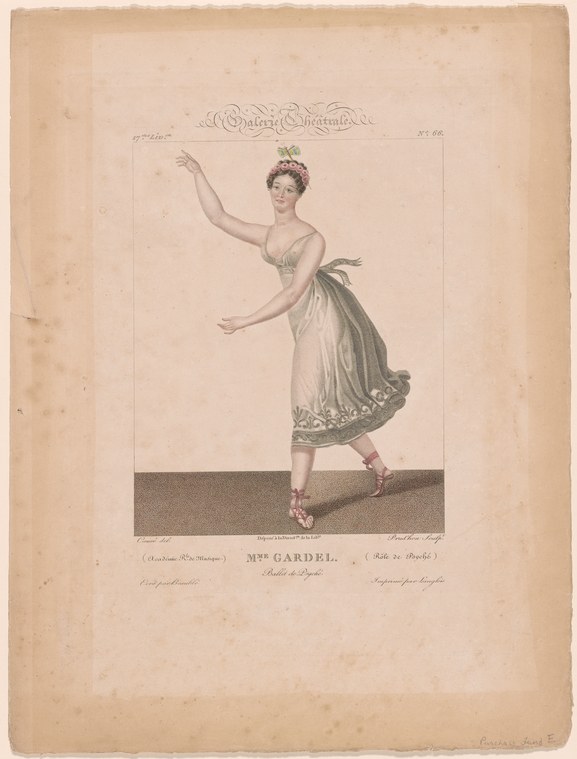
(Académie Rle de Musique). Mme. Gardel. (Rôle de Psyché). Ballet de Psyche.: Ecrit par Beaublé. Déposé à la Direction de la Libie
Unknown artist
- Collection:
- Prints depicting dance
- Source:
- New York Public Library
- Rights:
- Public domain — free to use, share and adapt.
- Recorded as:
- Public Domain
This image provides direct evidence of early 19th-century ballet technique, costume, and aesthetic as they were understood and marketed to the public. It documents both a specific dancer (Mlle. Gardel) and a specific work, anchoring our knowledge of the ballet repertory of this period. Such prints are among the richest visual records we have of how early Romantic ballet actually looked in performance—they were made by theaters and publishers who had access to the dancers, and they circulated widely, shaping how audiences understood and remembered dance.
What you are looking at
A woman in early 19th-century dress stands alone against a neutral background in a posed, theatrical attitude. She wears a high-waisted white or pale muslin gown with short sleeves, caught at the bodice with delicate gathering, and a darker green or teal drapery falls from one side of her skirt to the floor, suggesting movement or an accessory element. Her hair is arranged with curls piled atop her head and adorned with what appears to be a small wreath or crown. She stands in a balletic pose with her weight shifted to one leg, her free leg extended slightly, and her arms held aloft in an open, expressive attitude—the raised arm reaches upward and outward, while the other extends horizontally. The pose suggests graceful elevation and control. Her feet are shod in pale pink or flesh-colored heeled slippers, and her posture conveys both classical training and theatrical presentation. The image is rendered as a hand-colored engraving or aquatint, with careful attention to fabric texture and the subtle modeling of flesh tones.
The dancing
The dancer occupies the center of the composition, isolated and self-contained. Her frame is upright and elongated; her torso is held in a lifted, open alignment typical of early ballet training. The raised arm curves gracefully overhead while the lower arm extends at roughly shoulder height, suggesting an épaulement or arm movement from classical vocabulary. Her weight appears concentrated on the supporting leg, leaving the free leg apparently ready for movement—a suspension or moment of repose between steps. Her head is held high, turned slightly, with the gaze directed upward and away, reinforcing an aristocratic, idealized bearing. The positioning of her heeled slippers indicates formal training: the heel of the supporting leg is prominent, and the position of the free foot suggests control of turned-out positions.
The dance depicted
This is a theatrical ballet image, most likely depicting a solo from a neoclassical ballet of the early 19th century. The catalogue identifies the role as Psyché from 'Ballet de Psyche' (Ballet of Psyche), with text crediting a libretto by Beaublé. Psyche was a popular subject in Romantic and neoclassical ballet; the role typically demanded a dancer of technical accomplishment and grace, often portrayed as ethereal or divine. The pose—lifted, open, with arms in a graceful attitude—reflects the aesthetic vocabulary of this period: elongation, control, and an air of weightlessness or transcendence. The green drapery may represent a specific costume element associated with the character, and the wreath suggests divine or allegorical status. The image captures the dancer in a moment of classical repose, emphasizing the precision and elegance expected of a principal dancer in this repertory.
How it was made
This is a hand-colored engraving or aquatint, likely produced in France in the early 19th century. The fine linear work and careful hatching visible in the background and drapery are consistent with intaglio processes; the hand coloring—applied in discreet, flat areas of pale flesh tone, soft greens, and delicate pinks—suggests a commercial theatrical print made for the public market. The technique allowed for relatively rapid reproduction and wide circulation, making such images accessible to a theater-going public interested in their favorite dancers and roles. The precision of the line work and the restraint of the coloring convey both artistic ambition and commercial production: these were not luxury objects, but they were not ephemeral either. The style of inscriptions, numbering (visible as 'N.166' in the record title), and the notation 'Déposé à la Direction de la Libie' (registered with the Library directorate) indicates this was an officially published print, likely from a series documenting Opéra dancers and roles.
About this work
This is a theatrical portrait of a named dancer in a specific role—Mlle. Gardel as Psyché from a ballet of that name—rendered as a hand-colored engraving from the early 19th century. The work belongs to a significant tradition of dance portraiture in print, a visual record of the expanding star system and international fame of principal ballet dancers during the Romantic era. The image preserves not only a dancer's likeness and costume but also the aesthetic and technical values of early ballet: idealization, control, grace, and the illusion of effortless elevation. The work sits at the intersection of theater documentation, celebrity portraiture, and fine art print, reflecting the prestige of ballet as a public art form and the market for such images among educated spectators.
How to look at it
Focus on the moment of stillness the artist has chosen: this is not a leap or a turn, but a moment of composed repose, suggesting both the dancer's technical control and a narrative or emotional pause. The artist has frozen a moment of apparent weightlessness—the raised arm, the lifted torso, the seemingly effortless balance—that conveys both the physical training and the theatrical illusion that early ballet cultivated. Notice the care taken in rendering the costume: the high waist, the thin muslin, and the contrasting drapery were all marks of Neoclassical taste and of the specific role. The formal isolation of the figure against the neutral ground was a convention of theatrical portraiture in print, emphasizing the dancer as an object of admiration and focus.
The artist
The artist is not recorded in the catalogue. However, the style, technique, and inscriptions are consistent with French commercial theatrical print production of the 1800s–1820s. Such prints were often produced by publishing houses in Paris associated with the Opéra, sometimes after designs by theater artists or sculptors, and disseminated through print dealers. The anonymity is typical: these were products of a commercial workshop system rather than independent artistic creation, and attribution was often to the engraver or publisher rather than the original designer.
The period
The image dates to the early decades of the 19th century, when ballet was undergoing rapid transformation in France. The end of the Napoleonic era saw renewed enthusiasm for spectacle and the arts, and the Paris Opéra was at the forefront of European ballet innovation. The neoclassical aesthetic—evident in the simplified, graceful costume and the idealized pose—was giving way to Romanticism, though this image still reflects neoclassical values. The expansion of a star system and the commercialization of ballet through prints and lithographs was a new phenomenon; dancers like Marie Taglioni would shortly become international celebrities, and images like this one were part of the machinery of that fame. The role of Psyché—a mythological subject—fits the taste of the period for allegorical and classical themes in dance.
Where it lives
The work is held by the New York Public Library as part of its collection of prints depicting dance. The inscriptions indicate it was officially registered ('Déposé') with the French Library directorate, a requirement for published prints. The numbering (N.166) suggests it was part of a numbered series, likely a commercial suite of theatrical prints issued by a Paris publisher.
Dance in this work
Questions about this work
Who was Mlle. Gardel and why is she important?
Mlle. Gardel was a principal dancer at the Paris Opéra in the early 19th century. While detailed biographical records are sparse, her name in a print series indicates she was a notable performer of her era, and this image documents her in a significant role. The use of her name in the title suggests she had enough fame and market value to be named in a commercial print—a mark of celebrity status in the period.
What ballet is 'Ballet de Psyche' and when was it performed?
The Ballet of Psyche was a neoclassical ballet with a libretto credited to Beaublé. Despite the print's notation, firm dates and production history are not clear from available records, though the style and technique suggest early 19th-century creation. The role of Psyché—a mythological character—was popular in ballet repertory and often portrayed as ethereal, innocent, or divine, making it a signature role for accomplished dancers.
How do I know this is a real dance and not just theatrical posing?
The pose reflects the actual technical vocabulary and aesthetic of early classical ballet: the controlled use of turned-out positions, the lifted and open frame, the graceful arm placement, and the emphasis on elongation and lightness are all recognizable elements of ballet training. The image was made by professionals who had access to the theater and understood ballet aesthetics, so even in a posed, formal print, the movement vocabulary is authentic.
Why was she in heeled slippers rather than pointe shoes?
Pointe work as a standard technique had not yet been fully developed in the early 19th century. Dancers wore heeled slippers and used the strength of their legs and feet to rise onto the balls of their feet, achieving elevation and control. Specialized pointe shoes became common later in the century as the technique evolved. The heels visible in this image are historically accurate for the period.
More dance artwork





