49 works in this view — arrow keys or swipe to move between them.
Dance in Art
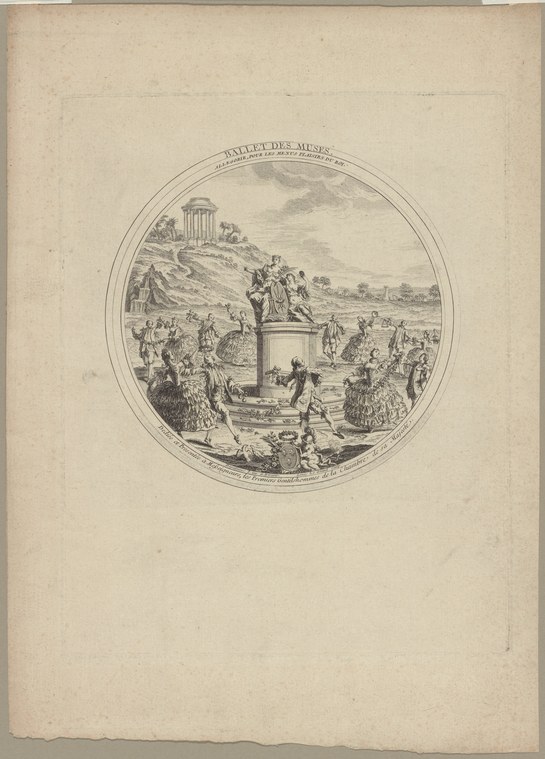
Ballet des Muses, allegorie, pour les menus plaisirs du Roi
Unknown artist
- Collection:
- Prints depicting dance
- Source:
- New York Public Library
- Rights:
- Public domain — free to use, share and adapt.
- Recorded as:
- Public Domain
Court ballet was foundational to the emergence of professional dance and the codification of movement that would eventually become classical ballet. Engravings like this are among the only visual records we have of how these spectacles looked, what they communicated through visual arrangement, and what role dance played in the intellectual and political life of the royal court. For dancers and historians, this work offers concrete evidence of scale, costume, setting, and the formal aesthetic that governed courtly movement.
What you are looking at
A circular engraving depicting an elaborate allegorical scene centered on a classical temple or monument. The composition is densely populated with figures in 17th-century dress arranged across a landscape that recedes toward distant hills. In the immediate foreground, groups of elegantly dressed women and men gather in pairs and small clusters around the central structure. The figures wear full skirts, fitted bodices, and formal court attire typical of the period. The setting combines a formal garden or park with classical architecture: a domed rotunda or temple occupies the center, and broad pathways or terraces organize the space. The engraving employs fine cross-hatching to create depth and atmosphere, with lighter areas suggesting open sky and distance. The title *Ballet des Muses* appears in a cartouche at the top of the circular frame, identifying this as documentation or illustration of a court spectacle.
The dancing
The dancers are shown in upright, formal postures characteristic of 17th-century court dance. Pairs and small groups stand with composed bearing; several figures appear to be in the process of bowing or executing courtly gestures rather than rapid movement. The women's full skirts and the men's formal coats and hose constrain the range of visible motion. Arms are often at the sides or slightly extended in greeting or salutation. The composition suggests the stately, processional quality of court ballet rather than energetic choreography; the moment captured is one of assembly and formal interaction rather than dynamic leaping or turning.
The dance depicted
This engraving documents or commemorates a *ballet de cour*, a form of court entertainment combining dance, music, poetry, and allegorical spectacle that flourished in France during the 16th and 17th centuries. The title *Ballet des Muses* (Ballet of the Muses) signals a performance built on classical mythology and intellectual prestige. Court ballet was not virtuosic dance in the modern sense but rather a highly formalized social performance in which nobility participated, typically moving through geometric patterns and choreographed sequences in groups. The dense gathering around a monument suggests the narrative or allegorical focus of such spectacles: the muses themselves, as immortal patrons of the arts, were the subject and presumably the theme of the dance and music. The formal dress and composed deportment visible here are consistent with documented accounts of court ballet technique and the aesthetic values it embodied.
How it was made
This is a copper-plate engraving, executed using fine lines and cross-hatching to create tone and spatial recession. The technique allowed for precise linear detail and the reproduction of architectural forms and costume, making it an ideal medium for documenting court spectacles and their elaborate settings. Engravings were relatively portable and could circulate beyond the court itself, reaching a wider educated audience. The circular format, or *tondo*, was conventional for commemorative or allegorical engravings of the period and lent a sense of completeness and formal dignity to the subject. The technical refinement of the line work and the complexity of the composition suggest this was a work of considerable skill and expense, likely commissioned to preserve and celebrate a significant court event.
About this work
This engraving is a visual record of a *ballet de cour*, the dominant form of courtly entertainment in 17th-century France. It depicts the assembly of figures in formal dress around a classical monument, framed as an allegory of the Muses. The work is documentary in intent: it preserves for posterity the visual character of a court spectacle, including the architectural setting, the formal clothing, and the composed bearing of the participants. Court ballet was a political and cultural act as much as a dance: it displayed the refinement, learning, and orderly power of the royal court, and it involved the nobility themselves as performers. This image captures that intersection of dance, allegory, architecture, and courtly display.
How to look at it
Observe the dense, almost architectural arrangement of the figures: they are organized into groups and aligned with the geometric space defined by the monument and terraces. This is not a snapshot of spontaneous movement but a carefully composed scene that prioritizes order and visual balance over individual virtuosity. The engraver has chosen a moment of assembly and formal interaction rather than climactic gesture or rapid transition. Notice how the circular frame itself reinforces this sense of completeness and ceremony. The costume details—the women's full skirts, the men's formal coats and hose—constrain the visible range of motion and signal that this is not acrobatic or athletic dancing but movement governed by courtly decorum and the weight of elaborate dress.
The period
The *ballet de cour* emerged in the late 16th century at the French royal court and reached its height during the reign of Louis XIV (1643–1715), who was himself an accomplished dancer and a passionate patron of the form. These ballets were elaborate multimedia productions combining poetry, music, and choreography into allegorical narratives drawn from classical mythology, romance, or contemporary politics. They served as instruments of royal propaganda and courtly pedagogy, teaching and reinforcing the values of nobility and order. By the 17th century, dancing masters were beginning to codify technique and notation, laying groundwork for the professionalization of dance. Court ballet gradually ceded cultural primacy to opera and pure ballet in the 18th century, but its emphasis on formal geometry, courtly decorum, and allegorical content shaped European dance for generations.
Where it lives
The work is held in the New York Public Library's collection of prints depicting dance. It is an engraving from an unknown date and by an unknown artist, though the inscription and style are consistent with French court ballet documentation from the 17th century.
Dance in this work
Questions about this work
What is a ballet de cour?
A ballet de cour was a courtly entertainment combining dance, music, poetry, and theatrical spectacle, performed primarily by nobility at the French royal court from the late 16th to the 18th century. Unlike later ballet, it was not primarily concerned with technical virtuosity but with allegorical narrative, geometric patterning, and the display of courtly refinement. These were major political and cultural events, often lasting several hours and involving dozens of participants.
Who would have danced in such a performance?
Members of the nobility, including ladies and gentlemen of the court, typically danced the roles. The king himself often participated in court ballets, especially during the reign of Louis XIV. Professional musicians and some trained dancers might support the spectacle, but the primary performers were courtiers for whom participation was a mark of status and accomplishment.
How does court ballet relate to modern ballet?
Court ballet laid the foundation for classical ballet, particularly in its emphasis on formal technique, geometric patterning, and the disciplined training of the body. As court ballet declined in the 18th century, professional ballet developed, building on the codified steps and aesthetic principles that dancing masters had systematized in the ballet de cour tradition. However, modern ballet is far more demanding physically and virtuosic technically than the courtly form ever was.
Why is this engraving valuable?
Engraved records like this are among the few visual documents we have of how court ballets actually looked. They preserve information about costume, setting, scale, and the spatial organization of dancers that survive in almost no other form. For historians and dancers, such images are primary evidence of technique, aesthetic values, and the role of dance in court culture.
More dance artwork





