49 works in this view — arrow keys or swipe to move between them.
Dance in Art
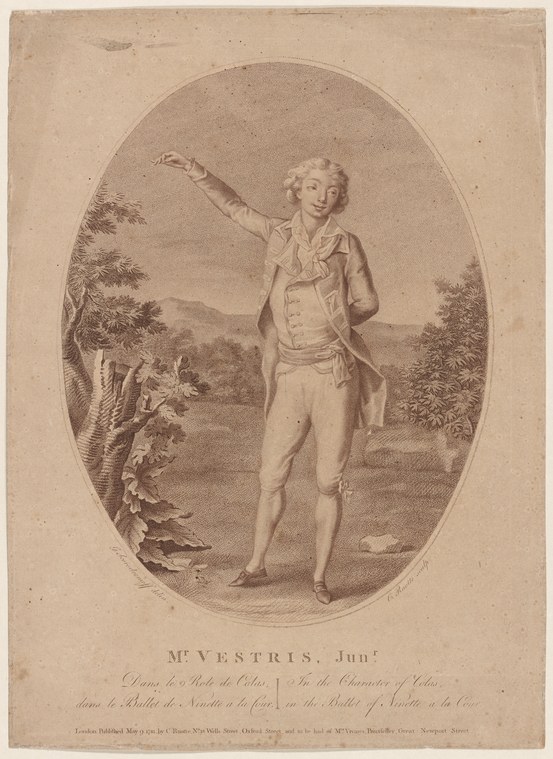
Mr. Vestris, Junr. dans le role de Colas dans le ballet de Ninette a la cour: in the character of Colas, in the ballet of Ninette a la cour
Unknown artist
- Collection:
- Prints depicting dance
- Source:
- New York Public Library
- Rights:
- Public domain — free to use, share and adapt.
- Recorded as:
- Public Domain
This print documents how a celebrated professional dancer of the 18th century was remembered and marketed to the public—as an image, a character, a presence on stage. It is evidence that dance was taught, performed, and valued as a branch of genteel accomplishment, and that even major theatrical roles were executed in the vocabulary of courtly posture rather than technical ballet vocabulary. For historians of theater and social dance, it reveals the taste of an era: how bodies were meant to move, what counted as beautiful, and what a skilled performer looked like when frozen in a moment of character.
What you are looking at
A young male dancer in light breeches and a fitted coat stands in a relaxed contrapposto pose in a wooded landscape, his left arm raised in a gentle gesture of address or acknowledgment. The setting is a pastoral idyll with trees framing both sides of the composition and distant hills, rendered in the soft tonal gradations typical of 18th-century engraving. The figure occupies the center of an oval compositional frame, a device that emphasizes his isolation and importance. His pose is genteel rather than acrobatic: he stands with weight shifted onto one leg, the other bent slightly, in the manner of aristocratic deportment. The light is even and cool, casting subtle shadows that model the musculature of his legs and torso. The whole image has the character of a theatrical portrait—a record of a celebrated performer in a memorable role.
The dancing
The dancer's frame is upright and composed, with no tension in the upper body. His left arm is raised to shoulder height with the elbow slightly bent and the hand open in a gesture of presentation or mild surprise; his right arm hangs at his side. His legs are straight but not locked, with the weight clearly distributed through the supporting leg. The pose conveys elegance and restraint rather than technical display: there is no turnout, no lifted extension, no suggestion of the rigor of ballet training. This is the vocabulary of courtly address adapted to the body of a skilled performer.
The dance depicted
This is a portrait of a dancer in character as Colas, a role from the pantomime-ballet *Ninette à la cour*, a work that achieved wide popularity in the mid-18th century. Colas is a peasant or village boy, and this image documents how that character was embodied on stage—with relaxed elegance and genteel posture rather than peasant crudity. The role belonged to the tradition of the *ballet d'action*, a narrative form in which dancing, pantomime, and plot advanced together. The figure's lack of technical display (no extension, no turnout) is itself informative: it suggests that 18th-century theatrical dancing, even for celebrated soloists, was rooted in the etiquette and carriage of polite society rather than in the codified technique that would emerge in the 19th century.
How it was made
This is an engraving, identifiable from the characteristic line-work, tonal hatching, and the pale cream paper stock. The technique allowed fine modulation of light and shade without color, making it ideal for the reproduction of theatrical images for circulation among the print-collecting public. The oval mat is hand-drawn on the plate itself, a refinement that speaks to the status of the subject and the intended audience. The colophon indicates London publication and sale through a named printseller, a distribution network that made such images widely available to theater-goers and dancers themselves. The print format suggests this was a marketable image, sold to audiences who wanted a memento of a celebrated performance.
About this work
This is a record of the London stage in the mid-18th century, when narrative ballet and pantomime occupied a central place in theatrical entertainment. It documents not only a dancer—almost certainly the younger Vestris, a member of the most celebrated dancing family of the period—but also a moment in the evolution of theatrical dance. The pose, the costume, and the pastoral setting all belong to the aesthetic of the mid-Georgian theater, in which grace and decorum were prized above technical virtuosity. The image is not a record of dance as we now think of it, but of the social art of movement on stage, where the body carried meaning through carriage and gesture rather than through extension or turnout.
How to look at it
The pose is the key: notice how the dancer stands in the manner of an 18th-century gentleman, with the weight shifted and the torso upright but not rigid. The raised arm is a gesture of address, belonging to the vocabulary of pantomime and courtly deportment. The pastoral setting is not incidental—it signals that this is a rural or comic character (Colas is a village boy), but one performed with grace rather than buffoonery. The oval framing device emphasizes the figure as a portrait, a record of a celebrated individual, rather than as a generic dance image.
The period
The mid-18th century saw the rise of the *ballet d'action*—a form in which narrative, mime, and dancing combined—as a major theatrical genre. *Ninette à la cour* (first performed in Paris c. 1778) was among the most frequently performed works of its kind, and its popularity ensured that images of celebrated performers in its roles circulated widely. This was the period in which ballet was still rooted in social dance and courtly behavior; the classical ballet technique of the 19th century had not yet crystallized. Vestris was a legendary figure of the London and Paris stages, and his image would have been sought after by print collectors and by theater-goers who wanted a souvenir of his performances.
Where it lives
The print is held in the New York Public Library's collection of prints depicting dance. It was published in London and bears the imprint of a named printseller, indicating it was part of the commercial print market of the mid-18th century.
Dance in this work
Questions about this work
Who was Vestris junior?
The younger Vestris (likely Auguste Vestris, 1760–1842) was a member of the most celebrated dancing family of the 18th century. He was renowned for his technical prowess, his elegance, and his ability to command the stage. He performed across Europe and was a major figure in both Paris and London.
What is *Ninette à la cour*?
A pantomime-ballet that tells the story of a peasant girl (Ninette) and her interactions with court society. It was hugely popular in the late 18th century and was performed repeatedly in Paris, London, and across Europe. The role of Colas was a key part of the work.
Why does the dancer not look like a ballet dancer?
Because 18th-century theatrical dancing was rooted in social dance and courtly posture, not in the codified technique of 19th-century classical ballet. Turnout, extension, and lifted carriage would come later. At this period, a skilled performer was one who moved with grace, elegance, and control within the vocabulary of polite society.
What does the pastoral setting signify?
It identifies Colas as a rural or comic character, in keeping with the plot of *Ninette à la cour*. The idyllic landscape was a conventional way of signaling the pastoral or comic mode, as opposed to tragic or heroic action.
More dance artwork





