49 works in this view — arrow keys or swipe to move between them.
Dance in Art
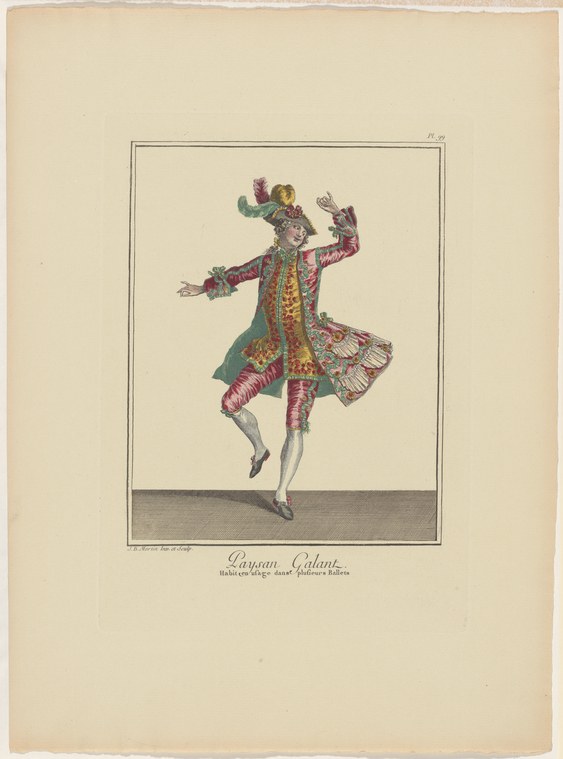
Paysan galant
Unknown artist
- Collection:
- Prints depicting dance
- Source:
- New York Public Library
- Rights:
- Public domain — free to use, share and adapt.
- Recorded as:
- Public Domain
This print preserves an ephemeral moment from a performance tradition that is otherwise known to us only through written description, musical scores, and other images. It shows us what the 18th-century audience valued in dance—the explosive physicality of the jump, the grotesque playfulness of the comic character, and the spectacular costume—and how artists recorded and circulated that record. For historians of theatrical dance before the Romantic era, such prints are primary documents.
What you are looking at
A single male dancer is caught mid-leap against a plain gray floor and cream background, his body suspended in an exuberant upward spring. He wears an elaborate costume of the 18th century: a richly patterned coat with yellow-gold embroidery and decorative loops, green undersleeves or breeches, pink or mauve stockings, and a tall feathered hat perched on his head. His arms are raised in a dynamic, unbalanced gesture—one higher than the other—and his legs are in the air, knees bent, suggesting the explosive energy of a jump or bound. The figure dominates the composition, isolated and theatrical against the neutral background. The engraving is hand-colored with delicate precision, the ornament of the coat rendered in fine detail that speaks to the work's circulation among the educated classes.
The dancing
A single figure executes what appears to be an allegro jump—the knees are bent and lifted high, the body rises freely off the ground, and the arms are flung upward in an expansive, somewhat asymmetrical port de bras. The head is tilted back slightly, the body twisted in space, suggesting the balletic principle of épaulement (shoulder shaping) even as the gesture reads as uncontrolled and gleeful rather than strictly classical. There is no partner, no group, no ground contact—only the moment of flight.
The dance depicted
This is most likely a representation of the 18th-century theatrical dance known as ballet d'action or court ballet. The title 'Paysan galant' (the gallant peasant or rustic suitor) points to the pantomime-comedy tradition in which stock characters—the peasant, the coquette, the nobleman—enacted courtship narratives through a blend of dance, mime, and gesture. The exuberant, somewhat ungainly quality of this figure's jump—less controlled than the measured elevation of classical ballet—suggests it represents a peasant or comic character rather than a noble dancer, and the elaborate costume, far from realistic rustic dress, indicates this is a theatrical interpretation performed on the professional stage. The image shows a moment of energetic abandon suited to a comedic role.
How it was made
This is an engraving (or possibly etching) that has been hand-colored with watercolor or gouache. The medium allowed for wide circulation as a printed document—such prints were collected as records of celebrated dancers and roles, sold at theaters, and distributed among the nobility and merchant classes. The hand-coloring adds specificity to the costume detail and suggests this was a higher-quality or luxury copy. The linear clarity of the engraved line beneath the color is visible and characteristic of 18th-century reproductive prints, which served both documentary and decorative purposes.
About this work
This engraving documents a moment of 18th-century French theatrical dance—specifically, a comic character role in the tradition of ballet d'action. The single figure, a peasant suitor in elaborate theatrical dress, is frozen at the apex of a buoyant, exuberant jump, arms raised in unbalanced energy. The work belongs to the large tradition of dance prints that served to preserve and circulate records of celebrated dancers and the roles they performed, functioning as both theatrical publicity and art object. It reflects the culture of bodily display and character-acting that defined the professional stage in the age of Louis XV and XVI.
How to look at it
Attend first to the moment the artist chose to freeze: not a moment of arrival or pose, but a moment of flight, when control is suspended and energy is released. Notice the asymmetry of the arms and the tilt of the head—this is not the balanced, symmetrical carriage of classical training, but rather a gesture of abandon suited to a comic role. The elaborate costume, rendered in meticulous detail, was the badge of a professional theatrical dancer and the marker of a character type. Look at the blank space around the figure, which emphasizes isolation and display—this is a performer shown off, not a narrative scene.
The period
This print dates to the 18th century, a period when French theatrical dance was the dominant European form and Paris the center of dance innovation and training. The ballet d'action—narrative dance with pantomime—was the reigning mode, and the Comédie-Italienne, the Opéra, and other venues regularly performed comedies featuring peasant characters and rustic settings. The engraved dance print was a flourishing commercial and artistic form during this period, serving as a record of celebrated performers (often named in the inscription) and as collectible art. The hand-coloring of such prints became increasingly refined and expensive in the latter 18th century.
Where it lives
This print is part of a collection titled 'Prints depicting dance' held by the New York Public Library. It is a hand-colored engraving, a form that was widely distributed and collected in the 18th century.
Dance in this work
Questions about this work
What is a 'paysan galant'?
The term refers to a stock comic character type in 18th-century French theatrical dance: a rustic or peasant suitor, usually portrayed as awkward, lustful, or bumbling. Despite the simple character, the costume shown here is entirely theatrical and elaborate—not realistic dress. The role combined dance, mime, and slapstick comedy and was a staple of the Comédie-Italienne and the Opéra.
Who danced this role?
The catalogue record does not name the artist or performer. However, such prints often carried the dancer's name in the inscription, and this work may have been created to commemorate or promote a celebrated performer in this role. Without the full inscription visible or readable, we cannot identify the dancer.
Why is this print hand-colored?
Hand-coloring added artistic value and specificity to an engraved print, allowing the costumer's intricate embroidery and the richness of the fabrics to be more accurately represented. Colored prints were more expensive and typically aimed at a wealthier market of collectors, theater patrons, and amateurs of dance.
Is this ballet?
This is 18th-century theatrical dance, which included ballet but also pantomime, character comedy, and spectacle. The term 'ballet' in this period referred to any theatrical dance performance, not specifically to the classical form we associate with the word today. This particular role was performed in a mixed-media entertainment combining dance, gesture, and narrative.
More dance artwork





