49 works in this view — arrow keys or swipe to move between them.
Dance in Art
Pastoral dance scenes of the eighteenth century
Unknown artist
- Collection:
- Prints depicting dance
- Source:
- New York Public Library
- Rights:
- Public domain — free to use, share and adapt.
- Recorded as:
- Public Domain
This image reveals how 18th-century aristocratic society blended dance, theater, and courtship into a unified system of refined bodily expression. For historians of dance and gesture, it documents the codified poses and interactions that preceded modern theatrical dance, showing how the body was trained to communicate social status and romantic intent. The print's circulation as a popular image suggests that such pastoral entertainments and courtly interactions were not confined to the court but were widely admired, imitated, and consumed as models of sophisticated behavior.
What you are looking at
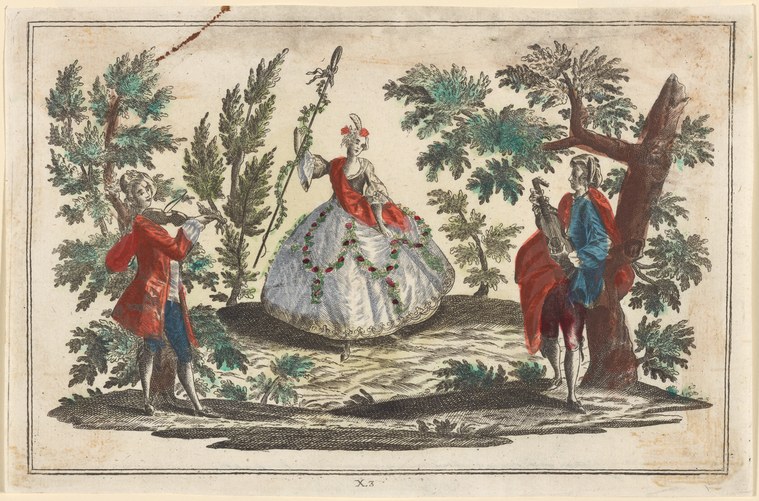
A pastoral scene set beneath tall trees depicts three figures in aristocratic dress arranged in a clearing. At center, a woman in a voluminous white skirt with red bodice and headdress holds a tall staff or wand aloft in an elegant pose. To her left, a man in red coat and blue breeches gestures toward her with one arm extended. At right, a second man in similar dress stands near a large tree trunk, watching the scene. The ground is rendered with hatching to suggest depth, and the foliage is delicately colored green. The composition is intimate and theatrical—the woman commands the center while the men attend to her, suggesting a courtship or allegorical narrative enacted through gesture and positioning rather than vigorous movement.
The dancing
The central woman stands with her weight seemingly balanced, her body held erect and composed, one arm raised high with the staff creating a vertical line. Her posture is formal and stationary rather than in motion. The man at left leans slightly toward her with an extended arm in a gesture of address or supplication—a courtly greeting rather than a partnered hold. The figure at right observes from a distance. All three maintain an upright, controlled carriage typical of aristocratic deportment; none shows the bent knees, pointed feet, or dynamic weight shifts of trained dancers, suggesting this depicts a social or courtship interaction enacted through dignified pose rather than choreographed steps.
The dance depicted
This appears to depict a pastoral courtship scene or allegorical entertainment of the 18th century, likely a moment from a court ballet or masque rather than a structured social dance. The woman's raised staff and central position, combined with the men's attending gestures, suggest a moment of theatrical presentation or ritual exchange. The scene is consistent with the conventions of Rococo pastoral entertainment—aristocratic figures enacting refined social interaction in an idealized natural setting. The static poses and gestural vocabulary align more closely with tableau or choreographed gesture than with the structured figures of contemporary dances like the minuet or cotillion, though the formal dress and setting indicate an aristocratic context.
How it was made
This is a hand-colored engraving or etching, executed with fine parallel lines to create tone and shadow, particularly in the ground and foliage. The delicate coloring—greens for vegetation, reds and blues for the figures' clothes—appears to be applied after the line work was complete, a common practice for popular prints of the 18th century. The technique allowed for multiple impressions to be distributed, suggesting this was a widely circulated image intended for a literate, leisured audience interested in fashionable courtship scenarios and pastoral entertainment. The careful attention to costume detail and the refined execution indicate this was made for an educated public familiar with Rococo aesthetics and courtly conduct.
About this work
This hand-colored engraving depicts an 18th-century pastoral courtship scene in which three aristocratic figures enact a moment of refined social interaction beneath trees. The central woman, holding a staff and dressed in elaborate white and red, is attended by two men in courtly dress. Rather than depicting an identifiable social dance like a minuet or cotillion, the image captures a theatrical or allegorical moment—a tableau vivant of aristocratic courtship performed through dignified pose and gesture. The work belongs in a dance archive because it documents how movement, gesture, and the body were used to express rank, courtship, and social relations in 18th-century aristocratic culture, and because such scenes were regularly incorporated into court ballets, masques, and pastoral entertainments that combined dance with dramatic narrative.
How to look at it
Attend to the woman's raised staff and central position, which signals her as the focus of the scene—she is being presented or gazed upon. Notice how the man at left leans toward her with an open gesture of greeting or supplication, a posture of deference. The figure at right maintains a more distant, observational stance. These asymmetrical positions create a narrative moment rather than a symmetrical dance formation. The artist has chosen stillness and pose over motion, capturing what might be a moment of address or revelation within a larger theatrical sequence, and inviting the viewer to read meaning from the dignified carriage and spatial relationships of the figures.
The period
This engraving belongs to the mid-to-late 18th century, when Rococo aesthetics dominated European art and aristocratic culture. In this period, pastoral and allegorical entertainments—including court ballets, masques, and choreographed spectacles—were central to aristocratic life and were widely reproduced in prints for domestic consumption. The minuet was the reigning social dance among the European nobility, characterized by precise, controlled movement and formal partnering; though this image does not depict a minuet, it shares the period's emphasis on dignity, restraint, and the communication of social hierarchy through bodily posture. Prints of courtship scenes, pastoral entertainments, and aristocratic leisure were extremely popular, circulated in albums and collections, and served as both entertainment and models for fashionable behavior.
Where it lives
This engraving is held in the New York Public Library's collection of prints depicting dance. It is catalogued as part of a series of pastoral and theatrical scenes, likely assembled in the 18th or 19th century as a record of fashionable entertainments and courtly manners.
Dance in this work
Questions about this work
Is this a specific named dance?
No. This appears to depict a moment from a court ballet, masque, or pastoral entertainment—a theatrical scene combining dance, gesture, and narrative—rather than a social dance like a minuet or cotillion. The static poses and symbolic gestures suggest a tableau or choreographed moment of courtship or allegory.
Why is the woman holding a staff?
The staff is likely a symbolic prop identifying the woman's character or role within the theatrical narrative—she may represent a allegorical figure (a muse, a goddess, or an allegorical virtue) or may be costumed as a shepherdess or similar pastoral character. It elevates her to a position of authority or special significance within the scene.
What does the formal dress tell us?
The elaborate court dress, the woman's voluminous skirts, and the men's tailored coats indicate these are aristocratic figures enacting a scene of leisure and courtship. This is not a dance of the common people but a refined, aristocratic entertainment designed for and by the nobility.
How do we know this is a dance-related image?
Pastoral courtship scenes like this were regularly incorporated into court ballets and masques, which combined choreographed dance with dramatic performance, allegorical narrative, and pantomime. The refined gestures, the theatrical setting, and the presence of multiple figures in a composed spatial relationship mark this as part of the culture of aristocratic performance and movement.
More dance artwork





