49 works in this view — arrow keys or swipe to move between them.
Dance in Art
Vin Mariani
Unknown artist
- Collection:
- Prints depicting dance
- Source:
- New York Public Library
- Rights:
- Public domain — free to use, share and adapt.
- Recorded as:
- Public Domain
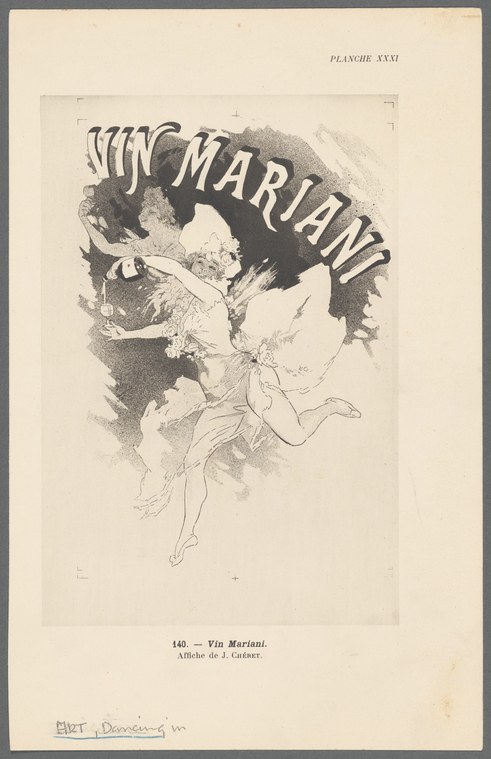
This image reveals how ballet was commodified and used to market consumer goods in the late 19th century, and how the ballet body—especially the female ballet body—became a symbol of luxury, refinement, and desirability in advertising. It documents a moment when theatrical dance imagery had become iconic enough to sell products unrelated to performance itself.
What you are looking at
A stylized promotional poster or advertisement design depicts a female dancer in a dynamic, off-balance pose against a dark background. The figure wears a white classical tutu and pointe shoes, with her body arched backward in an arabesque or penché-like position. Her face and upper torso lean back dramatically while one leg extends high behind her, creating a diagonal line across the composition. The word "VIN MARIANI" appears in bold, capital letters integrated into the upper portion of the design, rendered in a heavy sans-serif typeface. Ornamental foliage or decorative flourishes—possibly grape vines or stylized botanical elements—frame the figure, particularly around the head and shoulders, suggesting the product's herbal or grape-wine origins. The overall composition has the character of Art Nouveau graphic design, with flowing organic forms and theatrical drama.
The dancing
A single female dancer is shown in an extreme backward arch, her weight displaced onto her upstage leg while the downstage leg extends as a counterbalance. Her arms appear extended or held in a soft, open position suited to classical ballet vocabulary. The pose is acutely unstable and exaggerated—beyond typical performance alignment—which emphasizes the sensational and eye-catching qualities required for advertisement. Her tutu and pointe shoes are rendered in white against the dark field, providing stark visual contrast.
The dance depicted
The figure depicts classical ballet technique, specifically positioned as an arabesque or similar extension movement characteristic of 19th-century Romantic ballet. The extreme arch and theatrical distortion suggest this is not documentary of actual stage practice but rather an idealized, poster-style interpretation designed to convey elegance and movement. The association with Vin Mariani (a coca wine patent medicine popular from the 1870s onward) indicates this is commercial advertising using a ballet aesthetic to sell the product to a fashionable clientele.
How it was made
This is a lithographic print, identifiable by the crayon and wash technique visible in the soft tonal gradations, the grainy texture characteristic of lithographic stone, and the bold integration of lettering typical of commercial lithography. The process allowed rapid, economical reproduction of color or tonal variations, making this a mass-produced advertisement rather than a unique artwork. Lithography's capacity for fluid, organic lines suited the Art Nouveau aesthetic evident here.
About this work
This is a commercial advertisement for Vin Mariani, a cocaine-containing wine marketed as a tonic and restorative, rendered in the Art Nouveau style popular in the 1880s–1900s. The designer has recruited classical ballet imagery—the tutu, pointe shoes, and graceful arabesque—to position the product as sophisticated, refined, and associated with beauty and elegance. The theatrical exaggeration of the dancer's pose and the ornamental botanical framing work together to create visual spectacle and memorability. The work sits at the intersection of dance imagery, advertising history, and fin-de-siècle graphic design, illustrating how dance aesthetics were deployed in commercial culture.
How to look at it
Observe how the artist has taken a recognizable ballet pose and distorted it beyond realistic anatomical possibility to create dramatic visual impact. The backward lean is exaggerated to suggest motion and lightness; the integration of the lettering into the composition rather than below or beside it was a modernist approach that made the product name inseparable from the image. Note how the white tutu and the dark background create a luminous focal point—a printing strategy that makes the image readable from a distance and memorable. The ornamental botanicals are not merely decorative; they subtly reinforce the product's claim to be natural and plant-derived.
The artist
The artist is not recorded. The lithographic style and composition are consistent with commercial poster design of the 1880s–1900s, when firms like Maison Mariani in Paris employed graphic artists to create memorable advertisements for patent medicines and tonics. The work shows the influence of Art Nouveau designers such as Jules Chéret, who pioneered the use of dynamic, elegantly distorted figures in commercial lithography.
The period
The 1880s–1890s saw the peak of Vin Mariani's popularity; the product was endorsed by celebrities and positioned as a luxury tonic. In the same period, classical ballet was enjoying renewed prestige and visibility in Paris, particularly after the Romantic repertory was revived and the Paris Opéra ballet maintained a strong social profile. Art Nouveau emerged as the dominant commercial and fine-art aesthetic, emphasizing organic forms, theatrical dynamism, and the apotheosis of the elegant female figure. Using a ballet dancer to advertise a wine or tonic was a natural alignment of commerce, art, and aspiration.
Where it lives
This print is held by the New York Public Library in its collection of prints depicting dance. It is catalogued as plate XXXI in what appears to be a compiled portfolio or archival series.
Dance in this work
Questions about this work
What is Vin Mariani?
Vin Mariani was a French patent medicine and tonic wine containing cocaine, created by chemist Angelo Mariani in the 1860s and marketed throughout the late 19th and early 20th centuries. It was widely advertised as a restorative for fatigue, nerve disorders, and general debility, and was endorsed by celebrities, athletes, and physicians of the era. The product remained legal and fashionable until stricter drug regulation in the early 20th century.
Why would an advertisement use a ballet dancer?
In the late 19th century, classical ballet was a marker of elite culture, refinement, and beauty. Using a ballet figure in an advertisement positioned the product as luxurious and aspirational—something for fashionable, cultured consumers. The graceful, ethereal quality of the dancer conveyed both elegance and vitality, properties the product claimed to restore.
Is this pose actually performable in ballet?
The extreme backward arch shown here goes beyond typical performance practice and realistic anatomy. The artist has exaggerated the arabesque or penché position to create a more dramatic, eye-catching advertisement. This distortion was common in commercial lithography, where visual impact and memorability took priority over anatomical accuracy.
When was this printed?
The catalogue record does not provide a date. Based on the Art Nouveau style, the lithographic technique, and the known marketing period of Vin Mariani, this was most likely produced in the 1880s or 1890s, though an exact date would require further research.
More dance artwork





