49 works in this view — arrow keys or swipe to move between them.
Dance in Art
Mazurier, artiste de la Porte St. Martin
Unknown artist
- Collection:
- Prints depicting dance
- Source:
- New York Public Library
- Rights:
- Public domain — free to use, share and adapt.
- Recorded as:
- Public Domain
Mazurier represents a performance tradition—theatrical pantomime, féerie, and acrobatic virtuosity—that was as central to early 19th-century European entertainment as ballet, yet is often overshadowed by it in dance history. This print is evidence of his fame and of the market for theatrical portraiture; it shows how such performers were visualised and commodified for a paying public.
What you are looking at
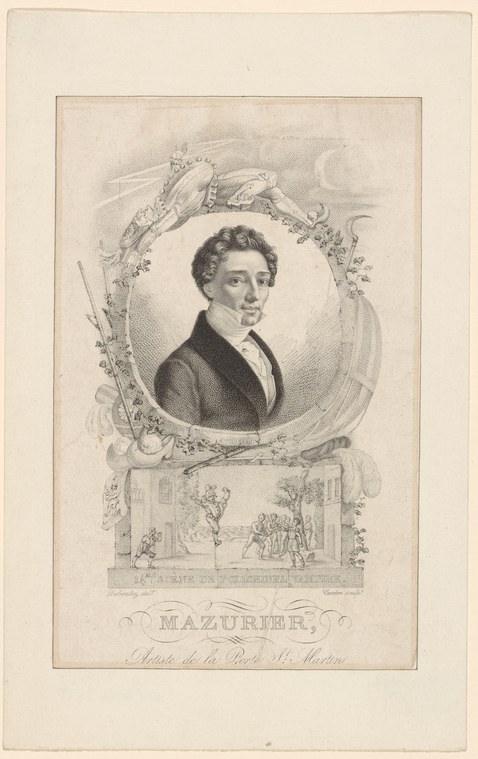
A portrait engraving of a young man in early 19th-century dress, positioned within an ornamental oval frame. The subject wears a dark coat with a white collar, his face turned three-quarters to the viewer. The oval is surrounded by an elaborate decorative border of vine scrollwork and classical motifs: at the top, a draped ribbon held by a theatrical mask and winged figure (likely a putto or Cupid); at the bottom, a columned architectural vignette depicting a stage scene with multiple figures in motion. The entire composition is centered on the page against a plain background. The inscription "MAZURIER" appears in capital letters below the architectural scene, with cursive text reading "Artiste de la Porte St. Martin" beneath it.
The dancing
The portrait head itself is static and formal. The significant kinetic content appears in the small architectural vignette at the base of the frame, which shows multiple figures in dynamic poses on what appears to be a theatrical stage. The figures there are too small to read gesture in detail, but their scattered positions and varied orientations suggest active movement and theatrical action rather than formal ballroom positioning.
The dance depicted
Mazurier was a celebrated mime and dancer at the Porte-Saint-Martin theatre in Paris during the 1820s–1830s, known for pantomime and acrobatic performance. The architectural scene at the base of the frame is likely a reference to the theatre itself and the kinds of spectacular, physically virtuosic performances he was famous for—possibly including the ballet-pantomime *Le Diable Boiteux* (1836) and similar works. The style and scale suggest theatrical pantomime or féerie rather than classical ballet in the strict sense, though acrobatic and aerial elements were common to his repertoire.
How it was made
This is an engraving, identifiable by the fine parallel hatching lines used to build tone and shadow, the crisp linear definition of the ornamental borders, and the characteristic plate-mark impression. The technique allows for fine detail in portraiture and ornament while also enabling mass reproduction—this would have been circulated as a theatrical print or souvenir to publicise the performer. The elaborate ornamental framing and inclusion of a stage vignette suggest this is a commemorative portrait-print, likely produced for sale to theatre-goers or collectors of theatrical imagery.
About this work
This is a commemorative engraved portrait of Mazurier, a leading performer at Paris's Porte-Saint-Martin theatre in the early 19th century. The work sits within a tradition of theatrical portraiture—particularly common in French prints of the 1820s–1830s—that celebrated individual star performers through elaborate allegorical framing. The inclusion of a stage scene within the ornamental border explicitly links the subject's identity to his professional role and the spectacles he performed. For dance historians, the work documents both the celebrity of pantomime and acrobatic performance in the Romantic era and the visual means by which such performers were promoted and remembered.
How to look at it
Attend to the scale and placement of the stage scene within the ornamental frame: it is small but centrally positioned, visually subordinate to the portrait head yet essential to the subject's identity. The ornamental border itself—with its theatrical mask, winged figure, and classical architectural vocabulary—visualises the performer as a figure worthy of allegorical celebration. The precision of the engraved line and the labour evident in the ornament suggest this was an expensive, high-quality object, confirming Mazurier's status as a marquee performer.
The artist
The artist is not recorded in the catalogue. The engraving is a professional theatrical print, likely produced by a commercial printmaker in Paris, possibly commissioned by the theatre or the performer's representatives for public sale.
The period
The 1820s–1830s were a peak period for both the star system in European theatre and the production of theatrical portraiture. French prints of this era frequently combined portrait heads with elaborate allegorical or professional frames—vignettes of the subject in performance, attributes of the arts, or scenes of acclaim. Simultaneously, this was the era of Romantic ballet (works like *La Sylphide*, 1832), but pantomime and acrobatic performance remained equally prestigious and commercially successful, particularly at theatres like the Porte-Saint-Martin, which specialised in popular, spectacular entertainments rather than classical ballet.
Where it lives
Held at the New York Public Library in the Prints depicting dance collection. It is a theatrical portrait print, likely produced in Paris in the 1820s–1830s and circulated as a commercial souvenir or collectible for theatre patrons.
Dance in this work
Questions about this work
Who was Mazurier?
Mazurier was a celebrated French mime, acrobat, and dancer at the Porte-Saint-Martin theatre in Paris, active from the 1820s through the 1840s. He was known for virtuosic pantomime and spectacular physical feats in popular theatrical productions (féeries and ballet-pantomimes). He was a major star of his day, rivalling classical ballet dancers in fame and earnings.
What does the theatrical scene at the bottom show?
The small vignette at the base of the frame depicts a stage scene with multiple figures in dynamic poses, almost certainly representing the kind of spectacular theatrical action Mazurier performed in. The exact work is not identified by the print, but such scenes were typical ways of demonstrating a performer's range and the excitement of their act.
What is the Porte-Saint-Martin theatre?
The Porte-Saint-Martin was one of Paris's leading popular theatres, known for lavish, spectacular productions including pantomime, féerie (fairy spectacle), and acrobatic performance. It competed with the Opéra and Opéra-Comique by offering sensational visual effects and virtuosic physical performance, and regularly produced star performers.
Why is this print important for dance history?
It documents a major performance tradition—pantomime and acrobatic theatre—that was as central to early 19th-century entertainment as ballet but is often neglected in dance histories. It also demonstrates how theatrical performers were commercially promoted and celebrated through portraiture and prints designed for mass circulation.
More dance artwork





