49 works in this view — arrow keys or swipe to move between them.
Dance in Art
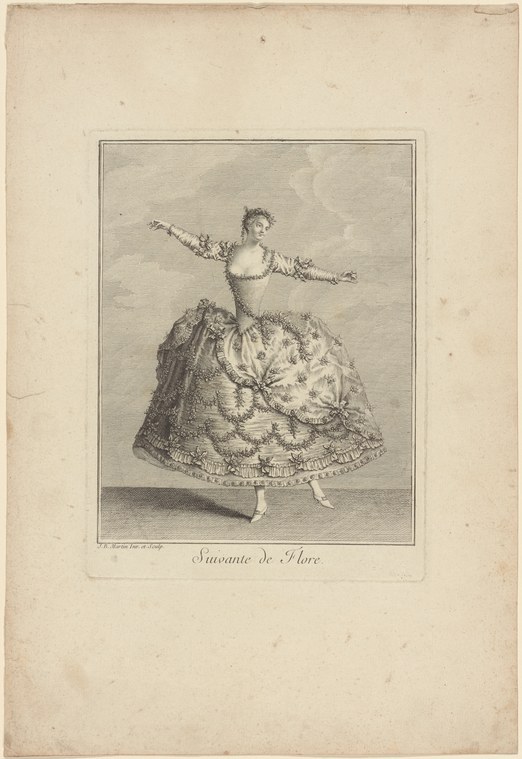
Suivante de Flore
Unknown artist
- Collection:
- Prints depicting dance
- Source:
- New York Public Library
- Rights:
- Public domain — free to use, share and adapt.
- Recorded as:
- Public Domain
This engraving is a direct visual record of how theatrical dancers dressed and posed in baroque-era spectacles, preserving details of costume construction and the somatic conventions of the period that words alone cannot convey. For dancers and choreographers interested in historical reconstruction or informed interpretation of baroque dance, such images are irreplaceable primary sources.
What you are looking at
A single female dancer stands in a three-quarter pose against a plain background, her body angled slightly to the right. She wears an elaborately decorated gown with a fitted bodice and voluminous skirt; the skirt is embellished with floral or foliate patterns and appears to be gathered or pleated, with what may be decorative trim or scalloping at the hem. Her arms are extended outward in a gesture of balance or presentation, elbows slightly bent, palms facing outward or downward. Her posture is upright and controlled, weight appears centered or slightly forward on the balls of her feet. The image is a finely executed engraving on paper, rendered in grayscale with careful attention to the texture and folds of the fabric, the delicate line work of the embroidery or patterning on the skirt, and subtle shading to model the body beneath the costume.
The dancing
A single dancer, viewed at roughly waist height or slightly below. The upper body is upright with shoulders level; both arms are extended laterally with a gentle curve, suggesting a moment of balance or formal presentation rather than active motion. The legs are straight and close together or in a narrow stance. The posture conveys control and poise; there is no sense of weight shift, jump, or rotation. The execution of the arm position—open, symmetrical, and deliberate—is characteristic of formal theatrical or courtly dance training.
The dance depicted
The title *Suivante de Flore* (Attendant of Flora, goddess of flowers) suggests this is a character dance or allegorical role from a baroque court ballet or early theatrical production. The lavish floral costume and idealized pose are consistent with the ornamental roles that populated French court spectacles of the 17th and early 18th centuries. The dancer's pose—arms extended in a gesture of offering or display—and the absence of any asymmetry, weight shift, or dynamic movement suggest a moment of formal presentation or a still attitude rather than a step in progress. Without additional context, we cannot confirm the specific dance form, but the costume and setting point to court ballet or a related theatrical spectacle.
How it was made
This is an engraving, a printmaking technique in which an image is incised into a metal plate (likely copper) with a burin or similar tool and then inked and printed. The fine parallel lines (hatching and cross-hatching) visible in the background and used to model the fabric demonstrate the precision and labor-intensive nature of the medium. Engravings were among the most widely distributed and collected prints of the 17th and 18th centuries, particularly for documenting costume and theatrical spectacle. The technique allowed for high-quality reproduction and wide dissemination, making this type of image an important historical record of dance dress and presentation.
About this work
This engraving documents a theatrical or court character—a nymph or attendant of Flora—in a formal dance attitude. The elaborate costume, the refined pose, and the careful execution of the print all point to a work created for documentation or commemoration of a court spectacle or theatrical dance, likely from the 17th or early 18th century. The image preserves not only the visual appearance of an ornate period gown but also the formal aesthetic principles of baroque-era dance training: upright carriage, symmetrical arm work, and a sense of measured elegance rather than explosive motion. For historians and practitioners of early European dance, this engraving is valuable evidence of how dancers held their bodies and presented themselves in formal theatrical contexts.
How to look at it
Observe the precise rendering of the costume's surface pattern and the sculptor-like treatment of the body beneath it; this reflects the engraver's care to document both the spectacular visual effect of theatrical dress and the formal, controlled posture of the trained dancer. Note the stillness of the figure and the symmetry of the arm gesture—this is not a moment of dynamic action but rather a pose of presentation or display, typical of formal court spectacle where static, symmetrical beauty was prized. The artist has chosen a moment of poised balance rather than movement, emphasizing the dancer's elegance and control.
The period
This print dates to the era of French court ballet (17th–early 18th century), when dance was an ornamental and ceremonial element of aristocratic life and theatrical entertainment. Louis XIV's court at Versailles was the center of dance innovation; ballet technique was codified, and dancers trained in a system that emphasized turned-out legs, lifted carriage, and formal port de bras. The allegorical theme—Flora, goddess of flowers—was common in court spectacles, which drew on classical mythology and pastoral imagery. Engravings of dancers and costumes from this period circulated among the nobility and served as records of notable productions and as models for costume makers and dancers in other European courts.
Where it lives
The work is held in the New York Public Library's prints collection, which documents dance and theatrical spectacle. Such prints were produced and circulated as souvenirs of court spectacles, records for dancers and patrons, and works of art in their own right.
Dance in this work
Questions about this work
What does 'Suivante de Flore' mean?
'Suivante' means attendant or lady-in-waiting; Flora is the Roman goddess of flowers and spring. In court ballets, character roles like this represented mythological or allegorical figures. The dancer would have performed in costume as part of a larger spectacle, often with music and scenery.
How do we know this is an engraving and not a drawing or painting?
The technique is visible in the image: the parallel lines (hatching) used to create shading and texture are characteristic of engraving, in which lines are cut into a metal plate. The even, controlled quality of the lines and the absence of brushwork distinguish it from hand-drawn media.
What does the pose tell us about baroque dance training?
The upright carriage, level shoulders, extended arms, and closed foot position reflect the formal aesthetic of court ballet. The pose conveys control, symmetry, and elegance—values central to baroque courtly culture. This is not an active movement but a moment of presentation.
When and where would a dancer have performed this role?
Without more information, we cannot date the image precisely or identify the specific production. However, allegorical roles like Flora were common in French court ballets from roughly the 1650s through the 1750s, and similar roles appeared in theatrical productions throughout Europe during this period.
More dance artwork





