49 works in this view — arrow keys or swipe to move between them.
Dance in Art
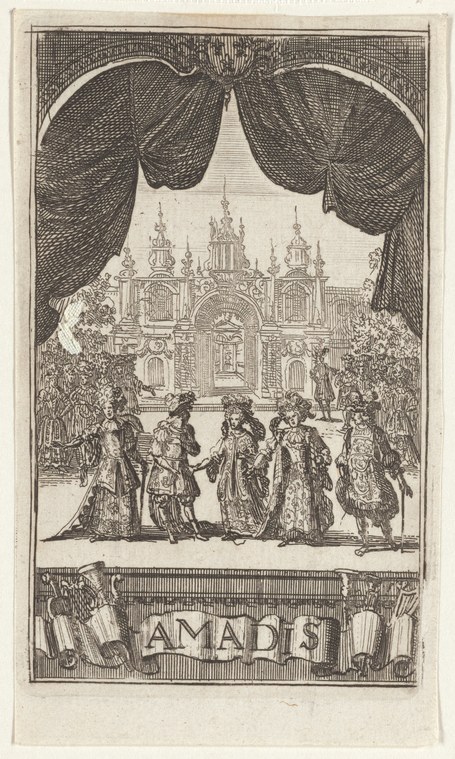
Amadis
Unknown artist
- Collection:
- Prints depicting dance
- Source:
- New York Public Library
- Rights:
- Public domain — free to use, share and adapt.
- Recorded as:
- Public Domain
Engraved records of court spectacles are among the most reliable visual sources for understanding how Renaissance and Baroque court dances were performed and what they meant socially. This image shows the integration of dance into elaborate theatrical design, revealing that court dance was not simply social but a high-status artistic practice closely allied with architecture, music, and narrative. For anyone studying how bodies moved in early modern courts, this engraving provides concrete evidence of posture, costume, and spatial arrangement that written accounts alone cannot convey.
What you are looking at
This is an engraving depicting a formal court or theatrical scene framed by a grand proscenium arch with heavy draped curtains. The architectural structure behind features multiple domed towers and ornamental details characteristic of Baroque or early modern design. In the foreground, a group of elegantly dressed figures in 17th-century court costume occupy a shallow stage space. The figures wear long gowns with full skirts, fitted bodices, and elaborate headdresses typical of Renaissance or early Baroque fashion. Several figures stand in conversational or processional groupings; at least two pairs appear to be engaged in formal interaction or dance. The composition uses careful linear perspective to recede toward the ornate building. Spectators occupy the lower register of the frame, visible behind a balustrade, suggesting this is a representation of a court performance or entertainment witnessed by an audience. The engraving employs fine cross-hatching to create depth, shadow, and texture throughout.
The dancing
At least six to eight figures occupy the stage space, arranged in small groups and pairs rather than in unified formation. The bodies are upright and formal, with restrained gesture befitting court propriety. Several figures appear to be in the early stages of a processional or promenade, moving forward with controlled posture. The women's full skirts suggest restricted lower-body movement; any footwork would have been minimal and gliding rather than vigorous. At least one pair shows positioning consistent with a formal court dance hold, with figures turned toward one another in close proximity. The overall frame is courtly and ritualistic rather than energetic or gymnastic.
The dance depicted
This represents a court dance of the Renaissance or early Baroque period, most likely a pavane, galliard, or similar processional court dance associated with aristocratic ceremony. The title 'Amadis' suggests a connection to the romance *Amadis of Gaul*, a widely performed court spectacle and ballet subject across Europe in the 16th and early 17th centuries. The formal stage setting, elaborate costume, and pageantry indicate this was theatrical rather than social-ballroom dance—a court entertainment or intermedia production in which dance formed part of a larger dramatic or musical program. The women's costumes and the restrained, processional quality of movement are consistent with documented court dance of this era, where elegance and formal pattern took precedence over footwork display.
How it was made
This is a copper-plate engraving, a printmaking technique that allows fine detail, sharp lines, and precise linear perspective. The artist has used cross-hatching extensively to model form and create atmospheric depth, particularly in the architectural setting and the shadowed areas of the curtains. Engraving was the dominant medium for disseminating images of court spectacles, theatrical designs, and social practices in the 16th and 17th centuries, allowing multiple impressions to be circulated to a learned and aristocratic readership. The technique's labor-intensive nature and the sophistication of the design suggest this was produced for a documented court entertainment, likely as part of a published commemorative account or design treatise.
About this work
This engraving documents a court dance associated with the *Amadis* narrative tradition, probably from a Renaissance or early Baroque court spectacle. The work captures the formal, ceremonial character of aristocratic dance as it was staged in the theater—a context where dance served narrative and dynastic purposes rather than social pleasure. The precise architectural setting, the careful rendering of costume, and the processional arrangement of figures all testify to the visual and social importance of such performances in the court culture of the period. For historians of Renaissance and Baroque dance, this image provides rare documentary evidence of how court dances were actually staged, what the dancers wore, and what physical restraint and formality governed their movement.
How to look at it
Observe the careful symmetry and restraint of the figure groupings—no one leaps, spins, or displays vigor. Notice the women's skirts and how their fullness dictates the boundaries of movement: the dance must accommodate the costume, not overcome it. Look at how the architecture frames and contains the action, making the stage itself a formal garden or courtyard rather than an open dancing ground. The engraver has chosen a moment of processional poise, not a moment of footwork or turn—this tells you that display in court dance was about elegance, formation, and ceremonial progression, not technical difficulty.
The period
The *Amadis* cycle was one of the most popular narrative subjects in Renaissance court spectacle across France, Italy, and Spain. Court dances in the late 16th and early 17th centuries were increasingly integrated into elaborate theatrical productions involving multiple arts—music, design, poetry, and machinery. Dance in such contexts was not improvised or social but choreographed and rehearsed, performed by nobility and professional dancers in costume on designed stages. The engraving medium itself reflects the growth of court culture documentation: as princes invested in elaborate spectacles, they commissioned engravings to record and circulate the design and magnificence of these events to other courts and to posterity.
Where it lives
This engraving is held in the New York Public Library's collection of prints depicting dance. The print survives as a documentary record of a court spectacle, likely published as part of a commemorative volume or design treatise. Its precise origin, the artist's name, and the date of production are not recorded in the current catalogue.
Dance in this work
Questions about this work
What is Amadis and why would a court dance be named for it?
*Amadis of Gaul* was a chivalric romance that became one of the most celebrated literary properties of the Renaissance, adapted across Europe for court spectacles, ballets, and theatrical productions. Courts staged elaborate entertainments based on the *Amadis* plot as demonstrations of cultural sophistication, artistic investment, and dynastic prestige. Dance was central to these productions, performed by courtiers and professional dancers in costume as part of the narrative action.
How is this different from social ballroom dance?
Court spectacle dance was choreographed, rehearsed, costumed, and staged as part of a theatrical entertainment, not social interaction. The elaborate costume, the formal stage architecture, and the processional arrangement visible here show that this dance served narrative and ceremonial purposes. Social dances of the same period were simpler in form and were danced without costume or stage machinery at court balls.
Why is an engraving valuable as a source for dance history?
Dance leaves no physical record—it exists only in the bodies of dancers and in how it is documented. Engravings made shortly after or during court spectacles preserve details of costume, posture, spatial arrangement, and relative positioning that written descriptions alone cannot convey. This engraving shows us how dancers actually stood, how their costumes constrained movement, and how the stage was designed to frame the action.
More dance artwork





