49 works in this view — arrow keys or swipe to move between them.
Dance in Art
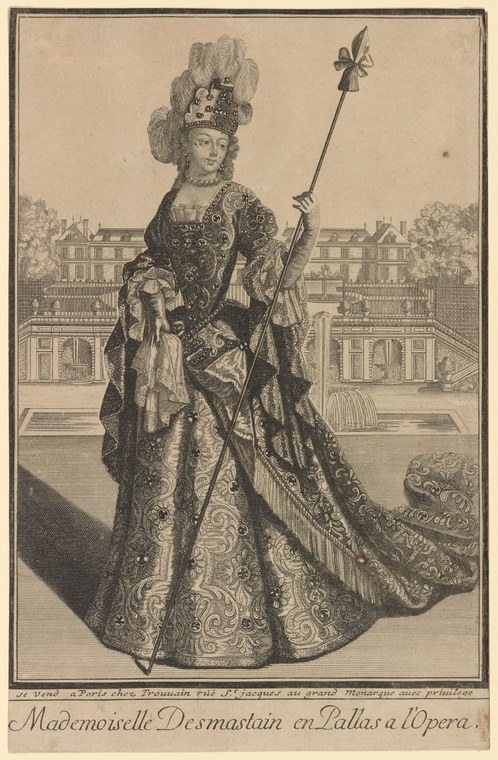
Mademoiselle Desmastain en Pallas a l'Opera
Unknown artist
- Collection:
- Prints depicting dance
- Source:
- New York Public Library
- Rights:
- Public domain — free to use, share and adapt.
- Recorded as:
- Public Domain
This engraving is vital evidence of court ballet as theater and as a document itself—how performance was commemorated, circulated, and understood in late 18th-century France. For historians of dance, it shows the moment when court dancing began to be fixed and celebrated through printed imagery, marking the transition from ephemeral court ritual to recorded theatrical spectacle.
What you are looking at
A woman in elaborate 18th-century court dress stands in a grand formal pose against a palatial backdrop of the Palais de l'Opéra. She wears an ornate embroidered gown with a dramatically long train, a high Baroque coiffure topped with feathers and jeweled ornaments, and holds a decorative staff or scepter topped with a fleur-de-lis. Her posture is ceremonial and statuesque, with one leg extended in a graceful line, suggesting the beginning or stylized moment of a theatrical entrance or formal court procession rather than active choreographed movement. The background shows the façade of a grand baroque palace with formal gardens, establishing the setting as the French court. The engraving's fine line-work and formal composition suggest a commemorative print documenting a specific performer or court event.
The dancing
A single figure dominates the composition. Her weight appears to rest primarily on one leg while the other extends gracefully forward in a pose suggesting either a reverence or the opening position of a formal court dance. Her upper body is held in an upright, dignified frame, with one arm raised to hold the staff and the other positioned at her side. The gesture is controlled and ceremonial rather than dynamically energetic—this is the pose of a performer presenting herself to court society, not mid-phrase in a traveling movement.
The dance depicted
This appears to document a court ballet or pageant performance, most likely from the late 18th century. The subject, Mademoiselle Desmastain, is shown costumed as Pallas (Athena), indicating this was part of an allegorical or mythological court spectacle. The pose and presentation suggest the formal opening or presentation moment of a theatrical dance, typical of court ballet conventions where a soloist would stand in classical contrapposto alignment before beginning her choreography. The staff she holds—a property rather than a dance implement—marks this as theatrical spectacle rather than social dancing.
How it was made
This is an engraving, likely a fine-line or copperplate engraving given the delicate parallel hatching visible in the fabric textures and the precise architectural detail of the palace. The formal technique and high quality of execution indicate this was a commemorative print of some circulation, likely produced for a French court audience or theater-going public. Such engravings documenting court performers and spectacles were typical products of 18th-century Paris and would have been relatively widely distributed among the aristocracy and theater enthusiasts.
About this work
This commemorative engraving documents a late 18th-century court ballet performance at the Palais de l'Opéra in Paris, featuring Mademoiselle Desmastain in the allegorical role of Pallas Athena. It captures the formal presentation moment of a theatrical spectacle that blended court ceremony with theatrical dance—the performer posed in classical contrapposto with properties, costume, and palatial setting all designed to invoke mythological authority and aristocratic refinement. The image is a record of how court ballet was documented and circulated: not as a sequence of movement but as a moment of theatrical presentation, freezing the performer in a pose that conveyed both classical allusion and the glamour of court society.
How to look at it
Attend to the pose itself: the extended leg, the upright carriage, and the controlled arm position are all conventions of court dance formality translated into theatrical spectacle. Note how the artist has chosen not a moment of dynamic movement but a moment of presentation—the performer facing the viewer, her body in classical alignment, ready to perform but not yet in motion. This freeze-frame at the threshold of performance was a standard convention of theatrical portraiture, allowing the viewer to admire both the performer's grace and the magnificence of her costume and setting. The staff she holds is not a dance implement but a symbol of Pallas's authority, marking this as allegorical theater where costume and property are as important as movement.
The artist
The artist is not recorded in the catalogue. The engraving's style and subject suggest it was produced by a Parisian printmaker working in the mid-to-late 18th century, likely someone specializing in court and theatrical subjects for aristocratic and theater-going audiences. The quality and formality of the work indicate a professional atelier practice rather than an amateur effort.
The period
The late 18th century was a period of transition for court ballet. While the formal court ballet as a participatory aristocratic activity was in decline, theatrical ballet was flourishing at the Opéra and other venues. Performers like Desmastain were celebrated as solo virtuosos, and their roles in allegorical spectacles continued the tradition of court pageantry but now as professional theater. The Palais de l'Opéra (present-day Opéra Garnier was not built until the 1860s, so this likely refers to the Palais-Royal or an earlier Opéra location) was the center of theatrical dance in Paris. Engraved portraits of performers were standard marketing and commemorative tools, circulating among the nobility and theater patrons.
Where it lives
The print is held in the Prints collection of the New York Public Library, catalogued under prints depicting dance. No information on artist, date of creation, or printing history is recorded in the catalogue entry.
Dance in this work
Questions about this work
Was Mademoiselle Desmastain a real historical dancer?
The inscription identifies her by name, suggesting she was a known performer at the Palais de l'Opéra. However, little biographical information about her survives in standard historical records. The fact that she merited a commemorative engraving indicates she was celebrated enough to warrant documentation and circulation among the Paris theater audience, but details of her career and repertory are not available through this image alone.
What is Pallas? Why would she be portrayed as a dancer?
Pallas Athena, the Greek goddess of wisdom, was a standard character in 18th-century allegorical court ballet and theater spectacle. Allegorical pageants using classical mythology were a way for the court and theater to celebrate power, virtue, and cultural refinement. A solo role as Pallas would have been a prestigious, virtuosic part for a leading performer.
Is this showing an actual dance move?
This is more a formal presentation pose than a captured moment of active dance. The extended leg and upright posture suggest the opening position or a formal court bow rather than a movement in progress. The engraver has chosen to show the performer in her most dignified and classical pose, which was the convention for commemorating theatrical dancers of this period.
What can we learn about how people danced in the 18th century from this image?
The pose reflects the formal, upright carriage and classical alignment valued in court and theatrical dance of the period. The absence of any dynamic action and the emphasis on costume and setting suggest that 18th-century court spectacles prioritized visual splendor, allegorical meaning, and the performer's authority and grace over virtuosic or rapid movement. The engraving itself—formal, commemorative, and widely distributed—tells us that dancers were celebrities and that their images were valued commodities among the urban aristocracy and theater patrons.
More dance artwork





