49 works in this view — arrow keys or swipe to move between them.
Dance in Art
Psyché
Unknown artist
- Collection:
- Prints depicting dance
- Source:
- New York Public Library
- Rights:
- Public domain — free to use, share and adapt.
- Recorded as:
- Public Domain
This image documents the role of formalized dance procession in Renaissance court theatre, a genre fundamental to the development of ballet. It shows how dance was integrated with myth, music, and visual spectacle to create a total artwork—a principle that would shape European court culture for two centuries. For anyone tracing the roots of theatrical dance or the allegorical use of women's bodies in performance, this work is primary evidence.
What you are looking at
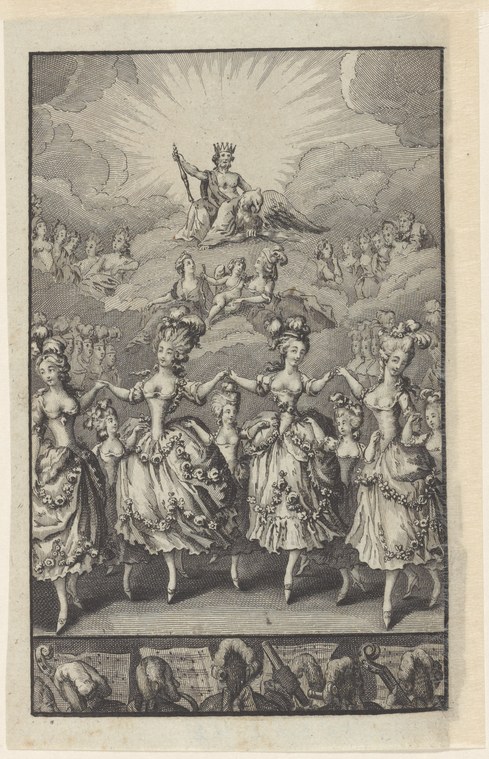
A hierarchical vision of the Psyche myth unfolds across three distinct registers. In the celestial realm above, a crowned and haloed female figure (Psyche) sits enthroned among clouds, attended by winged putti and bathed in divine light radiating from behind her. Below, in the middle register, a processional line of elegantly dressed women advances across a stage-like platform, their bodies inclined forward in synchronized movement, their elaborate gowns with full skirts and ornate details creating a unified visual rhythm. The foreground shows a dense crowd of onlookers—both men and women in period dress—witnessing the spectacle from below. A smaller frieze of figures occupies the bottom margin, possibly indicating another scene or continuation of the narrative. The composition uses deep cross-hatching and tonal gradation typical of Northern European printmaking to create spatial recession and drama.
The dancing
The dancing women in the middle register move in a coordinated line, their bodies leaning forward at a marked angle from the vertical, arms generally held at their sides or in modest gestures. Their weight appears shifted onto their front feet, suggesting forward momentum and purposive procession rather than static display. The unified inclination of their torsos and the regularity of their spacing indicate a formal, choreographed formation—neither free nor chaotic, but ordered according to a pattern. The crowd figures are more varied in gesture: some stand upright and observe, others gesture or turn toward the action, creating a sense of gathered attention.
The dance depicted
This appears to document a Renaissance court spectacle or pageant—specifically an allegorical procession honoring Psyche, the mythological figure of the soul. The format and style suggest a Florentine intermedio or similar theatrical event from the 16th century, where mythological narratives were performed through coordinated movement, music, and visual splendor. The dancers move in a formal processional formation characteristic of court dance of this period—stately, hierarchical, and symbolic rather than acrobatic. The crowned figure above suggests the triumph or deification of Psyche, while the procession enacts her apotheosis or honors her status. Without inscription or additional documentation, the specific event cannot be named, but the visual language is unmistakably that of Renaissance court theatre.
How it was made
This is an engraving or possibly an etching, executed with fine cross-hatched lines to create tonal depth and atmospheric perspective. The technique allows for intricate detail in costume and setting while maintaining legibility at a distance—essential for a print circulating among educated courtiers and scholars. The regular hatching and careful composition suggest a professional workshop production, not an amateur effort. As a print, this work was reproducible and portable, likely distributed to document an ephemeral performance or to advertise the magnificence of a court and its artistic ambitions.
About this work
This engraving records or imagines a moment from a Renaissance court spectacle celebrating the mythological figure of Psyche. The work combines heavenly vision (the apotheosis of Psyche in the upper register) with earthly performance (an ordered processional dance of courtly ladies), bridging the allegorical and the actual. It testifies to the centrality of choreographed movement in Renaissance court culture, where dance was inseparable from narrative, spectacle, music, and visual magnificence. The print format allowed such ephemeral performances to outlive their single occasion and to circulate as records of courtly refinement and artistic innovation.
How to look at it
Note the rigorous alignment of the dancing women—their bodies form a nearly perfect diagonal line across the composition, creating visual unity and emphasizing the processional rather than individual nature of their movement. Observe the forward inclination of their torsos: this is not the upright carriage of later classical ballet but the courtly bow or forward presentation of the body in deference. The crowd surrounding them is essential—the dance exists as a spectacle for witnesses, not as pure movement, and the print captures both the movement and the social frame that gave it meaning. The heavenly vision above connects the earthly performance to the myth it enacts, a visual conceit that was central to Renaissance thinking about court spectacle.
The period
This engraving likely dates to the late 16th or early 17th century, when Italian and Northern European courts were at their height of investment in intermedi, ballets, and court spectacles. The Renaissance revival of classical mythology created demand for performances that dramatized ancient narratives. Dance was not yet a freestanding art form but was always embedded in larger spectacles that combined poetry, music, scenery, and pantomime. The refinement of court dance technique—the turn-out, the lifted carriage, the formalized positions—was just beginning to be codified during this period, and performances like the one depicted here were laboratories for that development.
Where it lives
This work is held in the Prints collection at the New York Public Library, part of their holdings of historical dance imagery. As a print in institutional collection, it is part of a much larger body of ephemeral documentation that recorded or commemorated court performances.
Dance in this work
Questions about this work
Is this a real dance or an invented one?
It almost certainly documents a real event—a court spectacle or intermedio performed at an Italian or Northern European court. However, the engraving may have been created sometime after the performance, or it may be a design for a planned event. The print format suggests it was meant to circulate as a record, which was common practice for important court performances.
What makes this Renaissance and not medieval or baroque?
The classical subject matter (Psyche from Ovid), the humanist interest in reviving ancient narrative, and the particular style of court costume and spectacle are all unmistakably Renaissance. The later 16th century saw the flowering of the intermedio genre in Italy, which combined these elements. The composition and engraving technique also suggest the period of around 1560–1610.
Why are all the dancers women?
In Renaissance court spectacles, allegorical and mythological female figures were typically performed by noble women and professional entertainers, often as a display of courtly grace and virtue. Male dancers appeared in other roles (as gods, warriors, or attendants). This gendering of roles was conventional to the genre.
What is the connection between this and later ballet?
These court spectacles were direct precursors to ballet. The formalized positions, the integration with music and narrative, the elevation of dance as an art requiring training, and the theatrical frame all emerged from intermedi and court ballets like this one. By the early 17th century, dance was beginning to be taught and codified as a technical discipline.
More dance artwork





