49 works in this view — arrow keys or swipe to move between them.
Dance in Art
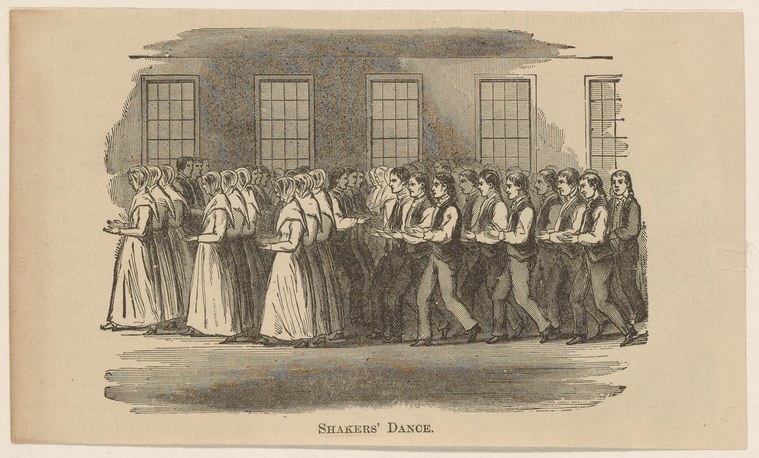
Shakers' dance
Unknown artist
- Medium:
- Source:
- New York Public Library
- Rights:
- Public domain — free to use, share and adapt.
- Recorded as:
- public_domain
The image documents an important American devotional practice that influenced later artists and continues to shape understanding of the relationship between religious movement and dance. For historians of American movement culture, it is evidence of how non-theatrical, ecstatic forms of physical practice were observed, recorded, and circulated through mass media in the 19th century.
What you are looking at
An engraved scene depicting a Shaker worship gathering in a large room with tall windows. A line of roughly twenty figures extends across the composition—women on the left in simple white or pale dresses and caps, men on the right in dark coats and trousers. The figures stand in a single file or loose formation, many with arms raised or extended in characteristic gestures. The architectural setting is spare and institutional: plain walls, a row of tall rectangular windows with gridded panes, suggesting a meetinghouse or chapel. The light falls flatly across the scene. The engraver has rendered the figures with careful attention to their individual postures and the particular quality of Shaker devotional movement—the upright but animated bearing, the trembling gesture, the structured informality of the line.
The dancing
The bodies are not in partnered contact but rather in vertical alignment within a single line. Many figures show raised or trembling arms, a characteristic feature of Shaker ecstatic worship. The postures are energetic but controlled, with shoulders and torsos engaged; the figures lean or sway rather than turn. The women's bodies are shrouded in long simple dresses with caps, while the men wear tailored coats. The composition suggests a rhythm and simultaneity to the movement—the impression of collective trembling or shaking rather than individual solo gesture.
The dance depicted
This depicts the shaking or trembling movements central to Shaker worship and religious practice. The Shakers (the United Society of Believers) were known from the 18th century onward for their ecstatic physical expression during worship, which included trembling, jerking, spinning, and rhythmic movement, understood as signs of divine possession and spiritual cleansing rather than choreographed dance. This print shows the formal, ceremonial setting of such worship—likely a gathering in a meetinghouse. The movement was devotional and collective, not theatrical, though 19th-century observers and artists often depicted it with the compositional tools of secular dance imagery, lending it the appearance of organized spectacle.
How it was made
This is an engraving, likely a wood or steel engraving based on the crisp line work, fine cross-hatching for tonal modeling, and the uniform black ink on cream paper. The technique allowed for wide reproduction and distribution; engravings of Shaker worship were popular in 19th-century illustrated newspapers, magazines, and books aimed at a curious public audience. The precision of the medium—the clean architectural rendering, the careful delineation of each figure—contrasts with the wild or ecstatic subject matter, creating an effect of respectful documentation or detached observation, characteristic of journalistic imagery of the period.
About this work
This is a 19th-century engraving documenting a Shaker worship service, showing the distinctive trembling and ecstatic movement that defined the sect's religious practice. The image preserves not a dance in the theatrical sense but a form of devotional embodied prayer that was widely observed, often skeptically, by the outside world. It belongs in a dance archive because Shaker movement—though sacred in origin and intention—established itself in American visual culture as a recognizable physical phenomenon, discussed and depicted alongside secular dance forms, and because the trembling and rhythmic group movement it depicts are forms of patterned, intentional, collective bodily expression.
How to look at it
Observe how the engraver has arranged the figures in a single line moving from left to right across the picture plane, creating the impression of a procession or collective moment rather than individual expression. Notice the raised arms and forward-leaning postures, which convey energy and tremor. The spare architectural setting—the plain walls and regular windows—emphasizes the orderliness of the space and creates a contrast with the animated, ecstatic movement of the bodies. The technique of fine parallel lines (cross-hatching) in the background and clothing gives the scene a sense of vibration or shimmer, subtly reinforcing the visual idea of trembling.
The period
This engraving dates to the 19th century, when Shakerism was still an active and growing movement (though now in decline from its 18th-century peak). The sect's ecstatic worship—particularly the shaking and trembling from which they took their name—had long fascinated outsiders. By the time this image was made, Shaker communities had developed more formalized and orderly worship practices, yet their movement remained visually distinctive and was frequently depicted in illustrated periodicals and books. The image reflects both genuine documentation and the 19th-century appetite for imagery of religious otherness and spectacular piety.
Where it lives
The engraving is held by the New York Public Library. It is a mass-produced print, likely from a 19th-century illustrated periodical or a book documenting American religious sects, reflecting the popular appetite for imagery of Shaker worship among general readers.
Dance in this work
Questions about this work
Is Shaker movement considered dance?
Not by the Shakers themselves, who understood their trembling, shaking, and rhythmic movement as religious expression and signs of divine presence, not as performance or art. However, historians of dance and movement culture include Shaker worship in the study of embodied practice, recognizing that structured, intentional, rhythmic collective movement constitutes a form of movement expression whether or not it is labeled or intended as dance.
What is the 'shaking' in Shaker worship?
The trembling, jerking, or vibrating movements understood by believers as signs of spiritual possession or divine inspiration. They were not learned or choreographed but were encouraged as authentic expressions of religious fervor. Over time, as Shaker communities became more established, some formalization of movement developed, but the practice remained grounded in spontaneity and conviction rather than technique.
Why would this be recorded in an engraving?
Shaker communities were objects of intense curiosity to the outside world in the 19th century. Illustrated newspapers and books regularly featured imagery of their worship, architecture, and communal life. This engraving is part of that documentary tradition, offering outsiders a glimpse of a distinctive and somewhat mysterious American religious practice.
More dance artwork