49 works in this view — arrow keys or swipe to move between them.
Dance in Art
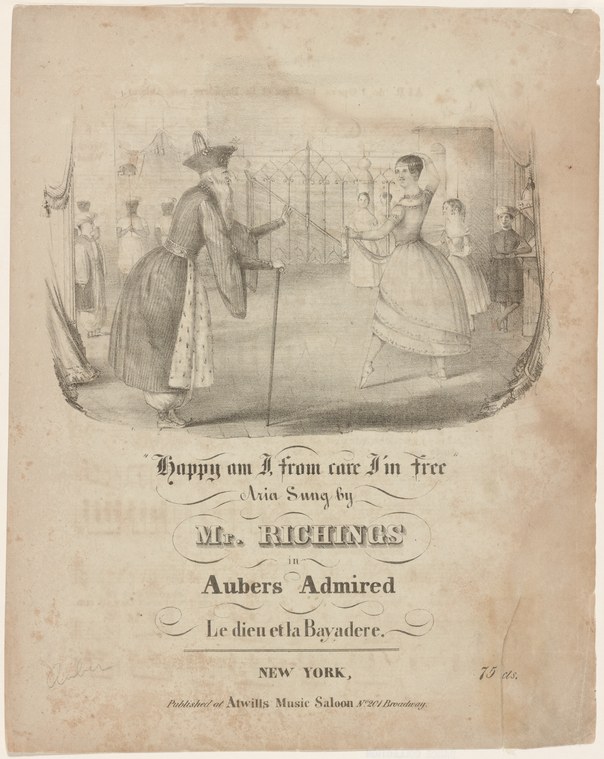
Le dieu et la Bayadère: Aria sung by Mr. Richings
Unknown artist
- Collection:
- Prints depicting dance
- Source:
- New York Public Library
- Rights:
- Public domain — free to use, share and adapt.
- Recorded as:
- Public Domain
This image reveals how Western theatrical dance absorbed and repackaged non-European dance traditions in the early 19th century: the bayadère was a real South Asian performing tradition, but here she appears in European ballroom costume and operatic staging, her movement and role entirely reconceived for European audiences. The inscription—crediting a male singer, Mr. Richings, as the featured performer in an aria, despite the bayadère being the nominal title character—shows how women's performance, even when central to narrative, could be subordinated to male vocal virtuosity in mixed theatrical forms.
What you are looking at
A theatrical scene set in what appears to be an ornate interior, possibly a palace or temple, with decorative architectural elements including balustrades and draped curtains framing the composition. Two principal figures dominate the center: a woman in elaborate dress facing a man in flowing robes and a distinctive tall headdress. The woman wears a pale, high-waisted gown with detailed skirts and appears to be in a moment of animated gesture or appeal. The man stands with one arm extended toward her in a commanding posture. Several other figures populate the background—attendants or chorus members—some standing, others seated, suggesting this is a formal dramatic moment rather than a social dance. The scene is rendered in fine detail with careful attention to fabric, shadow, and spatial recession, suggesting a moment of high dramatic tension.
The dancing
The two central figures are arranged in a formal, theatrical relationship rather than a partnered dance hold. The woman's body is turned three-quarter toward the man, her arms gesturing expressively—one raised, one lower—in a posture suggesting supplication or emotional appeal. The man stands more rigidly, his raised arm creating a diagonal line across the composition. Neither figure displays the closed or open dance holds characteristic of European ballroom or social dance; instead their positioning suggests pantomimic or operatic gesture. The background figures are dispersed and static, framing the action rather than participating in it.
The dance depicted
This is a scene from *Le dieu et la Bayadère* (The God and the Bayadère), a narrative work combining dance, pantomime, and theatrical spectacle. The bayadère—a temple dancer from South Asian tradition—is depicted in a moment of dramatic confrontation with a deity, likely a key narrative turning point. The image represents theatrical dance as it existed in early 19th-century Western opera and ballet: a fusion of classical European movement vocabulary with exotic staging and costume. The aria sung by Mr. Richings suggests this is documentation of a specific stage production, probably British, in which professional singers and dancers performed interrelated roles.
How it was made
This is an engraving, evidently a theatrical keepsake or score illustration—the kind of commercial print published to capitalize on successful stage productions and sold separately. The fine linear detail and careful modeling of light and shadow are characteristic of steel or copper engraving of the 1820s–1840s. The dedication to Atwills Music Saloon in New York indicates this was produced for a commercial American market, likely after a successful run; such prints were inexpensive enough to reach middle-class households and served as mementos of performances or as illustrations for sheet music of popular theatrical songs.
About this work
This engraving documents a moment from *Le dieu et la Bayadère*, a work that blended Romantic theatrical conventions with fantasies of exotic, Oriental dance. The scene captures the aesthetic of early 19th-century theatrical spectacle: elaborate costuming, architectural staging, and the tension between a professional female performer and a powerful male authority figure. The bayadère—a South Asian temple dancer transposed into European theatrical convention—was a stock character type in Romantic opera and ballet, embodying both eroticism and pathos. The work belongs to the period when European theaters were hungry for non-Western dance content, albeit filtered entirely through European formal vocabulary and dramatic expectations.
How to look at it
The artist has frozen a moment of dramatic confrontation, not actual dance movement. Notice the theatrical framing—the architectural frame-within-a-frame created by the balustrades and drapery—which emphasizes the artificiality of the scene and its presentation as spectacle rather than reality. The two central figures are placed on a shallow, tilted stage plane, a convention of theatrical prints that exaggerates their prominence. Look at the woman's face and gestures: they convey emotional intensity through pantomime and operatic expressiveness rather than dance technique. The background figures are barely individuated, serving as atmospheric witnesses rather than performers.
The artist
The artist is not recorded. The engraving was published by Atwills Music Saloon at 347 Broadway, New York, suggesting it was produced by a commercial print shop serving the theatrical and music market. The notation "75 cts" indicates a modest retail price. Such prints were typically unsigned or credited only to the publisher; the engraver's identity and the original designer of the theatrical production both remain unknown.
The period
The 1820s–1840s were the height of European Orientalism in the arts, including dance. Works like *La Bayadère* (the most famous version choreographed by Jean-Auguste-Dominique by 1830s and later by Marius Petipa) capitalized on Western fascination with Asia, Egypt, and the Middle East. The bayadère—a real tradition of South Asian temple dancers—became a stock character in Romantic ballet and opera, typically portrayed as erotic, tragic, and ultimately doomed. This theatrical production appears to predate or coincide with the most famous ballet adaptations, suggesting the story circulated across performance genres (opera, musical theater, ballet) in the 1820s and reached American audiences quickly through both live performance and prints like this one.
Where it lives
Held in the New York Public Library's print collection on the subject of dance iconography. This is a commercial theatrical keepsake or souvenir print, one of many produced in the early 19th century to publicize and commemorate successful stage productions in America.
Dance in this work
Questions about this work
What is a bayadère and why does she appear in a European opera?
A bayadère is a South Asian temple dancer, a real profession in India. European artists of the Romantic period became fascinated with Asia and created fictional versions of bayadères for the stage, typically portraying them as exotic, erotic, and tragic. These characters bore little resemblance to actual bayadère performance but became stock figures in opera and ballet, appealing to audiences' curiosity about non-European cultures.
Why is a male singer featured in an aria if this is about the bayadère?
In early 19th-century mixed theatrical forms—opera, musical theater, ballet with sung interludes—male performers, especially singers, often held principal billing and longest roles despite female dancers or characters being the nominal focus. This reflects the market value placed on virtuoso male singers and the subordinate status of female performers, even in starring roles.
How was this print made and why should I care how?
This is an engraving, made by hand-incising metal with fine lines, then inking and printing. The detail and labor required made each print valuable; it was not cheap to produce. That it was published and retailed suggests genuine commercial success and public hunger for this story. The print reached people who had not seen the live performance, spreading the work's narrative and imagery across America.
Is this a good representation of actual dance?
No. The figures are posed in theatrical gesture and pantomime, not in recognizable dance holds or technique. The bayadère's body position is expressive and dramatic, but it does not show us how an actual bayadère moved, or how the character danced on stage. This is a narrative illustration, not a technical document of dance.
More dance artwork





