49 works in this view — arrow keys or swipe to move between them.
Dance in Art
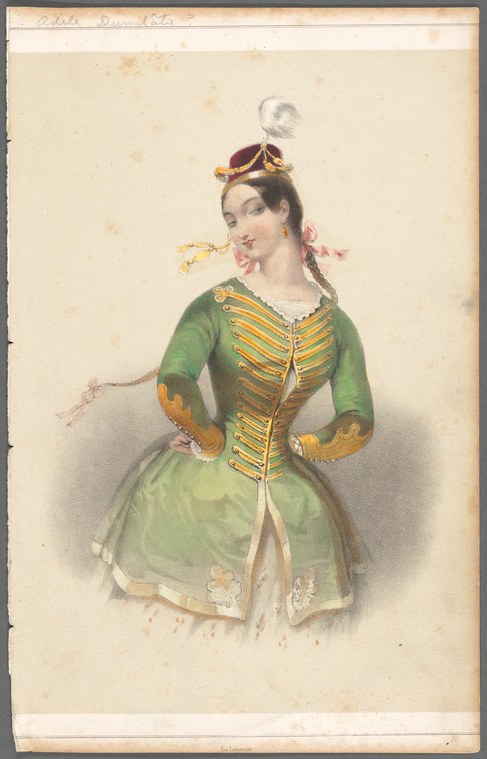
Woman in green military-style jacket and red shako with white feather, her arms akimbo
Unknown artist
- Collection:
- Prints depicting dance
- Source:
- New York Public Library
- Rights:
- Public domain — free to use, share and adapt.
- Recorded as:
- Public Domain
This print is a rare survival of how 19th-century theatrical performers and their characters were marketed to audiences through printed costume studies. For historians of stage dance and performance, it documents the visual codes—the pose, the military dress, the open stance—that signaled character type and comedic intention on the popular stage. The work shows that dance history includes not only ballet and ballroom but also the vernacular, commercial, theatrical world where most people encountered moving bodies.
What you are looking at
A single female figure occupies the composition against a plain cream background. She wears a striking green military-style jacket with gold frogging (decorative cord fastenings) down the front and matching gold-trimmed cuffs, worn over a pale skirt with white hem detail. A red shako (military cap) sits jauntily on her head, decorated with a white feather that curves upward. Her dark hair is arranged in braids pinned up at the back. She stands in a three-quarter view with arms akimbo—elbows bent and hands placed on her hips—in an attitude of confident, almost flirtatious ease. Her expression is animated and cheerful, with a hint of a smile. The figure casts a soft shadow to the left, suggesting warm overhead lighting. The hand-colored technique shows careful attention to the gold detailing and subtle shading of the fabrics, particularly in the folds of the skirt and the modeling of her face.
The dancing
The dancer's posture is upright and spirited, with the weight distributed evenly on both legs in a relaxed stance. The arms are held away from the body at the elbows in a characteristically theatrical or music-hall attitude—a pose associated with coquettish display rather than formal ballroom technique. The overall frame is open and outward-facing, designed to present the figure to the viewer. There is no evidence of a partner or closed hold; this is a solo figure study.
The dance depicted
This appears to be a character from a theatrical or operatic performance, most likely from a 19th-century military or patriotic work, possibly a vaudeville or music-hall number. The military dress and the spirited, flirtatious pose suggest a 'soubrette' or comic female character—stock theatrical types who performed vivacious solo turns or couplets. The costume is too theatrical and specific to depict social ballroom dancing; the green jacket and shako are costume rather than street wear. Without additional context or inscription, the specific work cannot be identified, but the figure's animated demeanor and confident stance suggest she is performing a light, comedic number to entertain the audience rather than participating in a formal social dance.
How it was made
This is a hand-colored lithographic or engraved print, based on the delicate line work and the precise registration of the colored inks. The technique—combining line rendering with selective hand-coloring—was characteristic of mid-19th-century theatrical portraiture and costume studies. This method allowed rapid, affordable distribution of images of celebrated performers and popular characters to audiences, making it a key medium for documenting stage fashion and performance. The quality of the print and the professionalism of the hand-coloring suggest this was a commercial publication for a mass market rather than a unique artwork.
About this work
This is a theatrical character print documenting a stage costume and performance persona from the 19th century. The figure's military dress, jaunty attitude, and solitary presentation mark her as a stock character—likely a soubrette or vivandière type—from a popular comic opera or music-hall performance. The hand-colored print format confirms this was a commodity: promotional material or souvenir circulated to theatergoing public to commemorate the character and (probably) the famous performer who played her. The work belongs in a dance archive not because it depicts ballroom or concert dance technique, but because it documents how character dancing and theatrical movement were visualized, commodified, and consumed in the 19th century, and because such prints are primary evidence for the material culture of stage performance.
How to look at it
Observe the deliberate openness of the pose: the elbows-out stance with hands on hips is not a position of repose but of display and address—the figure is speaking or performing toward you. Notice how the costume draws attention to the figure's silhouette and the interplay of colors: the bold green and gold military jacket contrasts with the pale skirt, and the red shako punctuates the composition. The animated expression and the slightly cocked head are equally important to the stance; this is a portrait of performance personality, not just costume. The print is meant to be read as a momento of a specific performer and character, a way of 'keeping' the experience of seeing her on stage.
The period
This print dates stylistically to the 1840s–1860s, a period of explosive growth in popular theatrical entertainment and the mass production of theatrical imagery. The military costume and burlesque character reflect the European vogue for comic opera and music-hall performance in this era—genres like opéra bouffe and vaudeville that blended singing, dancing, and comic business. The soubrette character, of which this appears to be an example, was a stock figure in these productions: a young, witty, flirtatious female character who performed solo turns and displayed both costume and personality to the audience. The vivandière (a female military camp follower or sutler) was a particularly popular costume for such characters, allowing for patriotic and martial comedy. The hand-colored print was the primary medium for circulating images of celebrated performers and roles to a mass audience hungry for theatrical novelty.
Where it lives
This print is part of the New York Public Library's collection of prints depicting dance. The collection includes theatrical imagery, costume studies, and performance documentation from the 17th to 20th centuries, serving as a visual archive of how dance and performance were represented and consumed across different media and periods.
Dance in this work
Questions about this work
Is this ballet?
No. This is a theatrical character print documenting a stage costume and solo performance number, likely from a 19th-century comic opera or music-hall production. The military dress, open stance, and animated demeanor are characteristic of character dancing and vaudeville performance rather than classical or romantic ballet technique.
Who is the performer?
The artist is unknown, and the catalogue record does not identify the performer or the specific work. The costume and character type (a military-dressed soubrette or vivandière) were stock figures in 19th-century popular theater, so without additional inscription or provenance, it is not possible to name the actress or the production.
What is the vivandière?
A vivandière was historically a woman who followed an army to sell provisions and supplies to soldiers. In 19th-century theater, the costume and character became a popular comedic or burlesque figure, often performed by female actors in military dress as a vehicle for witty banter and performance. The character allowed for patriotic humor, cross-dressing play, and flirtation—all staples of comic opera and music-hall entertainment.
Why does this belong in a dance collection?
Theatrical character prints like this one document the visual culture of stage performance and dance in the 19th century. They show how bodies were posed, dressed, and presented to audiences; how character was conveyed through costume and stance; and how performance and persona were commodified and circulated. For dance historians, they are primary sources for understanding theatrical movement and the popular performance genres that employed dance and dancing bodies.
More dance artwork





