49 works in this view — arrow keys or swipe to move between them.
Dance in Art
Monsieur Balon
Unknown artist
- Collection:
- Prints depicting dance
- Source:
- New York Public Library
- Rights:
- Public domain — free to use, share and adapt.
- Recorded as:
- Public Domain
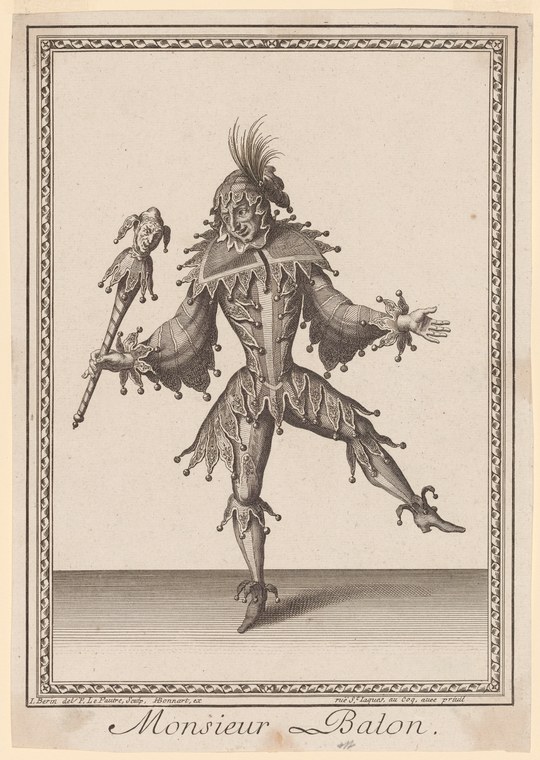
Balon was foundational to ballet history; the bounce and buoyancy that defines classical technique is named for him. This engraving is one of few surviving visual records of an actual performer from the court ballet era, showing the costume, elevation, and aesthetic of baroque theatrical dance at its height. For any study of how ballet developed its technical vocabulary and physical ideal, this image is primary source material.
What you are looking at
A single figure strikes a dramatic pose against a plain ground, framed by an ornamental border typical of seventeenth-century prints. The dancer wears an elaborate costume of segmented, pleated construction—the upper body appears armored or corseted with pointed flaps radiating outward, while the lower limbs are covered in similar articulated segments that hang in strips or fins. A tall feathered plume crowns the figure's head. The dancer is caught mid-leap or mid-gesture, with limbs splayed dynamically: one leg extended forward at height, the other bent beneath; arms spread wide, one holding what appears to be a small figure or prop, the other gesturing outward. The pose conveys exuberance and theatrical artifice—this is a performer in full costume, not a naturalistic representation of the body. The title beneath reads "Monsieur Balon" in an elegant hand.
The dancing
A single dancer is shown in a balletic, elevated pose with the body weight seemingly transferred to one supporting leg (though both feet appear to leave the ground). The arms are thrown open in a gesture of expansiveness and showmanship. The limbs are long and attenuated, suggesting a lean, trained physique. The segmented, pleated costume obscures the precise articulation of the joints, but the overall frame is one of lightness and ascension—the figure appears to be jumping or rising. The posture and arm placement suggest a performative, theatrical manner rather than social dance.
The dance depicted
This is almost certainly Jean-Baptiste Balon (or Ballon), the legendary French dancer of the late seventeenth century, known for his exceptional lightness and elevation—the quality of "ballon," a term now central to ballet vocabulary, is said to derive from his name. The segmented, wing-like costume reflects the theatrical dress of court ballet and early professional dance spectacles of the period, where allegorical and fantastical characters were performed. The exaggerated leap and the decorative costume suggest a scene from a court ballet or early opera-ballet, forms in which Balon was celebrated. The image shows a dancer in the height of technical virtuosity: the floating elevation, the expansive arm gesture, and the theatrical costume all point to aristocratic performance practice of the 1670s–1680s.
How it was made
This is an engraving, as evidenced by the fine parallel hatching lines used to create shadow and texture, the clean linear definition of forms, and the ornamental frame border rendered in line work. The technique allows precise reproduction of the figure's elaborate costume and the dynamic pose, and suggests this was a print made for circulation among the educated public and court circles—engravings were the primary medium for disseminating images of celebrated performers and dances in the seventeenth century. The quality of the line work and the attention to costume detail suggest this was a professional, high-status production, likely made after a drawing or painting.
About this work
Monsieur Balon depicts the celebrated French dancer Jean-Baptiste Balon in mid-leap, caught in a moment of spectacular elevation characteristic of court ballet performance. The engraving records the costume and physique of one of the most influential dance figures of the late baroque period, a performer whose technical mastery gave his name to the essential quality of "ballon"—the appearance of weightlessness and suspension in the air. The segmented, pleated costume and feathered headdress place the image firmly in the world of allegorical court entertainment, where spectacular athletic feats and exotic costumes were combined for aristocratic audiences.
As a historical document, this print preserves a precise record of how an elite performer moved and dressed in an era before photography or notation could capture performance. The engraver has frozen a moment of virtuosic display—the high jump, the open arms, the theatrical presence—that would have been the signature of Balon's style. For dancers and historians, the image is evidence of the technical demands and aesthetic values of late seventeenth-century French dance.
How to look at it
Attend to the precise moment the engraver chose: not a moment of repose, but the apex of a leap, when the dancer is fully suspended in the air. This choice emphasizes the quality Balon was famous for—the illusion of effortlessness and weightlessness. The expansive arm gesture and the open posture convey theatrical display and confidence. The costume, while fantastical, is rendered with anatomical clarity beneath; the engraver took pains to show how the segmented garment sits on a real, trained body. The ornamental frame dignifies the image as a portrait of an important public figure, not merely a record of a dance step.
The artist
The artist is not recorded in the catalogue. The print is executed with professional competence and was clearly made for an educated audience familiar with court dance and courtly portraiture. The style and technique are consistent with Parisian engraving practice of the late seventeenth century. It is likely that the print was made as a record of a celebrated performer, possibly commissioned or sold as a memento or publicity image.
The period
The late seventeenth century was the era of court ballet's greatest elaboration in France under Louis XIV, who was himself a dancer and patron of the form. Balon was active during the transition from court ballet (where aristocrats danced) toward professional theatrical performance. The period saw increasing interest in recording and celebrating individual performers through print, and engravings of celebrated dancers were collected as luxury items. The baroque aesthetic of theatrical excess—the wild costume, the feathered headdress, the exaggerated pose—was at its height. Dance was increasingly seen as a virtuosic art worthy of technical discussion and admiration, and performers like Balon were treated as celebrities whose images were in demand.
Where it lives
This engraving is held by the New York Public Library in a collection of prints depicting dance. It is a loose print of the sort that circulated widely in Europe as a luxury item, likely acquired by collectors interested in courtly culture, theatrical spectacle, or the history of dance.
Dance in this work
Questions about this work
Who was Monsieur Balon and why is he important to ballet?
Jean-Baptiste Balon was a celebrated French dancer of the late 1600s, renowned for his extraordinary elevation and the illusion of weightlessness in the air. The ballet term "ballon"—the quality of appearing to float or bounce—is named after him, indicating his profound influence on how ballet technique developed. He represents a transitional moment in dance history, performing at court under Louis XIV and helping establish dance as a virtuosic art form worthy of professional performance and technical analysis.
What is the costume in this image, and what does it tell us about baroque dance?
The segmented, winged costume is typical of allegorical or fantastical roles in court ballet spectacles of the period. The exaggerated, theatrical nature of the dress reflects the baroque aesthetic of spectacle and display. Under the costume, the engraver has clearly defined the dancer's own body, showing he was lean and trained. The costume tells us that baroque theatrical dance was as much about visual extravagance and theatrical character as it was about athletic movement.
How was this image made, and what does that tell us about dance in the 1600s?
This is an engraving—a printmaking technique that allowed professional mass reproduction. The existence of this print shows that celebrated dancers were treated as public figures whose images were commercially valuable. Prints like this circulated among educated, aristocratic collectors across Europe, indicating that dance was not only a courtly entertainment but also an object of cultural prestige worthy of collection and study.
More dance artwork





