49 works in this view — arrow keys or swipe to move between them.
Dance in Art
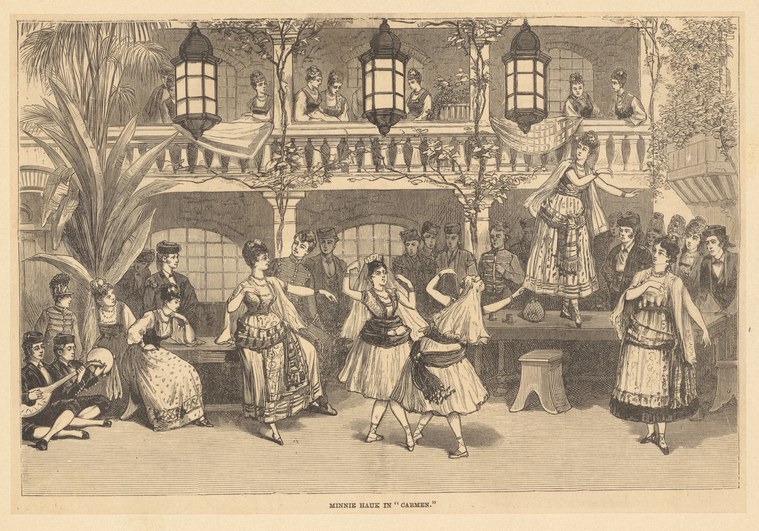
Minnie Hauk in "Carmen"
Unknown artist
- Collection:
- Prints depicting dance
- Source:
- New York Public Library
- Rights:
- Public domain — free to use, share and adapt.
- Recorded as:
- Public Domain
Minnie Hauk was a significant transatlantic performer whose career bridged opera and ballet; this image is among the few visual records of her in the role that made her famous. The print demonstrates how 19th-century theatrical engraving functioned as a system of celebrity documentation and mass circulation, bringing performance to audiences far beyond the opera house—an early form of theatrical publicity culture.
What you are looking at
A theatrical interior, likely a ballroom or opera house foyer, rendered in an engraving technique typical of late 19th-century theatrical illustration. The composition centers on a woman in mid-performance—her body arched backwards in an arabesque or penché position, one leg extended high behind her, dressed in a light classical tutu. She occupies the foreground center, immediately drawing the eye. The surrounding space is occupied by elegantly dressed spectators: women in bustle gowns and men in formal dress, seated and standing in clusters around the margins. Large hanging lanterns illuminate the scene from above. The architectural setting includes ornamental balustrading, decorated columns, and a sense of deep theatrical space receding into shadow. The figure labeled as Minnie Hauk commands the composition as the principal performer, while the crowd serves as an audience frame, creating a mise-en-scène that records a moment of theatrical acclaim rather than an abstract choreographic study.
The dancing
The central dancer displays the characteristic port de bras and body alignment of mid-19th-century classical dance: an extended arabesque with the supporting leg straight and the free leg lifted high, the torso in a controlled arch, arms positioned to balance the extreme line. The posture and positioning suggest training in the Romantic or early Classical ballet vocabulary. Surrounding figures are static and observational—seated women in profiled poses, standing men in conversation posture—none participating in the dance but all oriented toward the central figure. The spatial relationship emphasizes the solo performer and the passive spectatorial framework typical of theatrical performance documentation.
The dance depicted
This is a theatrical ballet scene, almost certainly depicting a moment from the opera-ballet *Carmen*, the 1875 work by Bizet. Minnie Hauk was an American mezzo-soprano who achieved fame in the title role; this print likely documents her performance in the ballet divertissement that forms act 3 of the opera. The pose shown—a high arabesque—was a signature move of virtuoso ballerinas of the period and would have been interpolated into the dance sequences within the operatic context. The image records not a complete choreographic work but a moment of display within a larger hybrid theatrical form.
How it was made
This is a wood engraving or steel engraving, a medium that dominated theatrical and operatic imagery in the 19th century and allowed for mass reproduction in newspapers and illustrated journals. The fine cross-hatching, precise linear articulation of fabric folds, and controlled tonal range are characteristic of engraving technique. The format and style indicate this was likely published in an illustrated weekly or theatrical journal—instruments of rapid circulation that brought performance imagery to a broad middle-class audience who could not attend the theater. The technique allows sharp delineation of costume and bodily position while emphasizing the theatrical moment over atmospheric naturalism.
About this work
This engraving documents a performance by Minnie Hauk in Bizet's *Carmen*, capturing a single virtuosic moment—an arabesque in the ballet sequences of the opera. It records not a distinct choreographic style but a theatrical moment within the hybrid form of 19th-century French grand opera. The work belongs in a dance archive as evidence of how ballet was embedded within operatic spectacle, how a virtuoso female dancer's body could dominate a theatrical frame, and how engraving technology distributed images of performance to a broad public. The image is valuable not as evidence of systematic choreographic vocabulary but as a document of how a particular performer—Hauk—was marketed and memorialized, and how the era understood the relationship between classical ballet and operatic drama.
How to look at it
Attend to the arabesque itself: the exact degree of the arabesque (higher arabesques were more difficult and more admired), the line of the supporting leg, the position of the arms. Note how the engraver has rendered the costume—the tutu, the corset, the pointe shoes—with precision, allowing a viewer to assess the technical apparatus of mid-19th-century ballet. Observe the spatial arrangement: the dancer is isolated by light and position, while the crowd creates a frame that acknowledges her as spectacle. The moment chosen is one of maximum extension and visibility—not a moment of transition or narrative action, but pure virtuosic display.
The artist
The artist is not recorded. The engraving technique and compositional style are consistent with the practices of theatrical illustrators working for major journals in the 1870s–1880s, a period when illustrated weeklies like the *Illustrated London News* and *L'Illustration* employed staff engravers to document major operatic and theatrical events. Such images were often produced from sketches made at live performance or from photographic documentation, then engraved and printed for rapid publication.
The period
This image dates to the height of French grand opera and the international star system of the 1870s–1880s. Ballet within opera was undergoing transformation: virtuosic displays of technique—arabesques, fouettés, rapid petit allégro—were increasingly foregrounded as evidence of a dancer's merit. Simultaneously, the engraving technology that produced this print was beginning to face competition from photographic reproduction, though engraving remained preferred for theatrical imagery because it allowed artistic control over narrative moment and emotional emphasis. Minnie Hauk's international fame exemplified the new operatic star system, in which a single performer could command the entire marketing and publicity apparatus of a production.
Where it lives
This print is held in the New York Public Library's collection of prints depicting dance, a curatorial category that emerged in the mid-20th century as institutions began to systematize theatrical and performance imagery as an archival domain distinct from fine art.
Dance in this work
Questions about this work
Who was Minnie Hauk?
Minnie Hauk (1851–1929) was an American mezzo-soprano and operatic star who achieved international fame in the 1870s–1880s. She was particularly celebrated for her interpretation of the title role in Bizet's *Carmen* after its Paris premiere in 1875, and performed the role extensively in London, Paris, and America. She was known for her dramatic presence and for integrating virtuosic ballet sequences into her operatic performances.
What is the connection between ballet and opera at this time?
Throughout the 19th century, ballet was integral to operatic spectacle, particularly in French grand opera. Acts typically included elaborate divertissements featuring virtuosic dancers, often interpolated without direct narrative connection to the plot. Star singers like Hauk frequently performed alongside or within ballet sequences, blending vocal and choreographic virtuosity. This hybrid form reflected operatic composers' ambition to create total theatrical works that combined all performance arts.
What is an arabesque and why is it shown here?
An arabesque is a classical ballet position in which one leg is extended behind the body while the dancer balances on the supporting leg. It was a signature move of virtuoso ballerinas because it demands balance, control, and the ability to lift one leg to an extreme height. The artist chose to depict Hauk at this exact moment because the arabesque is visually striking, technically difficult, and instantly recognizable as a mark of superior training—the kind of moment an illustrator would choose to commemorate a star performer.
How were theatrical images like this one distributed?
This engraving was likely published in an illustrated weekly journal or sold as a separate print. Engraving technology allowed for rapid, inexpensive reproduction and distribution compared to paintings or sculptures. Such prints were collected, framed, and displayed in homes—a major form of celebrity culture and theatrical publicity in the 19th century, bringing images of famous performers to audiences far beyond those who attended the theater.
More dance artwork





