49 works in this view — arrow keys or swipe to move between them.
Dance in Art
Melle Richard dans Trilby
Unknown artist
- Collection:
- Prints depicting dance
- Source:
- New York Public Library
- Rights:
- Public domain — free to use, share and adapt.
- Recorded as:
- Public Domain
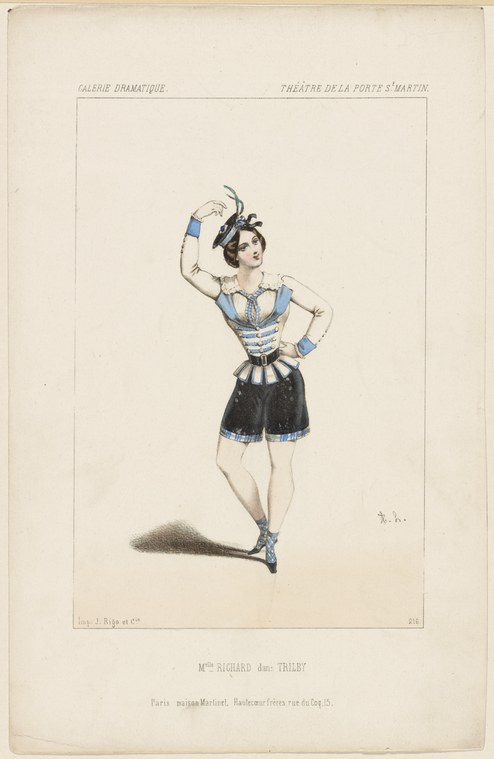
This print is evidence of how theatrical dance was performed, publicized, and consumed in the late 19th-century operetta house. It shows a professional female performer in a named role, not as a classical ballerina but as a character dancer in musical theatre—a category often overlooked in dance history. The hand-colored lithograph itself is a window into how performance was circulated and commodified through print culture.
What you are looking at
A single female dancer in theatrical costume stands against a plain cream background, captured in a moment of energetic performance. She wears a blue and white corset-style bodice with short puffed sleeves, a black skirt with blue trim and white stockings, and blue ankle cuffs or garters. Her dark hair is styled up with an ornamental feather or plume. She stands in a dynamic pose with her left arm raised above her head and her right hand on her hip, her weight shifted to one leg in a posture suggesting motion or celebration. Her expression is animated and her gaze directed upward. The figure is rendered in delicate hand-colored lithograph with careful attention to fabric texture and shading, creating depth through the subtle shadow cast beneath her feet. The composition is a portrait-style theatrical character study, isolating the dancer against negative space to emphasize her costume and pose.
The dancing
The dancer's posture shows an upright, energized frame typical of music-hall and operetta performance. Her raised arm is extended and relaxed, her supporting leg is straight and firm, and her free hip is tilted—a pose suggesting a moment of energetic gesture or flourish rather than a codified step. The arm position and overall silhouette convey pleasure and display. There is no indication of a partner or ensemble; she occupies the entire composition as a solo performer.
The dance depicted
This is almost certainly a figure from operetta or music-hall theatre, most likely from the comic opera *Trilby* (which existed in several versions in the late 19th century), as the caption indicates. The pose and costume belong to the vernacular theatrical dance of the 1880s–1890s: energetic, playful, and designed for audience engagement rather than classical technique. The gesture suggests the kind of spirited, characterful dancing that punctuated operetta—a middle ground between mime and balletic movement. Without knowledge of the specific production, we cannot establish the exact dance type, but the costume, pose, and theatrical context all suggest French operetta dance of the period.
How it was made
This is a hand-colored lithograph, a commercial theatrical print. The artist has used lithographic stone to create the figure with delicate line work, then hand-tinted it with watercolor or gouache to render the costume details—the blue bodice, black skirt, flesh tones, and hair. Lithography was the dominant medium for theatrical portraiture and publicity in the late 19th century, allowing for relatively rapid production and mass circulation. The technique's capacity for fine detail and the addition of color by hand made these prints both affordable and attractive for theatre-goers and collectors.
About this work
This is a theatrical character study—a print of an actress or dancer named Melle (Mademoiselle) Richard in a role from *Trilby*, a work that circulated as both operetta and theatrical production in the late 19th century. The print documents not only the performer but the costume and theatrical style of a specific moment in European popular theatre. Such prints were both promotional material and collectible souvenirs, sold in theatre lobbies and through print dealers, preserving a record of performance practice that would otherwise be lost. The figure embodies the sprightly, character-driven theatrical dance of the operetta stage—neither classical ballet nor folk dance, but a vital vernacular form that entertained urban audiences across Europe.
How to look at it
Notice the artist's choice of a single, sustained gesture rather than a moment of technical movement. The raised arm and tilted hip are held poses, suggesting character and attitude rather than choreographed steps. This is characteristic of theatrical portraiture, which aims to capture the essence of a performer's stage presence—her energy, style, and appeal—rather than document a specific sequence of movement. The careful rendering of the costume is equally important; the blue and black color scheme and the ornamental details identify the character and mark the performer as a professional in a high-visibility role. The pose is calculated for display and recognition.
The artist
The artist is not recorded in the catalogue. The print is published by Imp. J. Rigo et Cie, a Paris lithographic firm, and bears a signature mark in the lower right that may indicate the artist or printer. Theatrical character studies such as this were produced by numerous lithographic workshops across France and Europe, often by designers and colorists whose names were not recorded or were lost to time. The print belongs to a vast commercial category of operetta and music-hall portraiture.
The period
The late 19th century was the golden age of operetta in Paris and across Europe. Works like *Trilby* (which had multiple operatic and theatrical adaptations after the 1894 novel by George du Maurier) were enormously popular, and their casts—especially female performers in comic and character roles—became celebrities. Hand-colored theatrical lithographs were the standard medium for promoting performers and preserving a record of how they looked in role. This was the era before photography dominated, when lithography remained the primary means of theatrical publicity. The costume and pose documented here reflect the aesthetic of French musical theatre: playful, flirtatious, energetic, and designed to project personality and charm to a paying audience.
Where it lives
This print is held in the New York Public Library's collection of prints depicting dance. It is a commercial lithograph, part of the vast corpus of theatrical publicity material produced in Paris and distributed across Europe and North America in the late 19th and early 20th centuries. Such prints were affordable and widely available, making them a major source of documentation about theatrical performance.
Dance in this work
Questions about this work
Who was Melle Richard and what is Trilby?
*Trilby* refers to George du Maurier's 1894 novel and its subsequent theatrical adaptations, which became the basis for operettas and plays across Europe. Melle (Mademoiselle) Richard was a theatrical performer, likely French, who played a role in one of these productions. Beyond what this print tells us, her biographical details are not established in the catalogue record.
Is this a ballerina?
No. This is a character dancer in a musical-theatre production—operetta or comic opera. Her costume, pose, and theatrical context indicate vernacular theatrical dance rather than classical ballet. The distinction mattered greatly in the 19th century and shaped how performers were trained, promoted, and perceived by audiences.
How was this image distributed?
As a hand-colored lithographic print, it was sold through theatre lobbies, print dealers, and subscription services. Theatre-goers could purchase portraits of favorite performers as souvenirs, and collectors assembled albums of such prints. This was a major form of fan engagement and a key means by which theatrical fashion and performance styles circulated across cities and countries.
What does the pose tell us about how the dance was performed?
The emphasis on gesture, attitude, and character—rather than technical feet or turnout—suggests that operetta dancing valued personality and charm above classical technique. The raised arm and hip tilt are readable poses meant to convey liveliness and flirtation, typical of the character-driven music-hall aesthetic.
More dance artwork





