49 works in this view — arrow keys or swipe to move between them.
Dance in Art
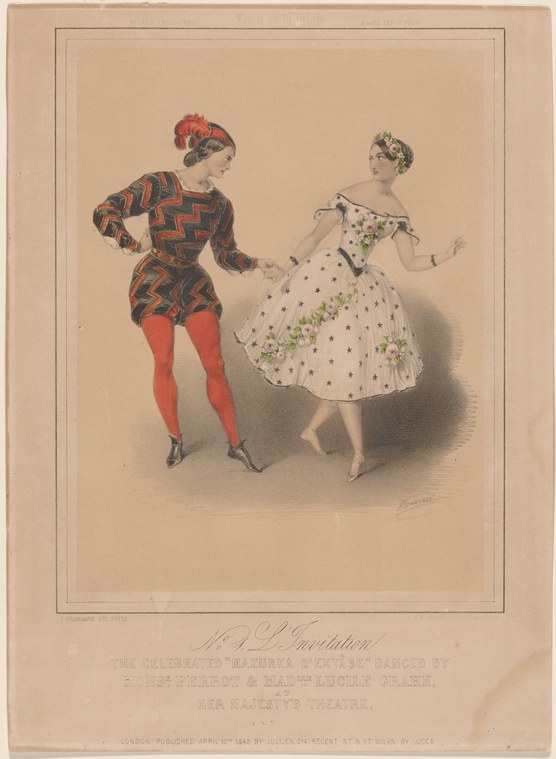
Eoline ou la Driade.: No. 1, L'invitation. The celebrated "Mazurka d'extâse" danced by Monsr. Perrot & Madlle. Lucile Grahn at Her Majesty's Theatre
Unknown artist
- Collection:
- Prints depicting dance
- Source:
- New York Public Library
- Rights:
- Public domain — free to use, share and adapt.
- Recorded as:
- Public Domain
This print is a primary source for understanding how the mazurka functioned in Romantic ballet and how its social protocols—invitation, courtship, response—shaped the movement vocabulary and staging of major works. It also documents Lucile Grahn's legendary role and the international prestige of Danish ballet in the 1840s, a fact often overshadowed by the dominance of French and Italian companies in dance history.
What you are looking at
Two dancers in theatrical costume occupy the center of this hand-colored engraving. On the left stands a male figure in a striking geometric patterned tunic of red and dark blue in a chevron design, with bold red tights and dark shoes, his posture dynamic with one hand on his hip and the other extended toward his partner. On the right, a female dancer wears a pale tulle skirt decorated with floral sprigs and a low-cut bodice, her hair crowned with a wreath; she faces her partner in an attitude of receptive engagement, one arm raised. The composition is set against a plain ground with subtle shading that suggests depth, and both figures are rendered with the precise anatomical definition typical of mid-nineteenth-century theatrical prints. The inscription below identifies this as a scene from *Eoline ou la Driade*, specifically the opening invitation (*L'invitation*), and credits the famous "Mazurka d'extase" to the celebrated performers Jules Perrot and Lucile Grahn at Her Majesty's Theatre.
The dancing
The male dancer's frame is open and invitational, his weight forward and his extended hand offering to his partner. The female dancer's posture is upright and receptive, with her body angled toward him in a courtship pose; her raised arm and the soft fabric of her skirt suggest readiness to move. Neither figure is in a closed partnership hold, indicating this is the moment of the social opening rather than an active dance phrase. The print captures the theatrical artifice of the period: idealized bodies, balletic port de bras, and a formality of approach that would have been recognizable to audiences of the 1840s.
The dance depicted
This print documents the Romantic ballet *Eoline ou la Driade*, which premiered in 1845, choreographed by Jules Perrot and danced by Perrot himself and the Danish prima ballerina Lucile Grahn. The "Mazurka d'extase" was a signature solo or duet within the work. The image captures the opening gambit of courtship in a Romantic ballet context: the male dancer's gesture and the female dancer's yielding posture align with the social protocols of the mazurka, a Polish court dance that became a vehicle for Romantic theatrical expression. The print is documentary evidence of how this dance was staged and costumed, and of Grahn's iconic role.
How it was made
This is a hand-colored engraving, a commercial print medium that allowed for rapid reproduction and wide distribution. The technique involved engraving fine lines into a metal plate, printing in black, and then hand-applying watercolor or gouache to each impression—a labor-intensive process that made these prints expensive objects aimed at subscribers and theater patrons. The precision of the engraved line work combines with the softness of the color application to create an image that is both documentary and aestheticized, capturing both anatomical accuracy and the theatrical idealization expected of ballet imagery in the mid-nineteenth century. The credit line at the bottom indicates this was a professional commission for commercial sale.
About this work
This hand-colored engraving documents a moment from the Romantic ballet *Eoline ou la Driade*, one of the landmark works of the 1840s and a vehicle for the celebrated dancer Lucile Grahn. It captures the formal opening of a mazurka sequence, showing the invitation and courtship ritual that frames the dance. The print is both a commercial theatrical souvenir and a precise record of how Romantic ballet was costumed, posed, and gendered: the active male suitor and the receptive female object, the geometric modernity of his costume set against the ethereal tulle and flowers of hers. For historians, it is invaluable as a window into the actual practice of Romantic choreography and into the careers of its most celebrated performers.
How to look at it
The viewer should attend to the formal geometry of the composition: the way the two figures are balanced in space, each mirroring the other's formal posture while maintaining distinct roles. Notice the precision of the line work in the male dancer's costume—the engraved chevrons create a visual rhythm that suggests movement even in stillness—and contrast it with the softer, more diffuse rendering of the female dancer's tulle skirt, a technique that emphasizes the gendered difference between solid, architectural masculinity and ethereal, yielding femininity. This is the moment before movement, a frozen instant of social protocol that would have been immediately legible to a nineteenth-century viewer as the opening of a courtship dance.
The period
The 1840s were the height of the Romantic ballet era in Europe. The mazurka, originally a Polish social dance, had become a favorite vehicle for choreographers like Jules Perrot, Michel Fokine, and others who found in its rhythmic structure and social character a perfect frame for the dramatic and emotional expression that Romanticism demanded. Lucile Grahn was one of the four greatest ballerinas of the age (alongside Marie Taglioni, Fanny Elssler, and Carlotta Grisi), and her partnership with Perrot—who was both dancer and choreographer—produced some of the most celebrated works of the period. This print dates from a moment when ballet was at the height of its cultural prestige and when the print trade was the primary means by which performances could be circulated beyond the theater itself. Subscribers could purchase such prints as souvenirs, and they served as advertisements for future performances.
Where it lives
This print is held in the New York Public Library's collection of prints depicting dance. It is a commercial theatrical souvenir, one of hundreds produced in the mid-nineteenth century to document and promote celebrated performances. Such prints were typically sold to subscribers and patrons and circulated widely among the theater-going public.
Dance in this work
Questions about this work
Who were Jules Perrot and Lucile Grahn?
Jules Perrot (1810–1894) was one of the greatest choreographers of the Romantic era and a celebrated dancer and pantomime artist. Lucile Grahn (1819–1907) was a Danish prima ballerina, one of the four great ballerinas of the Romantic period, known for her technical brilliance and dramatic presence. Their partnership produced some of the most celebrated works of the 1840s and 1850s, including *Eoline ou la Driade*.
What is the Mazurka d'extase and why was it famous?
The Mazurka d'extase was a solo or duet number within the ballet *Eoline ou la Driade*, likely a set variation based on the Polish mazurka. It became famous as a signature piece for Grahn and Perrot, and the title suggests the kind of emotional intensity and virtuosity that characterized Romantic ballet. The print documents this specific number, which audiences would have come to see.
What does the male dancer's costume tell us about the choreography?
The bold geometric pattern and the bright red tights suggest a character role rather than a classical prince—possibly a sylph-associated male character or a supernatural being. The costume's modernity and visual boldness would have created a striking visual contrast with the female dancer's ethereal tulle, embodying the Romantic opposition between material and spiritual realms.
Why was this print hand-colored if it was a commercial product?
Hand-coloring made the print more expensive and therefore more desirable as a luxury souvenir for affluent subscribers and theater patrons. It also allowed for greater subtlety in rendering the soft tones of the female dancer's tulle and the precise hues of the male dancer's costume, making the image a more faithful record of what audiences actually saw on stage.
More dance artwork





