49 works in this view — arrow keys or swipe to move between them.
Dance in Art
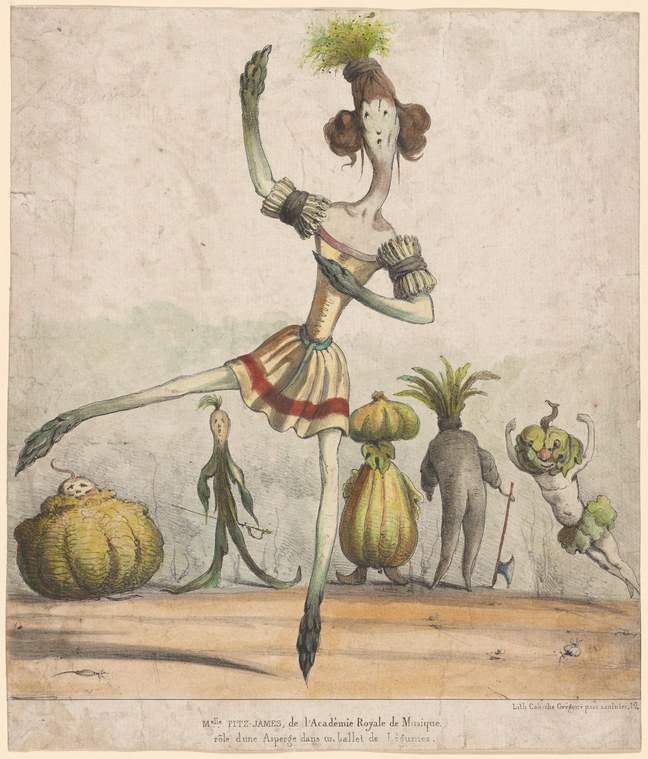
Melle. Fitz-James, de l'Académie royale de musique, rôle d'une asperge dans un ballet de légumes
Unknown artist
- Collection:
- Prints depicting dance
- Source:
- New York Public Library
- Rights:
- Public domain — free to use, share and adapt.
- Recorded as:
- Public Domain
It documents a historical dancer and a now-extinct theatrical genre—the vegetable ballet—revealing that 18th-century classical ballet was far more playful and eclectic than later, more rigid codifications suggest. The presence of a named professional dancer (Fitz-James) in a comic role shows that the hierarchy of genres in ballet was more fluid than we often assume, and that leading performers were comfortable mixing technical display with outright absurdity.
What you are looking at
A young female dancer in theatrical costume stands alone against a pale background, her body angled in a dynamic pose that suggests mid-movement. She wears a short, flounced skirt with red and gold striping, and her upper body is bare except for decorative cuffs at the wrists and what appears to be a jeweled belt. Her hair is styled in two prominent curls on either side of her head, crowned with a headdress of green foliage. Her left leg extends upward in an arabesque or attitude, while her right leg bears her weight, creating a diagonal line through the torso. Most striking is her face: it is pale, mask-like, and distinctly non-human, with an elongated nose and a fixed expression—she is not personifying a woman but a vegetable. Arranged on the ground at her feet are five other costumed figures, each representing different vegetables: a pumpkin with limbs, a melon, a bean or legume, a bulbous root vegetable, and what appears to be an onion or garlic bulb. This is a ballet design—a comedy of vegetables.
The dancing
The central figure's raised leg demonstrates classical ballet technique: a clean extension in what appears to be an arabesque, with the torso lifted and the supporting leg straight. The arm positions suggest theatrical port de bras, though the figure's vegetable anatomy—particularly the narrow, stem-like limbs—creates an almost caricatural effect. The five smaller figures below are less clearly articulated but appear posed to suggest dancing as well: some have raised limbs and angled bodies. The proportions and anatomy throughout are deliberately distorted; the bodies are unnaturally slender and elongated, fitting the conceit of vegetables with human movement.
The dance depicted
This is a design for a *ballet de légumes*—a vegetable ballet, a genre of lighthearted theatrical dance that emerged in France in the 18th century. The inscription identifies the figure as 'Melle. Fitz-James, de l'Académie royale de musique, rôle d'une asperge dans un ballet de légumes'—Mademoiselle Fitz-James of the Royal Academy of Music, in the role of an asparagus in a vegetable ballet. Fitz-James was a celebrated dancer of the Opéra in the mid-18th century, and this design documents her performance in a novelty genre that combined classical ballet technique with comic costume. The vegetable ballets were aristocratic entertainments, blending the formal training of the Opéra with carnivalesque humor. The presence of Fitz-James, a leading professional dancer, suggests this was a substantial theatrical production, not mere buffoonery.
How it was made
This is a hand-colored engraving or etching, executed with fine lines for the figural forms and washes of watercolor or gouache for local color. The precision of the line work—particularly visible in the facial features, the flounced skirt, and the decorative cuffs—is typical of 18th-century French theatrical prints. The artist has used colored inks or paints to differentiate the vegetables: golden yellows for the squash, greens for the foliage and stem-limbs, muted tones for the root vegetables. This technique allowed for multiple hand-colored impressions from a single plate, making it possible to distribute prints of celebrated performances and dancers to a broad, appreciative public. The relative sophistication and careful execution suggest this was a professional production document, not a sketch.
About this work
This is a record of a mid-18th-century Parisian theatrical novelty: a comic ballet in which classical dancers performed in vegetable costumes, combining the technical rigor of the Opéra with absurdist humor. The print documents one of the ballet's protagonists, Mademoiselle Fitz-James, a professional dancer of the Académie royale de musique, posed in an arabesque while dressed as an asparagus. The work belongs to a tradition of theatrical prints that celebrated dancers and performances, allowing the consuming public (primarily aristocratic and upper-middle-class patrons) to own images of the spectacles they had witnessed or heard about. It is evidence of the 18th-century ballet world's playfulness and its blending of high technical training with entertainment; it also documents the career of a notable (if now obscure) performer, and it captures a now-vanished genre of theatrical comedy.
How to look at it
Notice the contradiction between the dancer's face—a distinctly vegetable visage with an exaggerated nose—and her body, which is executing classical ballet technique with precision and grace. The humor lies in that tension: a professional dancer's trained form inhabiting a ridiculous costume. Look at the arabesque: it is technically correct, which is the point. The smaller figures at her feet are posed to echo her movement, as if they too are dancers; observe how they are arranged as a kind of chorus or corps. The color and detail devoted to the costume—the striped skirt, the cuffs, the foliage crown—tell us this was a considered design, not a hasty sketch.
The artist
The artist is not recorded. The inscription attributes the print to 'L. Créquy engraver p[ublic]', suggesting the engraver Créquy (first name unrecorded) was responsible for the print, likely working from a costume or character design by a theatrical artist. The print was made for public distribution, indicating it came from a professional print shop, likely in Paris.
The period
The vegetable ballet emerged in the 1740s–1760s as part of a broader 18th-century vogue for pantomime ballet, comic interludes, and naturalistic or burlesque subjects alongside the grand heroic ballets that dominated the stage. The Royal Academy of Music (Opéra) was at the height of its influence, and dancers like Fitz-James were celebrities whose likenesses circulated in prints. This period saw ballet diversifying beyond mythological and allegorical themes, incorporating comedy, spectacle, and topical humor. The fashion for hand-colored theatrical prints was at its peak, as a newly affluent bourgeoisie sought to own images of public entertainments.
Where it lives
The print is held by the New York Public Library in its collection of prints depicting dance. It is part of a larger body of 18th-century theatrical prints documenting performances, dancers, and genres that circulated in France and abroad.
Dance in this work
Questions about this work
Was this a real performance?
Yes. Mademoiselle Fitz-James was a named dancer at the Opéra, and vegetable ballets were documented entertainments in the 1740s–1760s. This print is a record of an actual theatrical event, not a fanciful invention. The presence of her name and institutional affiliation suggests the print was made to circulate after a performance.
Who was Mademoiselle Fitz-James?
She was a professional dancer (danseur or danseuse) at the Académie royale de musique (the Opéra) in Paris during the mid-18th century. She appears to have been known enough to merit named printings, suggesting she was a performer of some status. Beyond what appears in contemporary prints and records, little is known of her life.
What is a ballet de légumes?
A vegetable ballet was a comic theatrical genre, blending the classical ballet technique taught at the Opéra with absurdist costume and character. Dancers performed in vegetable costumes, creating a burlesque effect while maintaining professional technique. It was a form of theatrical entertainment and social satire, mocking both the formality of high ballet and the pretensions of aristocratic taste.
How was this print made?
This is a hand-colored engraving (or etching), executed by an engraver named Créquy. A copper plate was incised with fine lines to define the forms; impressions were then printed and colored by hand using watercolor or gouache. This technique allowed multiple copies to be made and sold to the public, making theatrical images affordable and collectible.
More dance artwork





