49 works in this view — arrow keys or swipe to move between them.
Dance in Art
Shakers dance
Unknown artist
- Medium:
- Source:
- New York Public Library
- Rights:
- Public domain — free to use, share and adapt.
- Recorded as:
- public_domain
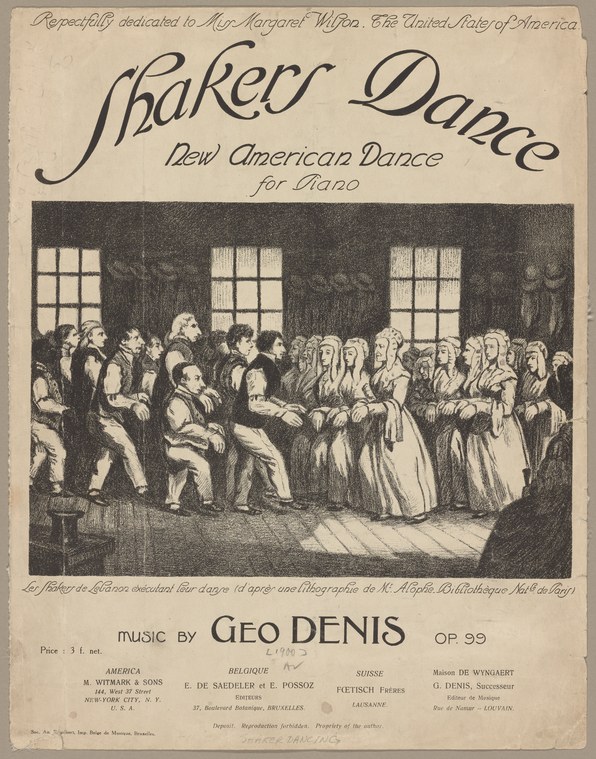
This engraving is a crucial visual record of Shaker worship and communal life at a moment when the sect was still active and documented by outsiders. It complicates the popular understanding of Shaker dancing by showing the formality and restraint that coexisted with their ecstatic practices. For historians of American religion, dance history, and 19th-century visual culture, the work offers evidence of how a movement-based spiritual practice was perceived, represented, and commodified as secular entertainment.
What you are looking at
This is a wood engraving depicting a Shaker religious gathering or worship service, not a secular dance performance. The composition shows two groups of figures facing each other across an interior space: on the left, men in dark coats and hats; on the right, women in long white dresses with white bonnets or caps. The setting appears to be a simple meeting house or hall with tall windows admitting light. The figures are arranged in parallel lines or rows, standing upright and composed. The mood is solemn and ordered rather than exuberant. This is a historical record of Shaker practice, not a depiction of secular dance entertainment or technique.
The dancing
The figures stand in formal, separated ranks by gender. The women stand with arms at their sides, posture upright and still. The men similarly stand without visible movement or gesture. There is no physical contact between dancers, no partner hold, no arm extension or turn. The bodies are rendered as static, witnessing figures rather than moving performers. This is a congregation at rest, not dancers in motion.
The dance depicted
The Shakers (the United Society of Believers) incorporated rhythmic movement and song into their religious worship, but what is shown here appears to be a moment of gathering or assembly rather than active dancing. Shaker worship did include ecstatic movement, trembling, and rhythmic stepping—practices that earned them their common name—but this engraving captures the formal, orderly aspect of their communal life. The work documents a religious practice that had dance elements, but this particular image freezes a moment of stillness and separation rather than movement or contact.
How it was made
This is a wood engraving, a relief printing technique that produces fine lines and high contrast. The image was printed and distributed as sheet music or an illustration, making it a mass-produced document rather than a unique artwork. Wood engravings allowed for wide circulation of images and information; this work served both as cover art for a piano composition and as documentary evidence of Shaker practice. The technique's precision and reproducibility made it ideal for both artistic and ethnographic purposes in the 19th century.
About this work
This wood engraving serves as a historical document of Shaker religious practice in 19th-century America. It shows a formal gathering of Believers arranged by gender in an ordered interior space, capturing the communal discipline and spiritual life of a group known for incorporating movement into worship. While Shaker practice did include ecstatic and rhythmic movement, this particular image emphasizes the orderly, contemplative side of their faith—the gatherings and meetings that structured their daily life. The work functions simultaneously as cover art for a piano piece titled 'Shakers Dance' and as visual testimony to the lived reality of a distinctive American religious community.
How to look at it
Attend to the formal separation of the figures by gender and their stillness. Notice the architectural framing—the windows and interior space—which emphasizes order and enclosure rather than liberation or movement. The engraver has chosen to represent not the moment of ecstatic movement for which Shakers were famous, but rather the gathering, the assembly, the social structure that contained and organized that practice. This reflects a particular moment in how Shaker life was understood and represented to outsiders: as orderly, disciplined, and remarkable more for social organization than for movement itself.
The artist
The composer and publisher information appears on the printed sheet. The music was published by Witmark & Sons (New York), E. De Saddler & E. Possoz (Brussels), and others, indicating an international music publishing network. The engraver's name appears in the caption line, though it is not clearly legible in this reproduction. The work is part of a commercial music publishing enterprise producing piano pieces inspired by or documenting American subjects and practices.
The period
This work dates to a period when American religious movements, particularly the Shakers, had become subjects of public curiosity and artistic interest. By the late 19th century, the Shakers' distinctive practices—their ecstatic worship, their separation by gender, their communal living—were documented in travel accounts, illustrations, and popular music. The Shakers themselves had begun to decline in number, making them increasingly subjects of historical and ethnographic interest rather than living movements. This engraving reflects both genuine documentary interest and the 19th-century appetite for music and imagery celebrating 'authentic' American life and exotic religious practice.
Where it lives
This is a printed work from the New York Public Library collection. It was created as cover art or illustration for a published piano composition, making it a mass-produced object designed for circulation to music students and amateur musicians. Its inclusion in the NYPL collection reflects the library's systematic acquisition of American music publications and cultural documents.
Dance in this work
Questions about this work
Did Shakers actually dance?
Yes. Shaker worship included rhythmic movement, trembling, rhythmic stepping, and song as expressions of spiritual ecstasy and union with the divine. However, Shaker movement had strict rules and structure—it was ecstatic but not chaotic. This engraving shows the orderly communal life that framed those practices rather than the movement itself.
Why is this called 'Shakers Dance' if the people are standing still?
This is cover art for a piano composition inspired by Shaker practice, not a literal representation of Shaker dancing in action. The title invokes the Shakers' cultural identity as a movement-based religious community, while the image documents their social organization and communal worship.
How do we know this depicts Shakers specifically?
The title is printed on the cover. The formal separation by gender, the distinctive dress (particularly the women's white bonnets), and the ordered interior space are consistent with documented representations of Shaker meetings. The women's white caps and long dresses and men's formal attire match descriptions and other images of Shaker dress.
Was this engraving made from life or from imagination?
It is unknown whether this was drawn from direct observation, from other published images, or from the engraver's understanding of Shaker practice. The engraving is competent and informed, but it may be a composite or idealized representation rather than a record of a specific gathering.
More dance artwork