49 works in this view — arrow keys or swipe to move between them.
Dance in Art
Ida Rubinstein in Schéhérazade
Unknown artist
- Collection:
- Prints depicting dance
- Source:
- New York Public Library
- Rights:
- Public domain — free to use, share and adapt.
- Recorded as:
- Public Domain
Rubinstein was a pivotal figure in twentieth-century dance, and Schéhérazade was the role that defined her career. This sketch captures the dramatic, sculptural approach to movement that made her a rival to Pavlova and an influence on modern dance, and it preserves a record of how the Ballets Russes conveyed Orientalist fantasy through the moving body.
What you are looking at
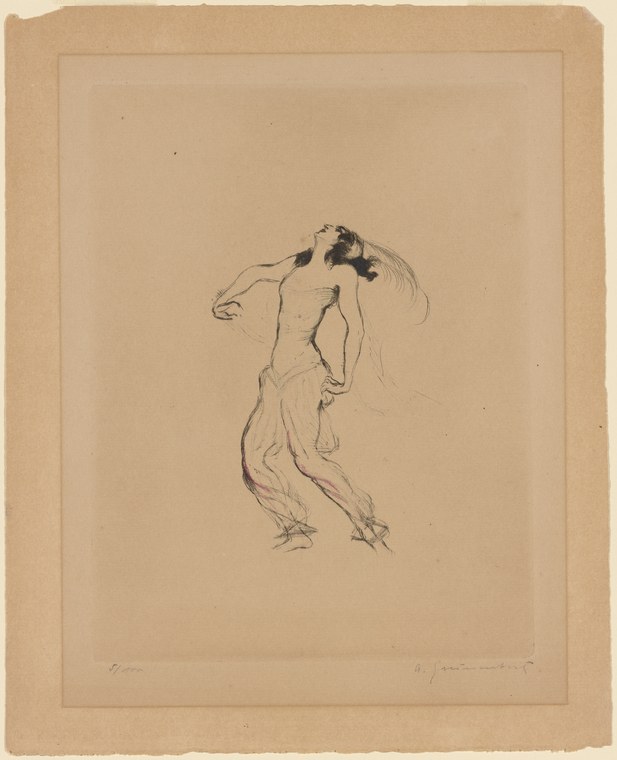
A single female figure stands in a twisted, balletic pose against a plain background. Her body arches backward with her right leg extended and left leg bent, head thrown back, arms reaching expressively. She wears a translucent garment—likely a tunic or draped fabric—rendered in delicate line work with areas of purple-pink wash applied to the lower body and legs. The figure's posture conveys dramatic emotion and physical control, capturing a moment of intense expression rather than a static position. The drawing uses minimal line to suggest anatomical form, relying on the artist's understanding of the body under tension.
The dancing
The dancer's weight appears to be held through a deep spinal arch and bent supporting leg, suggesting trained control rather than collapse. Her arms reach outward and upward with extension through the fingertips, a gesture characteristic of classical ballet vocabulary. The extended leg and pointed foot indicate balletic training. The head-back, open-armed posture conveys lyricism and emotional abandon, common to Romantic-era ballet vocabulary and the Oriental-influenced aesthetic of early 20th-century theatrical dance.
The dance depicted
This depicts Ida Rubinstein, the legendary Russian dancer and choreographer, in a moment from Schéhérazade. Rubinstein was renowned for her dramatic presence and sculptural use of the body rather than technical virtuosity; she performed the title role in the 1910 Sergei Diaghilev production with Michel Fokine choreography, designed by Léon Bakst. The pose reflects the Orientalist fantasy of the work—set in a Persian harem—in which Schéhérazade dances to save her own life through narrative and seduction. This image captures the interiority and expressiveness Rubinstein brought to the role, emphasizing drama and atmosphere over technical display.
How it was made
This is a line drawing with applied watercolor or ink wash, typical of theatrical costume and movement studies from the early 20th century. The economy of line suggests rapid notation—the kind of sketch made in or near the rehearsal studio or theater to capture a performer's likeness and characteristic gesture. The printing and signature visible at the base suggest this was reproduced as a print, likely for circulation among theater professionals, critics, or collectors of dance imagery. The technique allows for emphasis on bodily eloquence rather than costume detail.
About this work
This is a sketch study of Ida Rubinstein in the title role of Schéhérazade, the 1910 Ballets Russes production that became one of the defining achievements of early modern dance. Rubinstein's interpretation of the role transformed audience expectations of what a female dancer could be—not a technical display but a fully realized dramatic character moving through fantasy and desire. The image belongs in a gallery of dance art because it documents both a specific historical performer and a moment when Russian imperial dance tradition met avant-garde modernism, Oriental aesthetics, and the expressive freedom that would reshape 20th-century dance.
How to look at it
Notice the moment the artist has chosen: not a step or turn, but a moment of emotional and physical suspension. The arched back, the extended arms, the thrown-back head—these are signs of lyricism and vulnerability, not technical display. Observe how the artist uses minimal line to suggest form and relies on the viewer's understanding of the trained body; the purple wash applied to the legs and torso gives weight and three-dimensionality without overworking. The pose itself—backward arching with extended limbs—was novel for female dancers of the period and would have conveyed exoticism and emotional directness.
The artist
The artist is not recorded in the catalogue. The style and execution suggest a professional theatrical illustrator or dance documentarian working in the Parisian theater world of the 1910s, when the Ballets Russes and its stars attracted serious visual attention from sketch artists, photographers, and fine artists. The work may be by one of several artists who regularly captured Ballets Russes performances.
The period
Schéhérazade premiered in June 1910 at the Théâtre du Châtelet in Paris as part of Diaghilev's first Ballets Russes season. The production synthesized Russian Imperial ballet technique with modernist design, Orientalist fantasy, and a new freedom of movement. Michel Fokine's choreography departed from classical rigidity; Bakst's sumptuous sets and costumes evoked the Near East through Western romantic imagination. Rubinstein's casting—she was not a product of the Imperial ballet schools but a talented dramatic performer and patron—signaled Diaghilev's willingness to remake ballet around individual artists rather than institutional forms. In visual art, the 1910s saw intense interest in capturing performance through line and wash, both as documentary and as aesthetic object.
Where it lives
Held by the New York Public Library as part of its collection of prints depicting dance. The object is a reproduction print, likely created from the original sketch in the years following the 1910 premiere.
Dance in this work
Questions about this work
Who was Ida Rubinstein?
Rubinstein (1885–1960) was a Russian-born dancer, actress, and patron of the arts who became famous for her dramatic intensity rather than technical virtuosity. She commissioned and performed in some of the most important modernist works of the early 20th century, including Schéhérazade, Nijinsky's L'Après-midi d'un faune, and works by Ravel and Stravinsky. She was a rival and counterpart to Anna Pavlova.
What is Schéhérazade?
Schéhérazade (1910) was a one-act ballet choreographed by Michel Fokine with music by Rimsky-Korsakov and sets and costumes by Léon Bakst. It tells the story of the harem favorite who must dance to save her life. It was part of the first Ballets Russes season and became one of the most celebrated and frequently revived productions of the early 20th century.
What dance style is this?
Rubinstein trained in classical ballet but brought a dramatic, expressive approach more akin to modern dance. Fokine's choreography for Schéhérazade used classical technique but permitted much greater freedom of the torso, arm, and head than Imperial ballet had allowed. The role required both technical control and the ability to convey emotion through the whole body.
More dance artwork





