49 works in this view — arrow keys or swipe to move between them.
Dance in Art
La bergere galante
Unknown artist
- Collection:
- Prints depicting dance
- Source:
- New York Public Library
- Rights:
- Public domain — free to use, share and adapt.
- Recorded as:
- Public Domain
This print documents the visual and sartorial language of eighteenth-century theatrical dance, showing how pastoral characters were dressed, posed, and presented to audiences. For historians of dance and costume, it is a contemporary record of performance practice, attitude, and aesthetic values in an era before photography. The work also reveals how dance was consumed as a visual spectacle and circulated through prints—as image and idea as much as movement and skill.
What you are looking at
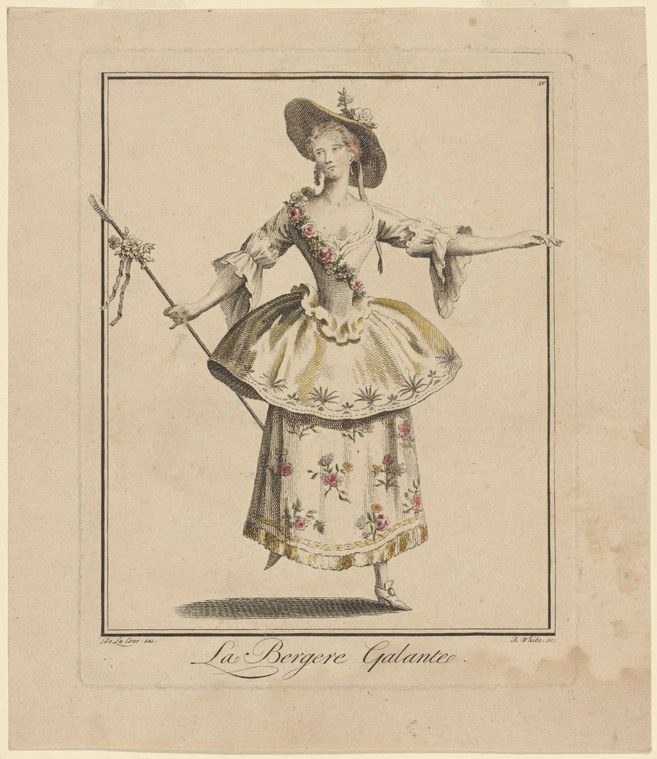
A single female figure stands in a theatrical pose against a plain background, captured in a hand-colored engraving. She wears an elaborate costume of the mid-eighteenth century: a fitted bodice decorated with floral sprigs, a dramatically projecting pannier skirt embellished with a band of star or flower motifs, and a wide-brimmed hat topped with feathers and ribbon. Her pose is one of studied elegance and playful theatricality—her body angled, her left arm extended upward in a graceful arc, her right arm reaching sideways, her head tilted, and her gaze directed outward toward the viewer. She holds what appears to be a shepherd's crook or similar staff in her left hand, a prop that signals her role. Her posture is weightless and elongated, suggesting she is captured mid-movement rather than at rest. The engraving is framed within a simple rectangular border, and the work is signed by the artist in the lower left corner.
The dancing
The single dancer occupies the full height of the composition, her body arranged in a characteristic Rococo S-curve: the upper torso tilted back and to the left, the hips pressed forward, creating an exaggerated elegance. Her arms are lifted and separated—not in a closed partnered hold but in an open, decorative frame that reads as a display of grace rather than a functional dance position. The weight appears to rest on one foot, the other foot lightly placed, suggesting a moment of movement or a posed attitude. Her head is elevated and her expression serene, embodying the courtly refinement expected of a pastoral character. There is no partner visible, making this a solo performance or a portrait of a dancer in character.
The dance depicted
The title *La Bergère Galante* (The Gallant Shepherdess) identifies this as a theatrical pastoral figure from the French Rococo stage tradition. The shepherd's crook, the rural dress, and the delicate posture all point to a character role in a court ballet or theatrical entertainment of the mid-eighteenth century—likely a *ballet de cour*, an allegorical pastoral, or a scene from an opera-ballet. The pose itself does not conform to the structured steps of any single named dance; instead, it represents a theatrical attitude or moment of elegant repose as a pastoral character would strike it. This image functions as a costume and character portrait, recording how such roles were embodied and presented to the audience. The figure's extreme refinement and the engraving's formal presentation suggest this was documentation of a professional or noble performance.
How it was made
This is a hand-colored engraving, identifiable by the fine parallel lines forming tone and shadow, the precision of the outline, and the delicate application of watercolor or gouache laid over the printed base. The technique of engraving allowed for mass production and wide circulation, making this a reproducible image likely used to document a notable performance, to serve as a model for other artists, or to circulate among courtly and theatrical audiences. The hand-coloring indicates a luxury edition, suggesting the work was aimed at collectors of prints or theatrical documentation rather than a purely commercial public. The clarity and finish of the print suggest professional production, likely by a specialized printmaker-publisher.
About this work
This is a record of a Rococo theatrical character, the Gallant Shepherdess, as she would have been seen on the eighteenth-century stage. The engraving captures not a balletic step or narrative moment, but a refined pose—a still attitude struck by a performer in pastoral costume. The image belongs to a rich tradition of theatrical prints that documented dance, costume, and character as entertainment spectacles. It shows us not how dance was structured in formal technique, but how it was consumed and circulated as visual culture: as an image to be collected, admired, and copied. The work is invaluable as evidence of how elite pastoral theatricality was staged, costumed, and celebrated in the age of Rococo refinement.
How to look at it
Attend to the pose: the dancer is not captured mid-step or in an active allegro moment, but rather in a held attitude of graceful repose. This reflects the aesthetic of Rococo dance, which prized elegance and decorative poise over virtuosity. Notice how the engraver has rendered the costume as much as the body—the pannier skirt, the ornament, the hat—all of which convey status and role. The lightness of her stance and the fluidity of her arm positions embody the ideal of effortless grace. The pose was likely held and rehearsed, designed to be seen and admired as a moment of perfect courtly refinement.
The artist
The engraver is not identified in the catalogue record. The signature visible in the lower left corner could establish authorship, but it is not clearly legible in the image. The work is typical of French theatrical print production in the mid-eighteenth century, when engravings of costumed dancers and theatrical characters were produced in quantity to satisfy the appetite of courtly and urban audiences for images of fashionable entertainment.
The period
This print dates to the height of Rococo taste in France, an era when pastoral themes, courtly refinement, and the aestheticization of leisure were dominant in both visual and performing arts. The pastoral ballet and theatrical entertainment were popular forms at court and in public theaters; figures like Marie Sallé and other celebrated dancers of the 1730s–1750s performed such roles. The engraving reflects the broader eighteenth-century fascination with recording, collecting, and circulating images of performance—a practice that predates photography and reveals how dance was valued as spectacle, costume, and elegance rather than primarily as technical athleticism.
Where it lives
The work is held in the New York Public Library's collection of prints depicting dance. It survives as a single leaf, likely once part of a bound volume or dispersed collection of theatrical prints. No accession number, acquisition date, or prior ownership is recorded in the available catalogue information.
Dance in this work
Questions about this work
What does the shepherd's crook indicate?
The crook is a theatrical prop that signals the dancer's character role as a shepherdess in a pastoral entertainment. In eighteenth-century court ballets and theatrical pieces, such props helped establish narrative and character at a glance, allowing the audience to read the performer's identity and role within the allegorical or romantic scenario.
Is this a real dance or just a costume portrait?
It is both. The figure strikes a pose that is characteristic of Rococo theatrical dance—an elegant, held attitude rather than a dynamic step. The image documents how a character would appear on stage, capturing the visual ideal of pastoral grace that audiences came to see. Dance of this era was as much about beautiful stillness and refined posture as about movement.
Why is the print hand-colored if it was meant to be reproduced?
Hand-coloring was applied to premium or deluxe copies of engravings, usually for wealthy collectors or as gifts. It added value and visual appeal, making the costume and character more vivid. Some prints were sold plain, others colored; the hand-coloring in this case suggests it was a higher-end or more prestigious version.
Who performed roles like this?
Gallant Shepherdess roles were performed by professional dancers and sometimes by members of the nobility in court entertainments. Celebrated dancers of the mid-eighteenth century, including women such as Marie Sallé, often played such pastoral characters. The role combined graceful movement, elegant costume, and the embodiment of refined, leisured femininity.
More dance artwork





