49 works in this view — arrow keys or swipe to move between them.
Dance in Art
The famous Dutch woman
Unknown artist
- Collection:
- Prints depicting dance
- Source:
- New York Public Library
- Rights:
- Public domain — free to use, share and adapt.
- Recorded as:
- Public Domain
This image is evidence of a professional female performer—named, celebrated, and documented in print—working in a demanding physical discipline during a period when few women's names were recorded in performance history. The specificity of the title suggests she was known across Europe; the print's survival indicates her act was considered worthy of artistic documentation. For historians of early modern performance and gender, this is a rare record of a woman's technical mastery and public fame in the entertainment world.
What you are looking at
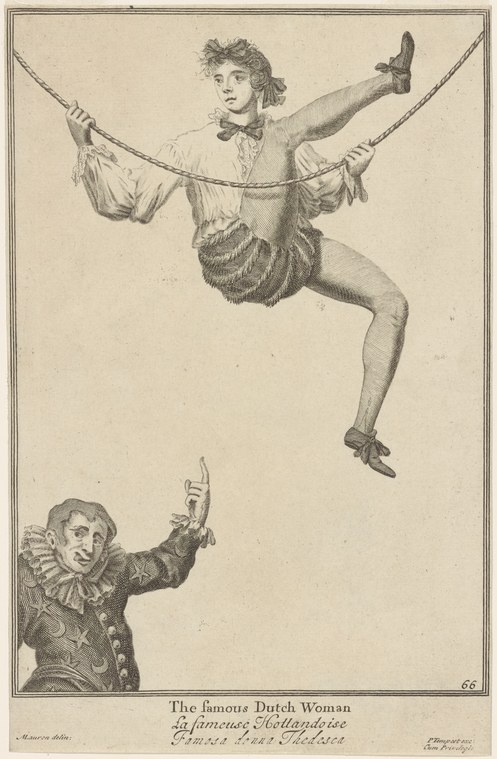
A young woman suspended in mid-air on two ropes, captured in a moment of acrobatic flight. She wears a light chemise or shift with draped sleeves, a fitted jacket or corset bodice, and gathered skirt, with her legs bare and feet in heeled shoes. Her body is held in an open, splayed position—one leg extended upward, the other bent, arms spread wide grasping the ropes—suggesting both control and weightlessness. Below her, a figure in ornate Renaissance or commedia dell'arte costume (featuring a patterned tunic and ruff collar) looks upward, pointing or gesturing toward the flying woman. The composition is spare and graphic, with no setting beyond the figures themselves and the two rope lines that frame and support the aerial figure. The image is rendered as a line engraving or etching on cream paper, with fine hatching creating volume and shadow.
The dancing
The suspended woman's body is fully extended in an asymmetrical pose that emphasizes weightlessness and control: her weight appears distributed across the two ropes held in her hands, her torso is arched backward and twisted, one leg points skyward while the other bends, and her head is tilted back with hair loose. The man below is static and earthbound by contrast, his posture deferential or amazed, looking up at her levitation. The aerial figure's musculature and limb extension suggest trained acrobatic strength rather than passive suspension. The spatial relationship between them—vertical separation, one active and one observing—creates a narrative hierarchy.
The dance depicted
This is a circus or theatrical aerial act, most likely from 18th-century European performance tradition. The woman is performing a rope-suspension trick, a feat of acrobatic skill that was a staple of court entertainment and popular theater in the Baroque and early modern periods. The title 'The famous Dutch woman' suggests this depicts a named performer, possibly a celebrity of the period, which would explain the print's existence as a record of a notable act. The act combines strength, flexibility, and spectacle—the performer must maintain grip and body control while appearing to fly, an illusion that required both training and dramatic presentation. The presence of the costumed figure below suggests this was performed as part of a theatrical or commedia dell'arte context rather than as pure circus.
How it was made
This is a line engraving or etching, indicated by the fine parallel hatching that creates shadow and volume, the precise lineWork, and the cream paper support. The technique allowed for rapid reproduction and wide circulation of images documenting celebrated performers and acts. The initials or mark visible in the lower right corner suggest this was a published print, likely part of a series documenting notable entertainers or acts. The careful attention to anatomical detail in the suspended figure's musculature and the delicate rendering of fabric folds indicates this was made by a trained hand, not a popular woodcut, suggesting circulation among educated audiences who could afford such prints.
About this work
This engraving documents a specific aerial acrobatic act performed by a celebrated performer known as 'the famous Dutch woman,' likely in the 17th or 18th century. The work captures a moment of theatrical spectacle that was central to early modern court and popular entertainment—the illusion of human flight achieved through rope suspension and acrobatic skill. The print preserves both the technical achievement (the difficult body position) and the theatrical context (the costumed observer) that framed such acts for audiences. It belongs in a dance history collection because aerial acrobatics were a recognized and valued performance form, often integrated into ballet, court spectacles, and circus entertainments.
How to look at it
Observe the moment chosen: the woman is captured at the apex of her suspension, legs akimbo, in the most visually dramatic and vulnerable position—not the easiest position to hold, but the most striking to see. This is a theatrical choice by the artist, prioritizing spectacle over narrative. Notice how the engraver has rendered her musculature and the tension in her arms and core: the figure is not limp or passive, but actively controlling her body against gravity. The positioning of the man below, gazing upward, cues the viewer to share his astonishment and to read this as a feat of skill rather than a magical illusion.
The artist
The artist is not recorded. The style, technique, and formality of the engraving suggest a professional printmaker working in the 17th or 18th century, likely in the Low Countries or Central Europe given the subject. The quality of the line work and anatomical observation indicates formal training. Such prints were often made to circulate images of celebrated performers, and the engraver may have worked from a painting, drawing, or even verbal description provided by a patron.
The period
Aerial acrobatics and rope-dancing were established entertainment forms by the 16th century, performed in courts, fairs, and theaters across Europe. In the Baroque period, such acts were often integrated into ballet de cour and court spectacles, particularly in France and the Low Countries. The early 18th century saw a growing market for prints documenting famous performers and acts, reflecting both the celebrity status of notable entertainers and the printmaking industry's ability to distribute their images. Female acrobats were known and documented, though less frequently celebrated than male performers; this print's emphasis on the woman's name suggests she was unusual in her fame.
Where it lives
The work is held in the New York Public Library's collection of prints depicting dance. It is a historical print, likely 17th or 18th century, reproduced and held as part of a broader archive of performance imagery.
Dance in this work
Questions about this work
Was rope-dancing considered a form of dance?
Yes, in the 16th–18th centuries, rope-dancing and aerial acrobatics were recognized entertainment forms, often performed in the same venues and theatrical contexts as dance. They required training in body control, balance, and performance, and were valued for their spectacle. They were frequently incorporated into court ballets and theatrical productions.
Who was 'the famous Dutch woman'?
The print's title suggests she was a celebrated performer known across Europe, but her specific identity cannot be confirmed from the image alone. The fact that she is named and documented in print indicates she was a professional performer of notable reputation, which was unusual for women in this period.
What is the figure at the bottom supposed to be?
The costumed figure below is likely a character from commedia dell'arte or court theater, or a servant or musician attending the performer. His upward gaze and gesture serve to frame the aerial act as a spectacle to be marveled at, directing the viewer's attention upward to the flying woman.
How would this trick have been performed?
The performer would grip the ropes tightly with both hands and use core strength and flexibility to hold her body in the extended positions shown. The ropes would be secured above (to a ceiling, beam, or rigging), and the performer's skill lay in maintaining control and creating the illusion of effortless flight while executing difficult acrobatic positions.
More dance artwork





