13 works in this view — arrow keys or swipe to move between them.
Dance in Art
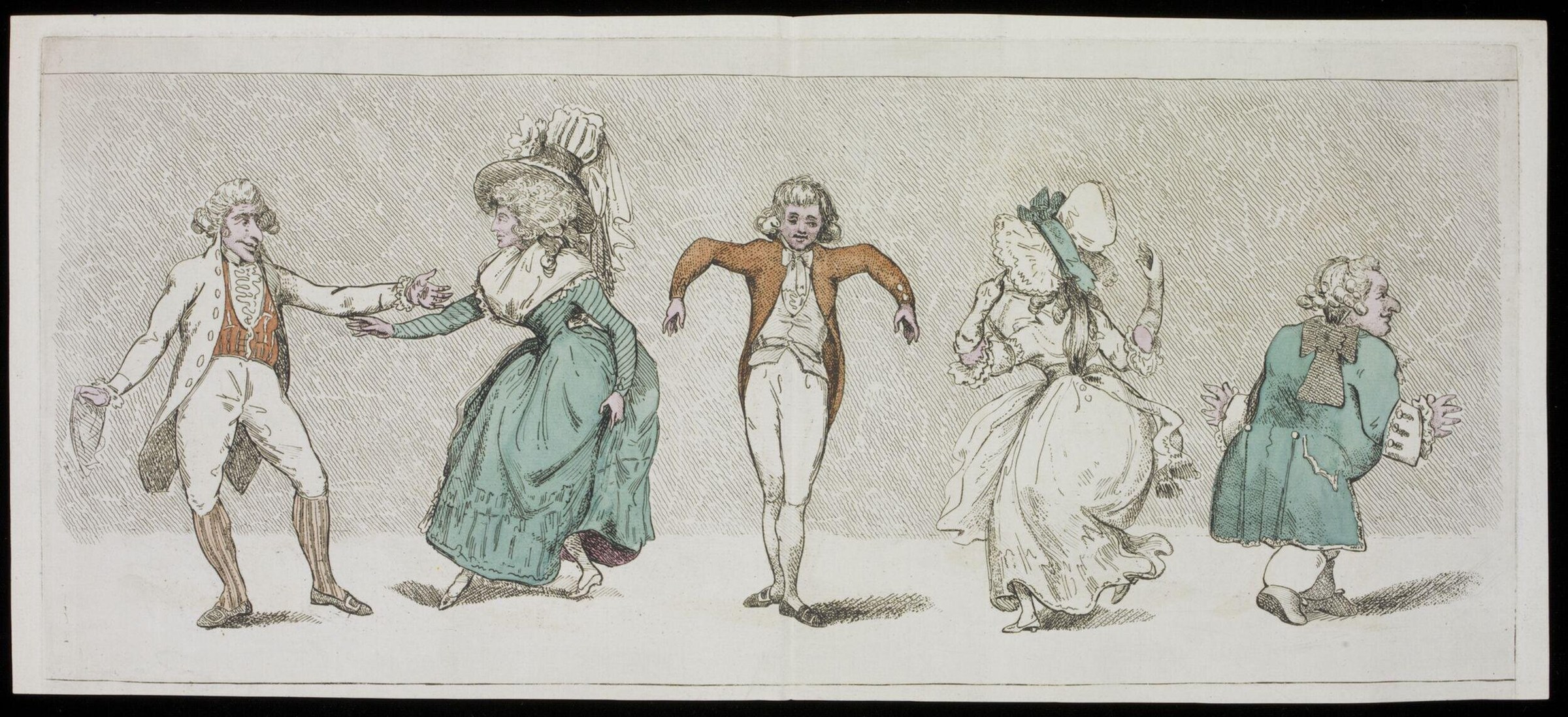
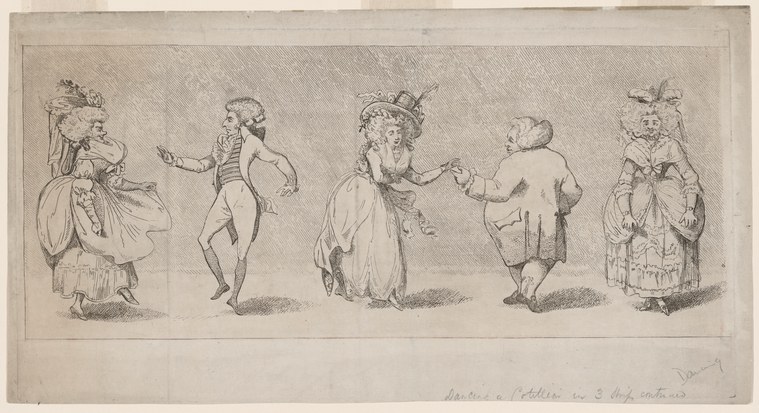
Dancing a cotillion
Unknown artist
- Medium:
- Lithograph
- Dance:
- Cotillion
- Era:
- Late 1800s (Victorian Ballroom)
- Source:
- New York Public Library
- Rights:
- Public domain — free to use, share and adapt.
- Recorded as:
- public_domain
The image is a rare document of cotillion pedagogy—showing not the dance in full performance but the isolated poses and gestures that made up its grammar. For dancers and dance historians, it reveals what 19th-century ballroom instruction emphasized: posture, arm carriage, the vocabulary of invitation and response. The satire implicit in the lithograph's treatment suggests contemporary awareness that these codes were learned, performed, and available to ridicule—a window into how ballroom dance functioned as a marker of class and social aspiration.
What you are looking at
Five figures stand in a shallow stage space arranged left to right, each captured mid-gesture in what appears to be a dance instruction or demonstration. At far left, a woman in a full skirt and bonnet gestures downward with both hands toward a young boy in striped breeches and jacket who stands facing her. To their right, a woman in an elaborate gown with feathered headdress and décolletage gestures with raised arms, her body turned in three-quarter view. Next to her stands a rotund man in profile, dressed in formal coat and breeches, one arm extended. At far right, a woman in a high-waisted gown with bonnet and lace fichu stands with arms raised in a dancing posture. The lithograph is executed in a light, sketchy hand with fine cross-hatching for shading. The figures cast faint shadows on the ground plane, and the composition reads as a series of pose studies or figure arrangements rather than a unified scene of action.
The dancing
The bodies display a range of arm positions and postures across the social dance vocabulary: raised arms suggesting a turn or invitation to dance; extended arm gestures as though instructing or inviting a partner; upright carriage typical of ballroom deportment. The figures do not appear to be in closed holds or couples; instead they are positioned as individual demonstrations of attitude or movement phrase. The clothing—full skirts, fitted coats, high waistlines, bonnets—indicates dressed figures rather than working dancers, and their poses suggest a choreographic or pedagogical moment frozen for study.
The dance depicted
The title 'Dancing a cotillion' identifies the work with the cotillion, a group dance popular in the late 18th and 19th centuries that combined elements of the quadrille with solo figures and invited a broader range of participants. The cotillion was both a social dance and a teaching vehicle, often demonstrated with instruction. This image appears to capture a moment of instruction or demonstration rather than active performance—the figures isolated, posed, their gestures reading as teaching points. The mix of male and female figures of different ages and body types suggests a didactic rather than performative intent, and the abbreviated, schematic style of the lithograph supports its function as an instructional or satirical print documenting the poses and protocols of the dance.
How it was made
The work is a lithograph, a printing technique that allowed artists to draw directly onto stone with greasy crayon or ink, then to reproduce the image in multiple impressions. This made lithography ideal for rapid, relatively inexpensive circulation of popular subjects—instruction manuals, satirical commentary, social documentation. The sketchy, economical handling of line and the pale tonal wash suggest a print intended for a broad audience rather than museum display. The technique allowed the artist to capture gesture and pose with a directness suited to both instruction and gentle satire.
About this work
This lithograph documents a moment in the teaching or demonstration of the cotillion, a popular ballroom dance of the 19th century. Rather than depicting an active dance performance, it isolates and presents five figures in teaching poses—instruction, invitation, and attitude—arranged across the composition like a vocabulary of posture and arm position. The print captures a specific historical moment when dances were not only performed but formally taught, often with printed guides and demonstrations aimed at the broadening middle class. The work belongs in a dance gallery as evidence of how the cotillion was transmitted socially and pedagogically, and as a record of the bodily culture and deportment that defined Victorian ballroom practice.
How to look at it
Attend first to the isolation of the figures and the absence of interaction between them—this is not a scene of dance in motion but of pose and instruction. Notice the variety of arm positions and their relation to the body: raised arms, extended arms, arms at the side. The artist has rendered the figures with a delicate, almost caricatural touch that suggests both instruction and satire. The composition reads as a plate from a dancing master's manual, but the slight exaggeration of posture and body type introduces a note of comedy that qualifies the instructional intent. The viewer is asked to read the image both as a guide and as commentary on the social pretensions it describes.
The period
The cotillion emerged in late 18th-century France and became a fixture of European and American ballroom culture through the 19th century. Unlike the quadrille, which was more rigidly choreographed, the cotillion allowed for improvisation, invited figures, and a wider social mix. The early-to-mid 19th century saw an explosion of dance instruction manuals, prints, and public instruction rooms where the emerging middle classes could learn the bodily comportment required for ballroom participation. Lithography, newly available as a reproductive technology, made such instructional and satirical images widely accessible. This print sits at the intersection of social aspiration, pedagogical documentation, and gentle satire directed at the formality and pretension of the dancing masters and their pupils.
Where it lives
The work is held in the New York Public Library collection and derives from their holdings. It appears to have been created for mass reproduction and circulation, as was typical of 19th-century instructional and satirical lithographs.
Dance in this work
Questions about this work
What is a cotillion?
A cotillion was a group ballroom dance that evolved from the French contredanse and quadrille in the late 18th century. It was popular through the 19th century and combined fixed choreographic patterns with improvised solo 'figures' performed by individual dancers while others watched. The dance was a staple of ballroom culture and an important vehicle for teaching middle-class men and women the deportment and social protocols of ballroom participation.
Why are these figures posed separately rather than dancing together?
The composition appears to document the teaching or demonstration of cotillion poses and arm positions rather than a live performance. This reflects the historical reality that dances were formally taught and often presented in instructional contexts where individual figures and postures were isolated and explained. The print may also function as a plate from a dancing master's manual or guide.
Is this image making fun of ballroom dancing?
The sketchy, somewhat caricatural handling of the figures and the emphasis on posture and pretension suggest a note of gentle satire. The lithograph documents ballroom culture with a mixture of instruction and commentary, implying that these codes of behavior were visible, learned, and available to critique by those both inside and outside the dancing world.
More Cotillion artwork