49 works in this view — arrow keys or swipe to move between them.
Dance in Art
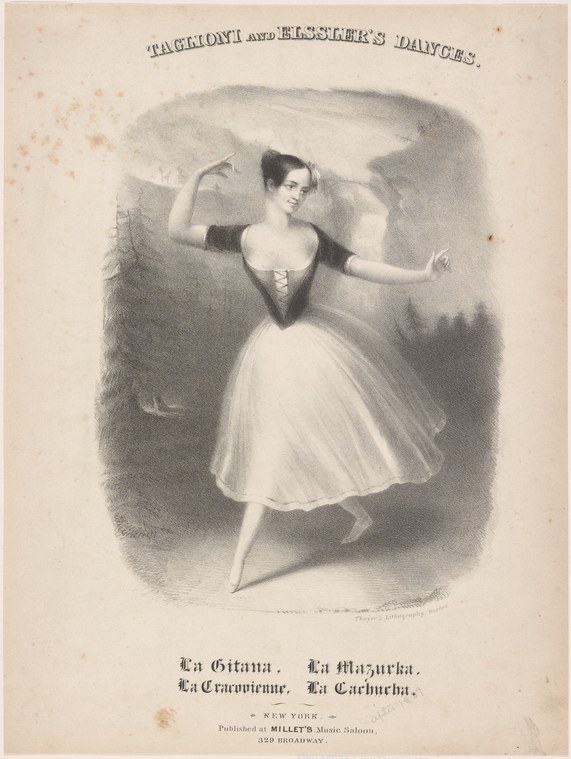
Taglioni and Elssler's dances.: La gitana, La mazurka, La cracovienne, La cachucha
Unknown artist
- Collection:
- Prints depicting dance
- Source:
- New York Public Library
- Rights:
- Public domain — free to use, share and adapt.
- Recorded as:
- Public Domain
This print directly illustrates the dominance of the Romantic ballet aesthetic—the weightless, ethereal ballerina in a tutu—in the mid-nineteenth-century imagination, and it documents how European dance forms were disseminated and celebrated in America through commercial print culture. For historians, it is material evidence of what Romantic ballet looked like, how it was performed, and who the major stars were; for dancers, it is a visual record of technique, carriage, and costume from one of ballet's most influential eras.
What you are looking at
A single female dancer dominates the composition, positioned center stage against a softly graduated gray background that suggests theatrical lighting or a studio setting. She wears a dark corseted bodice with off-shoulder sleeves and a voluminous white skirt falling to mid-calf—the canonical Romantic ballet costume of the 1830s–40s. Her pose is one of suspended elegance: she stands in profile or three-quarter view, her body tilted slightly backward with one arm raised gracefully and the other extended, as if caught mid-movement. Her head turns with focused attention, her posture suggesting either a pirouette's preparation or the closing moment of a solo variation. The skirt's fluid drape suggests movement arrested in time, and her pointed feet indicate the balletic technique of the era. The lithographic technique gives the figure a soft, idealized quality with careful gradation in the drapery and a luminous quality to the white silk.
The dancing
A single dancer, shown in a refined upright carriage with the elongated line characteristic of Romantic ballet. Her arms are positioned in a soft, open frame rather than clasped to a partner—one arm lifted to about eye level or slightly higher, the other extended to the side or forward. Her stance suggests she is on or near demi-pointe, with the weight distributed to allow rotation. The posture is one of controlled extension and balance rather than explosive motion, typical of the adagio or solo variation idiom. There is no partner, no supporting ensemble, no prop—only the dancer herself and her silhouette against space.
The dance depicted
This is a Romantic ballet solo, most likely representing one of the four dances named in the title: *La Gitana* (The Gypsy), *La Mazurka*, *La Cracovienne*, or *La Cachucha*. The costume and technique point to the Romantic period (c. 1830–50), and the presence of both these specific dances and the names Taglioni and Elssler in the title suggests this print documents celebrated soloists of that era performing character variations or national dances within a ballet context. The ethereal quality of the pose and the unadorned solo framing suggest a solo variation rather than ensemble or mime work; the soft, upright carriage is incompatible with the sharp, grounded footwork of the *cachucha* or *cracovienne*, which makes the *mazurka* or *gitana* more likely as the intended subject. The print may document a single dancer executing all four dances in sequence, or it may be one of a series.
How it was made
This is a lithograph, a print technique that involves drawing on stone with a greasy crayon or ink and then printing by exploiting the mutual repulsion of oil and water. The soft, tonal quality visible here—the atmospheric gray background, the subtle modeling of the white drapery, the refined line work—is characteristic of early-to-mid-nineteenth-century lithographic portraiture and theatrical documentation. Lithography was the dominant medium for dance prints of this period because it was faster and cheaper than hand-colored engraving, allowed for tonal variation without hand-coloring, and could reproduce soft, romantic effects that suited the aesthetic of Romantic ballet. The publication note indicates this was issued as sheet music cover art or a separate theatrical print by Miller's Music Saloon in New York, suggesting wide distribution among ballet audiences and music-lovers of the era.
About this work
This lithograph documents a moment in the history of Romantic ballet when European and American audiences were captivated by the virtuosity and ethereal presence of great ballerinas. The print belongs to a tradition of theatrical portraiture that circulated widely through the music and dance trade, framing the dancer as the primary spectacle and emphasizing her technical refinement and aesthetic allure. It is a record of what Romantic ballet looked like to its audience: a single figure suspended in balletic space, elegant, weightless, and self-contained. The title references multiple national dances, suggesting that the Romantic era saw ballet absorbing and aestheticizing folk and character dances from across Europe—Spanish, Polish, and Eastern European forms—and presenting them through the lens of Romantic technique and sensibility.
For dancers and historians, this image is evidence of how Romantic ballet was marketed, how its stars were portrayed, and what the visual and physical ideals of the era were. It shows the costume, carriage, and pose that defined the period; it documents the work of major artists; and it exemplifies the print culture through which dance circulated before photography dominated performance documentation.
How to look at it
Notice first the dancer's posture and the absence of a partner or narrative context. Unlike earlier ballet or court dance imagery, this work presents the dancer as the sole subject, frozen in a moment of pure movement and technical refinement. Observe the carriage of the arms—open, fluid, and unfixed—and the lifted, elongated line of the body, which conveys weightlessness and control rather than effort or emotion. The pose suggests a moment near the climax of a solo variation, perhaps at the completion of a turn or at the apex of a phrase. The soft lithographic technique—the atmospheric background, the subtle gradation in the drapery, the gentle modeling of the face and arms—creates an idealized, almost dreamlike quality that was central to Romantic aesthetic values. This is not a record of how the dance actually looked to someone standing in the theater, but rather an artistic interpretation shaped by lithographic technique and the Romantic taste for ethereality and refined elegance.
The artist
The artist is not recorded, but the print was published by Miller's Music Saloon in New York, a commercial music and entertainment vendor of the mid-nineteenth century. The lithograph is a work of theatrical documentation and portraiture rather than fine art; it belongs to the tradition of celebrity prints and theatrical illustrations that were produced rapidly and in quantity to meet public demand for images of popular performers. The quality of the draftsmanship—the careful modeling, the soft atmospheric effect, the refined line—suggests a skilled theatrical lithographer, but the anonymity of such work was typical of commercial print production of the era.
The period
This print dates from the height of Romantic ballet in Europe and America, roughly 1835–1850, when the technology of lithography had made theatrical portraiture accessible to a much wider audience than engraving alone could reach. The names Taglioni and Elssler in the title refer to Marie Taglioni and Fanny Elssler, the two greatest ballet stars of the era, whose rivalry and contrasting styles (the ethereal, weightless Taglioni; the dynamic, earthly Elssler) captivated European and American audiences. Both dancers performed these character dances—mazurkas, cracoviennesm cachucha, Spanish and Eastern European folk forms adapted for the ballet stage—as solo variations within full-length ballets or as independent concert pieces. The 1830s–40s saw an explosion of nationalism and interest in folk culture across Europe, and Romantic ballet absorbed and aestheticized these forms, presenting them to metropolitan audiences as exotic and picturesque. In America, such prints were sold as sheet music covers, theatrical keepsakes, and souvenirs, making Romantic ballet imagery part of popular visual culture.
Where it lives
This print is held by the New York Public Library as part of its collection of prints depicting dance. It is a theatrical lithograph of the type that was produced and sold in quantity in New York during the mid-nineteenth century, marketed to dance enthusiasts, music students, and theatergoers. The publication information indicates it was issued by Miller's Music Saloon, suggesting it may have been sold as a sheet music cover or as a separate theatrical print.
Dance in this work
Questions about this work
Who were Taglioni and Elssler?
Marie Taglioni and Fanny Elssler were the two greatest ballet dancers of the Romantic era (1830s–1840s). Taglioni, a Swedish dancer trained in France, epitomized the weightless, ethereal Romantic ideal and was the first ballerina to master pointe work as a signature technique. Elssler, an Austrian dancer, was known for her vivacity, technical brilliance, and mastery of character dances. The two were rivals, and their contrasting styles—Taglioni ethereal and otherworldly, Elssler earthy and dynamic—captivated audiences on both sides of the Atlantic.
What are the four dances named in the title?
La Gitana (The Gypsy) is a Spanish character dance; La Mazurka is a Polish folk dance in triple meter that became a Romantic ballet variation; La Cracovienne is another Polish form, from Krakow; and La Cachucha is a Spanish dance with sharp footwork and rhythmic complexity. All four were popular as solo variations in Romantic ballet, performed by the major stars of the era as displays of technical and dramatic range. Character dances like these were often incorporated into larger ballets or performed as concert pieces.
What is a lithograph?
A lithograph is a print made by drawing on the surface of a stone (usually limestone) with a greasy crayon or ink, then chemically treating the stone so that ink adheres only to the drawn areas and is repelled by the blank areas. The stone is then dampened with water and rolled with oil-based printing ink, which sticks to the greasy drawn areas but not to the wet blank areas, allowing the image to be printed. Lithography was fast, relatively cheap, and could produce soft tonal effects, making it ideal for theatrical portraiture and dance prints in the nineteenth century.
How was Romantic ballet different from earlier ballet?
Romantic ballet (c. 1830–1850) shifted away from the formal, court-derived vocabulary of Classical ballet toward an emphasis on ethereality, emotion, and supernatural or exotic subjects. Dancers began to perform consistently on the tips of their toes (pointe), and the ballerina became the primary focus rather than the male dancer. The tutu shortened to mid-calf, the bodice became a tight corset, and the overall aesthetic became one of weightlessness and otherworldly beauty. Romantic ballet also absorbed folk and character dances from across Europe, incorporating them as solos or variations within larger works.
More dance artwork





