49 works in this view — arrow keys or swipe to move between them.
Dance in Art · 2024
The Dance
Unknown artist
- Medium:
- Source:
- New York Public Library
- Rights:
- Public domain — free to use, share and adapt.
- Recorded as:
- public_domain
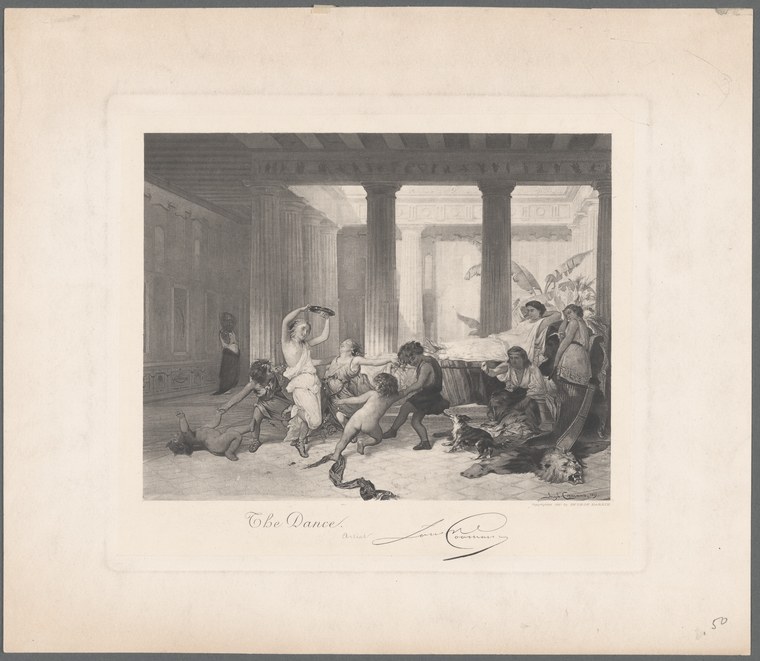
This engraving is one of many 18th-century prints that treated dance as a subject worthy of fine art and careful technical execution, and it shows how dance could be framed as an antique or mythological subject rather than a contemporary social practice. It demonstrates the circulation of dance imagery as high art through the medium of engraving, reaching educated collectors across Europe. For historians of dance and visual culture, it reveals the imaginative investment in classical antiquity as a source of dance subjects and the assumption that dance belonged to civilized, refined leisure.
What you are looking at
An engraving depicts a lively dance scene in a classical interior with Corinthian columns and a coffered ceiling. The space appears to be an ancient Roman or Greco-Roman setting, with drapery and a potted plant visible through the columned arcade on the right. A mixed group of figures—at least a dozen—occupy the floor in various states of motion and repose. Some dance actively in the center; others sit or recline on the floor around the margins, watching or resting. The figures are rendered in light tones against the darker architectural background, creating strong shadow and depth. The composition is crowded and informal, capturing a moment of social pleasure rather than formal ceremony. The title *The Orb Dance* (or possibly *The Orb Daunce*) appears in script below the image, followed by what may be an artist's signature or collector's mark.
The dancing
The dancers display varied postures and levels of engagement. Some stand and move in the center ground, their bodies twisted in active motion; others kneel or sit watching from the foreground and sides. The active dancers appear to be in loose, playful groupings rather than formal couples or lines. Their limbs are extended in gesture and movement, with a sense of informality and social mixing. The rendering suggests light, energetic movement rather than codified steps, and the intermixing of standing, sitting, and reclining figures suggests a scene of continuous social interaction rather than synchronized or formal choreography.
The dance depicted
The subject and style are difficult to identify with certainty from the engraving alone. The classical architectural setting and the title's reference to an 'orb' or 'ORB' suggest either an allegorical or mythological subject, or a historical recreation of antique dance. The informal grouping, the mixing of active and passive participants, and the social rather than performative quality suggest this may depict a Bacchic or Dionysian scene, or a fanciful reimagining of ancient Greek or Roman social dancing. The 'orb' may refer to a prop—a sphere used in a game or dance—or it may be a poetic/symbolic reference. Without clearer evidence of specific hold, footwork, or costume convention, the dance cannot be firmly identified, though the classical setting and allegorical title point toward historic-baroque or neoclassical theatrical practice.
How it was made
This is an engraving, a intaglio process in which an image is incised into a metal plate (typically copper), inked, and printed. The fine lines visible throughout—particularly in the architectural rendering, drapery, and hatching for shadow—are characteristic of line engraving. The technique allowed for precise detail and fine tonal gradation through cross-hatching, making engravings ideal for circulation as prints in the 18th century and beyond. The formal composition and careful execution suggest this was a substantial undertaking intended for a educated audience; the inclusion of a title and signature indicate it was a finished work of art rather than a sketch. Engravings of this type were commonly bound into books, sold individually as prints, or collected as artworks.
About this work
This engraving captures a classical-themed social or mythological dance scene set in an imagined antique interior. The title *The Orb Dance* and the Greco-Roman architectural frame suggest either a Bacchic/Dionysian subject or a fanciful 18th-century recreation of ancient dance practice. The work belongs to a tradition of allegorical and historical engravings that used dance as a subject to explore themes of pleasure, social order, and classical antiquity. It is a print made for circulation among educated collectors and patrons, combining technical virtuosity in the engraving process with a sophisticated subject matter that invited both aesthetic appreciation and learned interpretation. For a gallery of dance in art, it documents both how dance was visualized in the age of engravings and what kinds of historical fantasy or allegorical meaning dance could carry in neoclassical thought.
How to look at it
Attend first to the architectural frame—the columns and ceiling establish the classical setting and create a stage-like space. Notice how the artist has distributed figures across the depth of the floor, creating a sense of continuous activity and social mingling rather than a frozen moment of formal choreography. Look at the varied postures: the actively moving dancers in the center, the seated figures on the periphery, and the recumbent figure in the foreground. The engraving technique itself is worth studying—the fine cross-hatching that creates shadow and form, and the delicate rendering of drapery and architecture. The title invites interpretation: what is the 'orb' and what role does it play in the dance?
The period
This engraving likely dates to the 18th century, when engravings were the primary medium for the reproduction and circulation of imagery among educated classes. The neoclassical interest in Greek and Roman antiquity was at its height, and allegorical and mythological subjects—often involving dance, pleasure, and social life—were popular among patrons and collectors. Dance itself was a subject of increasing artistic interest; it appeared in prints, paintings, and theoretical writings as a marker of civilization, refinement, and aesthetic value. The technical sophistication of line engraving meant that dance scenes could be rendered with considerable detail and could reach a wide audience.
Where it lives
The work is held by the New York Public Library. It is catalogued as a print and appears to be an 18th-century engraving, though the artist and exact date are not recorded in the available catalogue information. The source designation 'nypl' indicates it is part of the library's collections, likely in their prints or drawings division.
Dance in this work
Questions about this work
What is 'the orb dance'?
The title remains somewhat obscure without additional context. It may refer to a prop (a sphere or ball used in a game or dance), a mythological reference, or a poetic name for a circular or ring dance. The classical setting suggests an antique or fanciful reimagining of Greek or Roman practice, but the specific source or meaning of the title is not clear from the print alone.
Is this a real historical dance or an imaginary one?
The setting and subject matter are clearly allegorical or mythological rather than documentary. The artist has created an imagined classical scene, likely influenced by Bacchic or Dionysian themes, rather than recording an actual 18th-century dance practice. It reflects the neoclassical taste for interpreting dance through the lens of ancient Greece and Rome.
Why would a dance scene be made as an engraving?
In the 18th century, engravings were the primary medium for reproducing and circulating images among educated audiences. A skillfully executed engraving of a dance scene—especially one with allegorical or classical meaning—was a valuable artwork that could be sold, collected, and appreciated for both its subject matter and its technical virtuosity. Dance was increasingly seen as a worthy subject for fine art.
How can I tell this is an engraving and not a drawing or painting?
The characteristic fine parallel lines (hatching and cross-hatching) used to create shadow and tonal variation are typical of line engraving. The precise, controlled quality of the lines and the even ink coverage are also marks of an intaglio print rather than a hand-drawn work. The paper and print medium are visible in the original object.
More dance artwork