33 works in this view — arrow keys or swipe to move between them.
Dance in Art · 2019
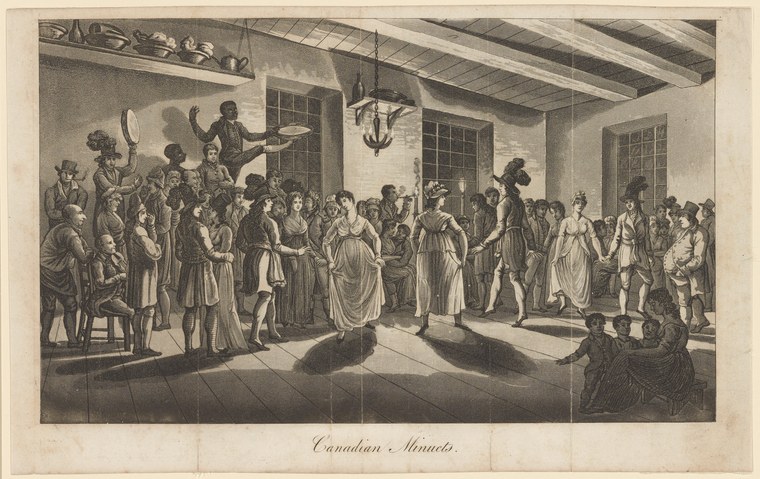
Canadian minuets
Unknown artist
- Medium:
- Engraving
- Dance:
- Minuet
- Era:
- 1700s (Enlightenment/Minuet Era)
- Source:
- New York Public Library
- Rights:
- Public domain — free to use, share and adapt.
- Recorded as:
- public_domain
The minuet was the high art of 18th-century ballroom dancing, and this engraving is a rare visual record of it in practice—showing not step-by-step instruction but the lived reality of how couples performed it in a formal assembly. For students of social dance history and period practice, the print documents the scale of the ballroom, the ratio of dancers to observers, the dress, and the formal spacing that governed the dance. The image also illustrates the engraving's role in spreading knowledge of fashionable behavior: this print was a manual for the aspirational, a way to learn what one should look like on a ballroom floor.
What you are looking at
A crowded interior scene of a formal social gathering, likely eighteenth-century, shows more than fifty figures arranged in loose groups across a substantial room with exposed beam ceiling and tall sashed windows. The figures wear the dress of the 1700s: women in long gowns with full skirts, many with their hair up; men in breeches, coats, and hats. At the center of the composition, several couples appear to be dancing or about to dance, while others stand in conversation or observation around the periphery. The floor is marked with strong geometric shadows cast by the windows, emphasizing the recessed spatial depth. A trident symbol hangs from the ceiling, possibly indicating Neptune or a masquerade theme. The scene captures a moment of social choreography—some bodies in motion, others poised and watching, all within a clearly defined ballroom or assembly room.
The dancing
The central dancers stand in an upright, formal posture characteristic of eighteenth-century ballroom etiquette. At least two or three couples are positioned face-to-face or in approximate social distance rather than in a tight closed hold. Their arms appear extended but not locked; the stance is one of controlled elegance rather than embrace. Many figures throughout the room hold themselves with the stiffness expected of formal dress and social performance. The engraver has paid attention to the turn of heads and angle of bodies to suggest the social dynamics of the gathering—some figures lean in conversation, others stand aloof.
The dance depicted
The title identifies this as depicting Canadian minuets, though the historical context of a 'Canadian' minuet in the 1700s requires skepticism—Canada was not independent, and 'Canadian' may be a later label or a reference to a colonial adaptation or a minuet with a Canada-themed name that circulated in European ballrooms. The minuet was the dominant courtly and upper-class social dance of the 18th century and remained the opening dance of formal balls well into the 1800s. The composition—couples, formal spacing, upright carriage, the ballroom setting—is entirely consistent with minuet practice. The presence of many onlookers is also typical: minuets were performed in a sequence, with couples dancing in turn while others observed. However, without closer detail of footwork or hand position, the identification must rest on setting, costume, and social context rather than visible technique.
How it was made
This is an engraving, a technique in which an image is incised into a metal plate (usually copper), inked, and printed. Engravings of this type—with fine parallel lines (hatching) to create tone and shadow—were the dominant medium for reproducing social scenes and dance imagery in the 18th century. The technique allowed wide distribution and was far cheaper than painting; an image like this would have circulated in prints, bound volumes, and collections of social manners. The precision of the line work and the careful composition suggest the work was made for a educated, prosperous audience interested in both dance practice and fashionable behavior. The engraver's hand is evident in the deliberate use of light and shadow to structure the crowded space.
About this work
This engraving depicts a formal 18th-century ballroom gathering identified as illustrating Canadian minuets—the opening and most prestigious social dance of the period. More than fifty figures, dressed in the full formal attire of the era, occupy a spacious room with tall windows and exposed beams. At the center, couples in minuet posture perform or prepare to perform while the rest of the assembly observes, converses, and waits their turn. The scene is a document of ballroom ritual: the minuet was not merely a dance but a theatrical display of grace, control, and social rank, and this print captures the hierarchy of participant and observer that defined its performance.
The work belongs in a gallery of dance imagery because it records not the steps themselves—which no engraving could fully convey—but the *social choreography* of the ballroom: the spacing, the formality, the presence of an audience, the pause and turn of bodies through space. It shows minuet-dancing not as an isolated technique but as an embedded social practice, one that structured an entire evening and demonstrated the dancer's breeding and courtesy. For historians, it is evidence of how dance functioned in 18th-century elite life; for dancers, it is a window into the world their ancestors inhabited.
How to look at it
Begin with the architectural framing: the room's proportions, the geometry of windows and beams, the careful perspectival recession. Notice how the engraver has used shadow and light—the diagonal shadows on the floor—to create spatial depth and to focus the eye on the central dancers. Then observe the bodies: the stillness and uprightness of the formal stance, the distance maintained between partners, the turn of the head and shoulder. Finally, attend to the social structure the image encodes—who dances, who watches, where people stand, how the space is organized. The minuet was a dance of display and observation; this print captures that logic entirely.
The period
The minuet dominated European ballroom culture from roughly 1650 to 1800, though it remained fashionable in some circles well into the 19th century. By the 18th century, it had become the opening dance of every formal ball and assembly, a ritualized display of elegance and social status. The dance required training—steps, timing, and comportment had to be taught—and minuet-masters were fixtures in the households of the gentry and nobility. Engravings of ballroom scenes were popular in the 18th century as both instructional aids and as fashionable prints for display; they documented the rituals of the drawing room and the ballroom for an audience eager to understand and emulate polite society. The proliferation of such prints reflects both the commercial expansion of print culture and the codification of social manners as a subject of public interest and instruction.
Where it lives
The work is held in the New York Public Library collection. It is catalogued as an 18th-century engraving, part of the NYPL's holdings of prints documenting social history and dance practice.
Dance in this work
Questions about this work
What is a minuet?
The minuet was a slow, stately couple dance in triple time that dominated European ballroom culture in the 17th and 18th centuries. It required training and was considered the mark of good breeding. Couples danced it in turn while others watched; it was as much a display of grace, posture, and manners as a display of footwork. By the 18th century, no formal ball began without minuets.
Why are there so many people not dancing?
The minuet was danced in sequence: one or two couples would perform while the rest of the assembly observed and waited. This was part of the ritual—minuet-dancing was a form of social theater. Watching was as important as dancing; it allowed the audience to admire (or judge) the dancers' grace and deportment.
What does 'Canadian minuet' mean?
The historical meaning is unclear. Canada was not independent in the 18th century. The title may refer to a minuet with a Canada-themed name or melody that circulated in European ballrooms, or it may be a later label applied by a cataloguer. Without additional documentation, the origin of the name cannot be determined.
How do we know this is a minuet and not another 18th-century dance?
The composition—the formal spacing, the upright carriage, the ballroom setting with spectators, the couple-based structure, the dress—all match minuet practice. The title also identifies it as such. Without close-up detail of footwork, we cannot see the specific steps, but the social and spatial choreography is unmistakable.
More Minuet artwork