49 works in this view — arrow keys or swipe to move between them.
Dance in Art
Rope dancing
Unknown artist
- Collection:
- Prints depicting dance
- Source:
- New York Public Library
- Rights:
- Public domain — free to use, share and adapt.
- Recorded as:
- Public Domain
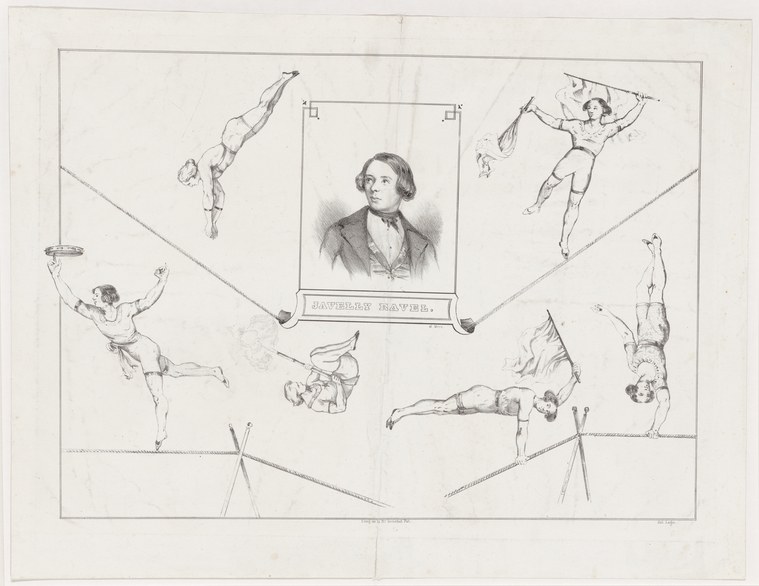
Rope dancing is a largely forgotten performance tradition that bridged circus, theatre, and street entertainment for over two centuries. This image is one of the primary visual records of what professional rope dancers actually performed and how their bodies moved, providing crucial documentation of an acrobatic vocabulary that would otherwise be lost to written description alone. For historians of circus, popular entertainment, and embodied skill, it is an invaluable record of technique.
What you are looking at
A portrait-centered composition showing a man's head and shoulders in the middle of the frame, surrounded by eight acrobatic figures executing stunts on tightropes. The central figure wears early 19th-century dress—a dark coat and cravat rendered in subtle shading. Around him, arranged at various angles along diagonal lines that suggest ropes under tension, are male and female acrobats in light tunics and tights, captured mid-movement: one upside-down in a handstand, others in splits or backbends, one performing what appears to be a headstand. The figures are drawn with anatomical precision, their musculature and joints sharply defined. The composition uses radiating lines from the portrait to anchor the acrobatic figures in space, creating a theatrical or promotional arrangement rather than a narrative scene. The style is neoclassical line engraving, with minimal background detail to focus attention on human form in extreme positions.
The dancing
The acrobats display the extended and inverted body positions characteristic of rope and contortion performance: several show full leg extensions in splits, one performs an inverted balance with legs overhead, and others demonstrate the arched backs and shoulder flexibility required for rope work. The bodies are rendered with anatomical accuracy, emphasizing musculature and joint articulation to show the physical demand of the skills. The central portrait figure is static and dignified by contrast, suggesting this may be a celebrated performer or director. The composition shows approximately seven to eight acrobats of mixed apparent gender, each isolated in individual feats rather than partnered or grouped.
The dance depicted
This depicts rope dancing (or rope-vaulting), a circus and theatrical performance art popular throughout the 18th and 19th centuries, in which acrobats performed acrobatic feats while walking, running, or balancing on tightropes. The array of stunts shown—handstands, splits, backbends, and headstands—were signature elements of professional rope-dancers' repertoires, often performed as solo exhibitions of skill rather than choreographed ensemble work. The central portrait suggests this may document a celebrated performer or troupe director, though the catalogue record does not confirm identity. Rope dancing was a staple of popular entertainment, performed in circuses, fairgrounds, and theatres, and required extraordinary flexibility, balance, and core strength. The precise execution shown here indicates professional, trained acrobats of some renown.
How it was made
This is a line engraving, identifiable from the fine parallel hatching used to create tone and shadow, particularly in the portrait's face and clothing, and the crisp black-and-white linework defining the acrobatic figures. Line engraving was well-suited to anatomical precision and could be widely reproduced and distributed, making it an ideal medium for documenting and promoting celebrated performers and spectacles to a broad audience. The careful delineation of musculature and the formal compositional arrangement suggest this was created as a commemorative or promotional print rather than a casual sketch. Engravings of this type served as both artistic records and popular souvenirs, circulating among audiences and collectors interested in theatrical performance.
About this work
This is a neoclassical line engraving documenting rope dancing, a major form of popular entertainment in the 18th and 19th centuries. The print combines portraiture of what appears to be a celebrated performer or troupe director with a systematic display of the acrobatic vocabulary of rope performance—the splits, handstands, backbends, and inversions that demonstrated a professional rope-dancer's technical mastery. The composition is formal and instructive rather than narrative, arranged almost as a compendium of skills, yet energetic in the variety of positions and the implied tension of the diagonal ropes.
Rope dancing occupied a peculiar position in the entertainment hierarchy of its era: prestigious enough to attract large paying audiences and to merit commemorative prints, yet regarded as a low or popular art form by academic standards. This print is valuable as both a record of what rope dancing looked like in performance and as evidence of how the skill was marketed, displayed, and celebrated through visual media.
How to look at it
Look first at the central portrait: the steady, dignified gaze of the central figure stands in stark contrast to the dynamic, extreme physicality of the surrounding acrobats, suggesting a distinction in status or role. Observe how the artist has used the radiating diagonal ropes to organize the composition and create spatial depth, anchoring each acrobat to a specific plane. Pay attention to the anatomical precision with which each body is rendered—the artist has taken care to show exactly where the spine bends, where the legs extend, and how the shoulders open. Notice that while the positions are extreme, they are drawn with scientific accuracy rather than caricature, indicating the artist's respect for the performers' technical skill and physical achievements.
The period
Rope dancing flourished particularly in the late 18th and 19th centuries as a staple of popular entertainment across Europe and America. Celebrated rope-dancers became celebrities, performing in theatres, circuses, and at fairs, and their feats were widely documented in popular prints, broadsides, and theatrical advertisements. The anatomical precision and neoclassical formal arrangement of this engraving suggests it was created during a period when popular entertainers were increasingly documented through fine-art media, elevating performers to the status of worthy subjects for engraving and print circulation. The portrait element indicates that the subject may have been a star of significant renown.
Where it lives
The work is held in the New York Public Library's collection of prints depicting dance. It is catalogued as a historical document of theatrical performance, though the specific identity of the subject and the exact date of creation are not recorded in the available catalogue.
Dance in this work
Questions about this work
What is rope dancing and how was it performed?
Rope dancing was an acrobatic performance art in which trained performers executed acrobatic feats—handstands, splits, backbends, headstands, and other inverted or extended positions—while standing, walking, or balancing on a tightrope. It was a staple of circus, theatrical, and fairground entertainment from the 17th through 19th centuries and required extraordinary strength, balance, flexibility, and nerve. Professional rope-dancers were celebrated performers, often becoming celebrities with significant public followings.
Who was the performer shown in this print?
The catalogue record does not identify the central portrait figure, so the subject's name is not currently known. However, the careful, commemorative nature of the engraving suggests this was a celebrated performer of significant renown, as stars of rope dancing were frequently documented in popular prints and theatrical engravings.
When was this made?
The catalogue record lists the date as unknown. However, the style of the engraving and the neoclassical treatment of the human form suggest it was made in the late 18th or 19th century, when rope dancing was at the height of its popularity and professional performers were being documented in fine-art media.
Why is rope dancing important to dance history?
Rope dancing represents a now-vanished tradition of acrobatic performance and popular entertainment that employed highly trained, specialized bodies. It documents a form of skill and athleticism that was celebrated in its time but has largely disappeared from modern performance, making visual records like this engraving crucial for understanding the history of embodied skill, circus arts, and popular entertainment.
More dance artwork





