49 works in this view — arrow keys or swipe to move between them.
Dance in Art
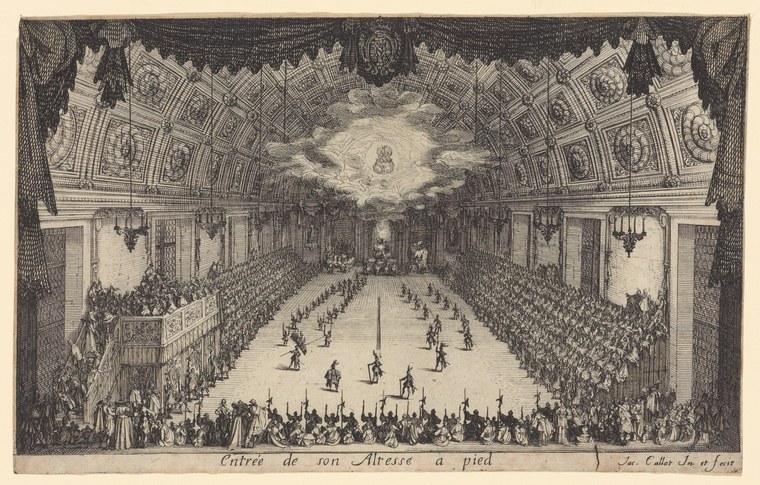
Entrée de son Altesse à pied
Unknown artist
- Collection:
- Prints depicting dance
- Source:
- New York Public Library
- Rights:
- Public domain — free to use, share and adapt.
- Recorded as:
- Public Domain
The entrée was a fundamental genre in early ballet and court spectacle, blending procession, music, and choreography into a single ceremonial form. This image shows the physical and architectural context in which such entries occurred—the formal hall, the hierarchical arrangement of participants and witnesses, and the theatrical perspective used to stage them. Understanding the visual and spatial logic of the entrée is essential to understanding the birth of ballet as a courtly art form.
What you are looking at
A formal ceremonial procession unfolds in a grand, coffered hall. The space is vast and symmetrical, with a barrel-vaulted ceiling decorated in geometric panels and illuminated by clouds of light at the apex—suggesting divine presence or theatrical illumination. Two colonnade galleries line the sides, filled with seated spectators who create a dense, orderly frame for the central action. Down the middle of the hall runs a single file of figures in formal dress, advancing toward the light source at the far end. The foreground is crowded with standing observers in rich costume—some in cloaks, some in court dress—creating a sharp visual contrast between the formal processional line and the press of witnesses. The perspective is deep and theatrical, emphasizing the ceremonial weight of the moment.
The dancing
The central figures walk upright and deliberate, maintaining a formal line with no visible dance hold or partnering. Their posture is rigid and processional—the gait of a ceremony rather than social dance. Some figures appear to carry items (possibly insignia or ceremonial objects). The spectators in the foreground stand in static poses, observing rather than participating. Heads are turned toward the processional line. The overall body language is one of formal witnessing and hierarchical arrangement rather than participatory or social movement.
The dance depicted
This does not depict dance in the modern sense, but rather a formal state or ceremonial entry—the 'entrée' of a person of high rank. The inscription reads 'Entrée de son Altesse à pied' (Entry of His Highness on foot), indicating a court spectacle or state ceremony typical of 17th-century European court culture. Such entries were often accompanied by dance and music but are here shown as a processional progression. The scene records a moment of formal display and audience assembly rather than choreographed movement. The work documents court ceremony as a form of staged presentation.
How it was made
This is a print, most likely an engraving or etching on copper based on the fine linear hatching, tonal gradation, and crisp detail characteristic of Northern European printmaking. The technique allows for precise architectural rendering and compositional depth. The print format indicates this was a widely distributed image—a record of the ceremonial event intended for circulation among court and courtly audiences across Europe. The detail and formal composition suggest a professional print commissioned to commemorate or document the spectacle.
About this work
This is a document of formal court ceremony cast in the language of theatrical architecture and perspective. It records an 'entrée'—a formal procession by a person of high rank through a ceremonial hall—witnessed by assembled courtiers. The image belongs in a gallery about dance because court ceremonial entries were foundational to early modern European dance culture and often incorporated dance, music, and choreography. This print shows the theatrical framing and spatial organization within which such ceremonies—and the dances that accompanied them—took place. The work is evidence of how dance was integrated into state ceremony and court display.
How to look at it
Observe the mathematical precision of the perspective: the viewer's eye is drawn down the receding line of the procession toward the light at the far end, a device that emphasizes the ceremonial importance of the journey. The symmetry of the galleries and the regularity of the crowd frame the proceeding as a stage for power. Notice the freeze-frame quality: the print captures no motion, only formal assembly and the pause before or during passage. This is typical of courtly engraving, which recorded the dignity and order of ceremony rather than its kinetic moments. The composition itself is the dance—the ordering of bodies and space according to rule and hierarchy.
The period
This print dates to a period when court ceremonies and ballets were inseparable from state power and courtly display in France, Italy, and the Holy Roman Empire. The formal hall architecture and the ceremonial procession reflect 16th- and 17th-century court practice. In this era, 'entrées' were often components of elaborate court ballets—longer spectacles that combined song, dance, costumes, and machinery. The print records a moment when dance was not yet an autonomous art form but rather one element of a larger courtly and political performance. The formal composition and technical precision of the engraving indicate this was an official record, likely commissioned to commemorate a significant state event.
Where it lives
This work is held in the New York Public Library's collection of prints depicting dance. It is a historical document of court ceremony, circulated in print form as a record of formal court spectacle.
Dance in this work
Questions about this work
What is an entrée and how does it relate to early ballet?
An entrée was a formal processional entry, often by a person of high rank, that became a standard genre in court ballet during the 16th and 17th centuries. Entrées typically combined procession, costume, music, and choreography into a single ceremonial number. This print shows the architectural and ceremonial framing within which such entries took place, revealing the close connection between court ceremony and the origins of ballet.
Who would have seen this print?
Court prints were commissioned to document significant ceremonial events and circulated among courtiers, nobility, and the educated elite across Europe. This image served as a record of the spectacle for those who attended and as a visual account for those in other courts who had not witnessed the event. Such prints also established the aesthetic and compositional standards by which court spectacles were understood and remembered.
Why is there no actual dancing shown here?
The entrée itself was a formal procession rather than a choreographed dance in the modern sense. However, entrées typically occurred as part of larger court ballets and were accompanied by music and often interspersed with danced sections. This print captures the processional moment—the formal entry—which was the framing act within which dancing and other spectacles occurred.
More dance artwork





