34 works in this view — arrow keys or swipe to move between them.
Dance in Art · 2019
The Devonshire minuet
Unknown artist
- Medium:
- Engraving
- Dance:
- Minuet
- Era:
- 1700s (Enlightenment/Minuet Era)
- Source:
- New York Public Library
- Rights:
- Public domain — free to use, share and adapt.
- Recorded as:
- public_domain
This engraving is primary evidence for how the minuet was actually performed and presented in the 18th century—not as historical description but as contemporary documentation of a live social practice. The image reveals the minuet as a display form: a dance watched and evaluated by others, executed with deliberate elegance, and embedded in the apparatus of fashionable society. For historians and dancers, it offers concrete visual information about posture, frame, spatial relationships, and the social performance that surrounded the dance itself.
What you are looking at
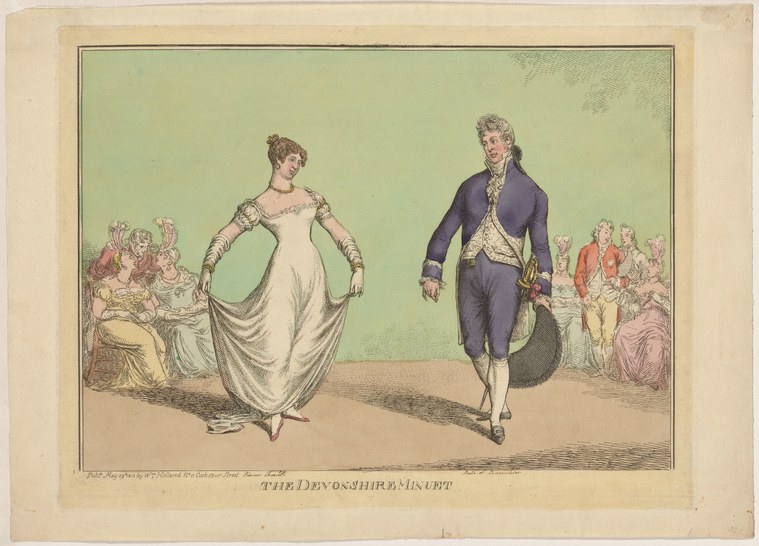
A formal dance scene set in an interior space with a pale green background, populated by fashionable figures in late 18th-century dress. In the center, a man in a dark blue coat with gold embroidery and white breeches executes a minuet step, one leg extended, holding his hat in his right hand. Opposite him stands a woman in a high-waisted white muslin gown with puffed sleeves, her posture upright and graceful. Both dancers occupy the middle ground, their bodies angled toward each other in the formal geometry of the minuet. Flanking them on both sides are groups of onlookers—seated and standing figures in fashionable dress, suggesting this is a performance or demonstration before an audience rather than a private lesson. The composition emphasizes the couple's isolation within their dance space while simultaneously framing them as objects of social observation.
The dancing
The male dancer displays the characteristic minuet posture: an elongated line through the torso, one leg extended in a controlled, turned-out position, the upper body erect, the free arm curved at the elbow holding his hat. The female dancer mirrors this formality—upright carriage, arms positioned gracefully, her body turned to face her partner. Both figures maintain the closed but not-quite-touching frame typical of the minuet, where partners acknowledge each other's presence without contact. The spacing between them and the careful positioning of their limbs suggest disciplined training in courtly movement; every line speaks of control and restraint rather than spontaneity.
The dance depicted
This is almost certainly a depiction of the minuet, the dominant social and courtly dance of the 18th century. The title confirms this, and the style, dress, and formal setting all support it. The minuet was danced by couples in the presence of onlookers, often as a display of refinement and social standing. The artist has captured the characteristic moment of the minuet's S-shaped floor pattern—the dancers separated, the man's extended leg and the woman's elegant carriage showing off the turned-out line prized in courtly movement. The presence of an audience suggests this may depict a formal ball or assembly rather than everyday social dancing. The epithet 'Devonshire' in the title likely references either a specific variation of the minuet or a notable dancer known for performing it in fashionable circles.
How it was made
This is a hand-colored engraving, a reproductive medium that allowed wide distribution of fashionable imagery in the 18th century. The delicate lines of the engraving define form with precision—the folds of the woman's gown, the braiding on the man's coat, the individual figures in the background—while the watercolor wash adds atmosphere and costume detail. Engravings of this type were commercial products, likely sold as individual prints to middle- and upper-class audiences interested in fashion, manners, and social life. The technique's clarity and portability made it ideal for documenting and disseminating knowledge of correct dance deportment and fashionable behavior.
About this work
This is a hand-colored engraving documenting the minuet, the signature dance of 18th-century elite society, as performed in fashionable circles. The image captures not just the dance itself but the social context in which it existed—a formal demonstration before an appreciative audience, where the minuet served as a performance of refinement, education, and social status. The artist demonstrates careful understanding of minuet technique: the turned-out line, the elongated frame, the controlled separation of the partners, and the geometric precision of the movement. As a commercial print, the work served to circulate knowledge of correct minuet style to an aspirational audience and to document the aesthetics of 18th-century courtly dance at a moment when the minuet was approaching the height of its cultural dominance.
How to look at it
Observe the careful spacing and angles of the two dancers' bodies. The minuet was a dance of approach and retreat, of geometric floor patterns traced by the couple as they moved through an S-shaped path. The artist has frozen a moment when the dancers are separated, perhaps mid-step, showing the extended line of the male dancer's leg and the woman's responsive posture. Notice too the audience: the minuet was not a private gesture but a public performance, watched and judged. The composition makes this clear by framing the dancers within a larger scene of observation. This tells us that the minuet was about displaying knowledge of correct form, not about spontaneous expression.
The period
The minuet was the dominant courtly and social dance of the 18th century, particularly in France and among European aristocracy and aspiring gentry. By the late 1700s, when this print was likely made, the minuet had been established for nearly a century as the essential mark of good breeding and correct deportment. Dancing masters published treatises on minuet technique, and knowledge of the dance was essential for anyone seeking entry into polite society. At the same time, the minuet was beginning to decline in favor—faster, more energetic dances like the contredanse and cotillion were becoming fashionable—but its prestige remained high. The print documents this moment of the minuet's continued cultural authority, even as its social dominance was waning.
Where it lives
The work is held in the New York Public Library collection and is documented as an 18th-century engraving. It represents the kind of commercial print that circulated widely among educated and aspiring audiences to document fashionable behavior and style.
Dance in this work
Questions about this work
How do we know this shows a minuet and not another 18th-century dance?
The title states this explicitly. Additionally, the visual evidence supports it: the formal, turned-out posture of both dancers; the separated frame (not touching, but in close proximity); the presence of an audience; and the elegant restraint of the movement all match descriptions and other depictions of minuet technique. The dress and setting are also consistent with the minuet's status as a courtly, fashionable dance.
What does the 'Devonshire' in the title mean?
This likely refers to either a specific variation of the minuet known by that name, or possibly to a well-known dancer or dancing master associated with the Devonshire family or known for performing this minuet. Without further documentation, the precise reference cannot be determined, but the epithet suggests this was a named, recognizable version of the dance, not a generic minuet.
Why is the couple not touching?
The minuet was danced with partners in close proximity but without contact. Dancers moved through prescribed floor patterns, approaching and retreating from each other, their bodies turned outward in the balletic line prized in courtly dance. This formal separation was part of the dance's aesthetic and its social meaning—it emphasized control, respect for one's partner, and the formality of the occasion.
Who danced the minuet?
The minuet was the dance of the aristocracy and gentry, and knowledge of it was essential for anyone seeking entry into polite society in the 18th century. Dancing masters taught it to paying students, many of them aspiring middle-class families. The presence of an audience in this print suggests a formal occasion—a ball or assembly—where the minuet would be performed by couples of social standing.
More Minuet artwork