49 works in this view — arrow keys or swipe to move between them.
Dance in Art · 2020
Dancing.
Unknown artist
- Medium:
- Source:
- New York Public Library
- Rights:
- Public domain — free to use, share and adapt.
- Recorded as:
- public_domain
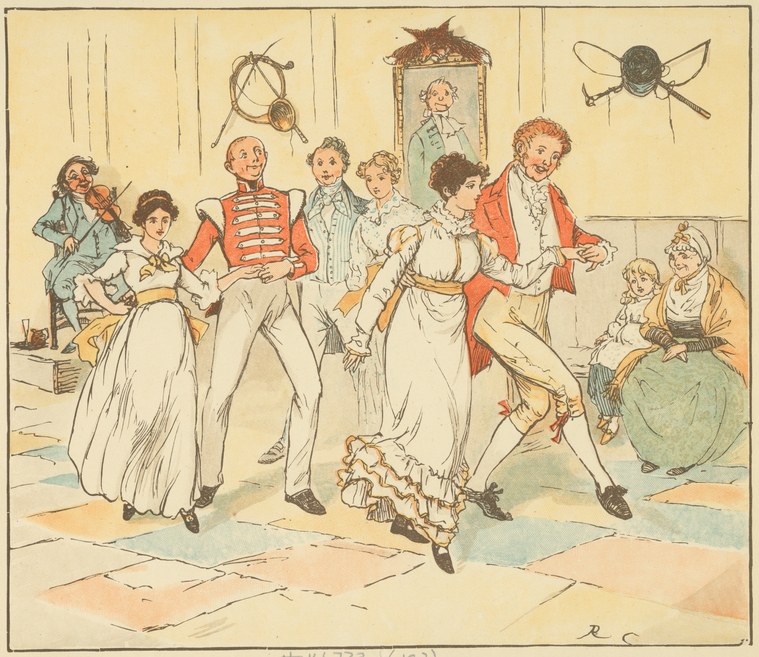
The image preserves evidence of how dance and performance functioned in domestic Regency social life: not as a separate theatrical event, but as one element of an evening's mixed entertainment involving games, display, and social interaction. For historians of ballroom culture and courtship ritual, it reveals the informal, playful context in which formal dances like quadrilles and cotillions occurred.
What you are looking at
A lively interior scene depicts a mixed group of figures in early 19th-century dress arranged around a room with a polished floor. In the center, a man in a striking red military coat with white trim stands in a prominent pose, his weight shifted onto one leg in an attitude of display or performance. Around him cluster women in high-waisted white muslin gowns and a variety of men in formal dress—some in colored coats, others in pale breeches and stockings. A small child in white sits on the floor in the foreground. The scene is framed by domestic furnishings: a mirror on the back wall, what appears to be musical instruments (a harp and other objects) hung above, and sketched windows suggesting a drawing room. The composition is crowded and playful, with figures at various heights and depths, some watching, others engaged with each other or the central figure. The artist uses watercolor or hand-tinted print techniques, with soft washes of color—pale yellows, greens, and blues—that give the scene an intimate, sketch-like quality.
The dancing
The bodies show varied postures and levels of engagement: the central man strikes a deliberately theatrical stance with one leg extended and arms held away from his body, a posture of presentation rather than partnership. The surrounding figures adopt social positions—some upright and observant, one woman with a child held at her side, others clustered in conversational pairs. The women's high-waisted gowns fall in long straight lines from the bust, characteristic of the Regency silhouette, while the men's breeches and stockings suggest the formal ballroom dress of the period. No closed holds or partner frames are visible; instead, figures occupy individual or loosely grouped positions suggesting a moment of spectacle or game rather than structured dance.
The dance depicted
The image most likely documents a social dance occasion—a Regency-era drawing room or ballroom entertainment—but the specific dance form remains ambiguous from the composition alone. The central man's exaggerated stance and the watching attitudes of others suggest a moment of display: possibly a demonstration, a game involving forfeiture or performance (such as those common in Regency parlor amusements), or a theatrical moment within a larger social gathering. The dress and setting place this firmly in the early 19th century, when such mixed-company entertainments in the home were fashionable among the gentry. The image captures sociability and performance rather than formal ballroom choreography.
How it was made
The work is a hand-colored print, likely a watercolor or hand-tinted engraving or lithograph given the delicate line work and soft color washes. The technique is economical and gestural—the artist sketches quickly, using simple contours and minimal shading, which gives the scene immediacy and the quality of an eyewitness account. This was a typical medium for social satire and genre scenes of the period, reproduced as prints for a broad middle-class audience. The technique's informality and the work's apparent circulation through a public collection suggest it was intended as entertainment and social commentary rather than a commission for a wealthy patron.
About this work
This is a Regency-era scene of domestic entertainment, a hand-colored print capturing a moment in an early 19th-century drawing room where a mixed group gathers around a man in a red military coat who is striking an exaggerated, performative pose. The scene documents the social rituals and parlor games that accompanied formal dancing and courtship in Regency England, where moments of individual display and theatrical behavior punctuated more structured social dances. The work belongs in the history of dance imagery because it records not choreographed performance but the performative social world in which ballroom and social dances took place—the flirtation, spectacle, and amateur entertainment that framed formal dance.
How to look at it
Attend to the central figure's deliberately unnatural posture—the extended leg and held arms create a theatrical, almost cartoonish effect that suggests mockery or exaggeration rather than genuine movement. Notice how the surrounding figures frame him as audience: their upright, watching postures and the way they are arranged around him suggest that the moment captured is one of display or performance, not participation in a coordinated dance. The artist's use of the red coat to draw the eye to the center, combined with the crowded, sketch-like composition, creates the sense of a lively, chaotic social moment rather than the orderly geometry of a formal ballroom dance.
The artist
The artist is not recorded in the catalogue. The style and subject matter—a genre scene of Regency social life rendered in the manner of contemporary caricature and satire—suggest a professional illustrator or caricaturist working in early 19th-century Britain, possibly associated with the tradition of social satire that included artists like Thomas Rowlandson. The work's provenance through the New York Public Library suggests it circulated as a print or illustration in popular collections.
The period
The image dates to the Regency period (c. 1811–1820) or the years immediately following, a moment when the English country dance and the quadrille were beginning to reshape ballroom culture. Regency society was marked by intense interest in courtship rituals, the formalization of ballroom etiquette, and the emergence of the drawing room as a space for mixed-gender social performance. Contemporary prints and literary evidence (particularly the novels of Jane Austen, whose work coincides with this era) document the importance of dancing as social accomplishment and courtship opportunity. At the same time, parlor games and amateur theatricals—moments of forfeiture and display like the one depicted here—were fashionable entertainments that offered opportunities for flirtation and self-presentation outside the formal structure of a dance.
Where it lives
The work is held by the New York Public Library as part of its print collection. It is catalogued by title alone and lacks artist attribution, accession details, or detailed provenance, suggesting it is one of many circulating prints of the period acquired as an example of popular social illustration rather than a documented unique work.
Dance in this work
Questions about this work
Is this a formal ballroom dance?
No. While the setting and dress indicate a formal social gathering in the Regency era, the composition captures a moment of informal display or parlor entertainment rather than structured choreography. The central figure's theatrical pose and the watching postures of others suggest a game or moment of individual performance within a larger social occasion.
What is the red coat and why is it emphasized?
The red coat was a military uniform, a mark of status and fashion in Regency society. Its prominence in the composition—bright red against the pale muslin gowns of the women—draws the eye to the central figure and emphasizes his position as the focus of attention in the moment the artist has chosen to illustrate.
What dances would have been danced at such a gathering?
By the early 19th century, a Regency drawing room would have featured quadrilles, cotillions, country dances, and the newer waltz. However, this print captures the social frame rather than the dances themselves—the flirtation, display, and amateur entertainment that punctuated formal dance.
More dance artwork