49 works in this view — arrow keys or swipe to move between them.
Dance in Art
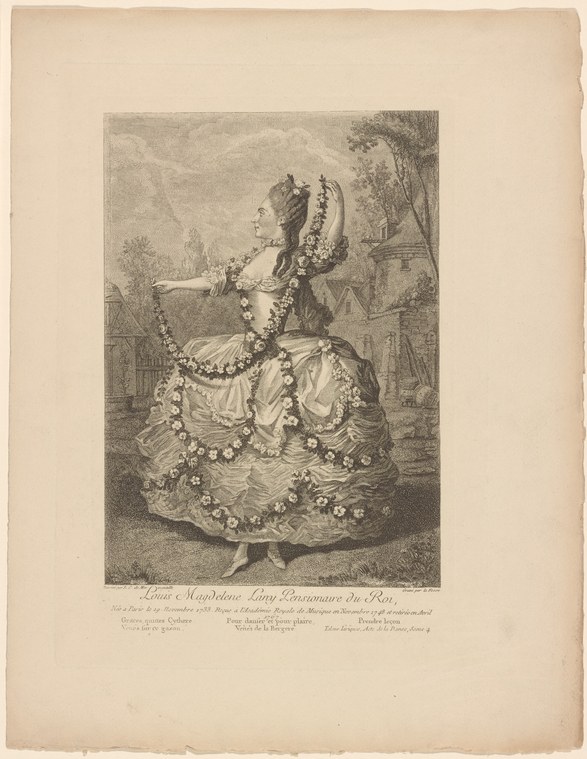
Louis Magdelene Lany pensionaire du roi: née à Paris le 19. novembre 1733, reçue à l'Académie royale de musique en novembre 1748 et retirée en avril 1767
Unknown artist
- Collection:
- Prints depicting dance
- Source:
- New York Public Library
- Rights:
- Public domain — free to use, share and adapt.
- Recorded as:
- Public Domain
This engraving is a rare documentary record of a named professional dancer from the age of Louis XV, showing exactly how a celebrated performer was dressed, posed, and publicly presented—invaluable evidence for understanding the visual culture of mid-eighteenth-century French ballet and the professional status of women dancers. It demonstrates that court and theatrical dancers were celebrated enough to merit formal portraiture and wide circulation through the print market, and it preserves the gestural language and costume aesthetic of this crucial period in ballet's development from court entertainment to staged performance art.
What you are looking at
A full-length portrait of a woman in elaborate eighteenth-century court dress, shown in three-quarter view against a classical architectural background. She wears an ornate gown with a full skirt of pale silk or satin, decorated with pearl or jeweled garlands that swag across the bodice and drape down the front—a signature of mid-eighteenth-century fashion. Her hair is dressed high and back, adorned with pearls and ribbons. She holds a fan in her right hand and gestures gracefully with her left arm extended, her body poised as if caught mid-movement or frozen in a moment of elegant repose. The setting is a formal garden or palace courtyard, with trees and architecture visible behind her. The composition and refined pose suggest this is a portrait of a professional dancer or court performer of high standing, capturing her in the gestural language of her profession rather than in daily dress.
The dancing
A single standing female figure dominates the composition, her weight lightly supported on one leg in a balletic stance. Her left arm is raised and extended, the hand gracefully articulated—a gesture typical of courtly dance deportment. The right arm is bent at the elbow, holding a fan close to the body. Her head is slightly tilted, her gaze directed outward with the dignified composure expected of a court performer. The overall frame is upright and collected, with no suggestion of vigorous movement; instead, the pose conveys the restrained elegance and formal poise central to aristocratic dance of the period.
The dance depicted
This is a portrait of a professional dancer of the French court ballet tradition, most likely depicting a dancer trained in the theatrical ballet of the 1740s–1760s. The pose and costume reflect the vocabulary of noble or heroic roles in the court ballet and early theatrical ballet of the mid-eighteenth century—the lifted port de bras, the elegant carriage, and the ornamental garlands mimicking the costume of a leading female dancer (likely a *prima ballerina* or *pensionnaire* of the Académie Royale de Musique). The gesture language and frame suggest classical ballet training, though the pose is too restrained to indicate a specific step; rather, it captures the dancer in her formal costume and bearing, emphasizing elegance and noble demeanor over dynamic action.
How it was made
This is an engraving, recognizable from the fine parallel line work (hatching and cross-hatching) that models form and shadow, and the precise linear definition of the drapery folds and facial features. The technique allows for sharp detail and tonal gradation while remaining reproducible—engravings of this type were relatively expensive but widely circulated among the educated classes and patrons of the arts. The skill evident in rendering the complex texture of the gown and the delicate articulation of the hands suggests a professional printmaker of considerable ability, and the scale and presentation indicate this was intended as a commemorative or documentary portrait for circulation within courtly and theatrical circles.
About this work
This is a formal engraved portrait of a professional court and theatrical dancer of the mid-eighteenth century, likely created to commemorate her status and preserve an image of her in the costume and bearing of her profession. The inscription identifies her by name and professional credentials—a practice common in France for recording celebrated performers. The work sits at the intersection of dance history and court portraiture, documenting not just the person but the aesthetic ideals and costume conventions of the mid-eighteenth-century ballet world. It preserves a moment of theatrical and social prestige, capturing the formal dignity and refined movement vocabulary expected of a leading dancer at the French royal court.
How to look at it
Look first at the pose: the weight is held, not released; the extended arm is controlled and graceful, not energetic. This is the vocabulary of poise and dignity—the dancer as embodiment of aristocratic virtue, not as acrobat or virtuoso. The ornament of the costume—the pearl garlands, the elaborate hair, the fan—is as important as the body itself; the total image is a statement of status and taste. Notice how the engraver has rendered the face with individual character, the hands with careful articulation, and the drapery with meticulous attention to texture: this is a portrait of a real person, not an idealized type. The formal setting and classical architectural elements place her within the courtly world where her art was practiced.
The period
The mid-eighteenth century was a pivotal moment for ballet in France. The court ballet tradition—danced in costume among the aristocracy—was gradually yielding to theatrical ballet performed on stage by professional dancers for paying audiences. The Académie Royale de Musique (founded 1661) trained and employed dancers, and a successful career there conferred significant social status. Women dancers, in particular, were beginning to achieve celebrity and recognition; the inscription on this print marks the subject's professional credentials (born in Paris, received at the Académie in 1748, retired in 1767), suggesting she was a dancer of sufficient note to merit formal commemoration. The ornate costume and elegant bearing reflect the aesthetic of noble roles—roles designed to express aristocratic grace and refinement rather than technical virtuosity, though Lany's career spanned the transition toward more demanding choreography.
Where it lives
This engraving is held in the New York Public Library's collection of prints depicting dance, which houses similar commemorative portraits and theatrical prints from the eighteenth and nineteenth centuries. Objects of this type were created and distributed as records of celebrated performers and as mementos for patrons of the arts; they functioned as both artistic documents and commercial prints.
Dance in this work
Questions about this work
Who was Louis Magdelene Lany?
She was a professional dancer at the Académie Royale de Musique in Paris, engaged from 1748 to 1767. Her birth year, 1733, made her a teenager when she entered the Académie—a significant achievement. She performed during a crucial transition in French dance, when court ballet was becoming theatrical ballet, and her career spanned roles in both traditions.
What is she wearing, and why does it matter?
She wears an ornate gown of the 1750s–60s with full skirts, a fitted bodice, and applied pearl or jeweled garlands—typical costume for a leading female dancer in theatrical ballet of the period. The costume tells us she performed noble roles (heroic or tragic characters requiring elegant carriage) rather than comic or character roles. The elaborate ornamentation reflects the expense and prestige of professional dancing at the royal court.
What dance is she doing?
She is not performing a specific step or moment; rather, she is posed in the formal bearing and port de bras that defined a professional dancer's public image. This was the era before pointe work and before the dramatic expressiveness of Romantic ballet; the ideal was elegant, controlled, and aristocratic. The pose reflects the dancer's training and professional status rather than capturing a specific choreographic moment.
Why was this portrait made and circulated?
Engravings of celebrated performers were commissioned and sold to patrons and the public as records of famous dancers and as commemorative souvenirs. They functioned like photographs or celebrity portraits today—documenting the performer at her peak and circulating her image among those who admired her art. The inscription ensures she is remembered by name and professional credential.
More dance artwork





