49 works in this view — arrow keys or swipe to move between them.
Dance in Art
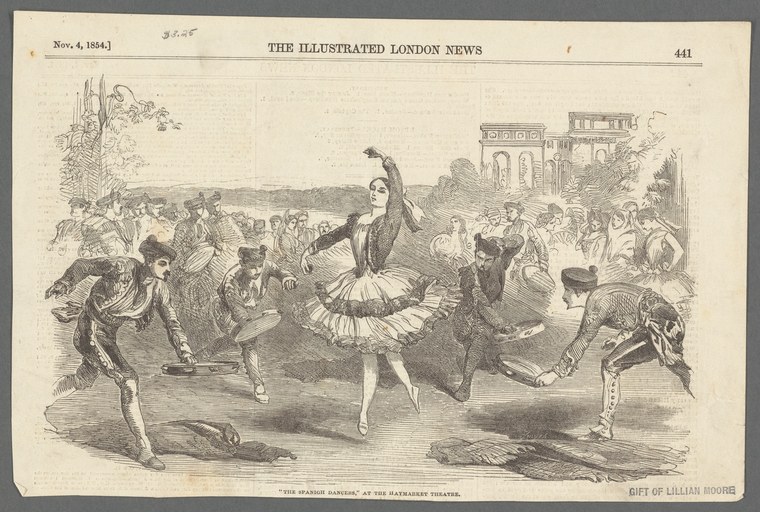
The Spanish Dancers, at the Haymarket Theatre
Unknown artist
- Collection:
- Prints depicting dance
- Source:
- New York Public Library
- Rights:
- Public domain — free to use, share and adapt.
- Recorded as:
- Public Domain
This image documents the exotic dance craze of the Victorian theater and shows how European audiences consumed and reimagined non-European dance traditions. For dance historians, it is evidence of a specific moment when 'Spanish' dance meant something very different from either authentic flamenco or later 20th-century codifications, and it shows the gender dynamics and virtuosity standards valued by that audience.
What you are looking at
A lively theatrical scene set in what appears to be an ornate interior space, with classical architecture visible in the background—columns and pediments suggesting a grand hall or theater stage. A central female dancer in a pale, voluminous skirt dominates the composition, captured mid-movement with one leg extended and arms outstretched. She wears a dark bodice and her pose suggests vigorous, virtuosic movement. Around her, numerous onlookers—both men and women in mid-19th-century dress—watch intently from the sides and background. The engraving's pen lines create a sense of bustle and animation: some spectators lean forward, others gesture, and the density of figures emphasizes the public nature of the performance. The foreground shows at least two male figures in profile, one of whom appears to be in motion himself, perhaps part of the ensemble or responding to the central dancer.
The dancing
The central female dancer stands in a position of extreme extension, with one leg raised high and the body arching backward or to the side—a pose requiring significant technical control and flexibility. Her arms are positioned to frame the movement and help with balance. The male figures in the foreground appear to be in supporting or ensemble roles, their bodies angled to accommodate the central figure's dominance of the stage. Multiple onlookers in the background create a framing effect, their varied postures (sitting, standing, leaning) suggesting they are witnessing rather than participating in the formal dance.
The dance depicted
The title identifies this as 'Spanish Dancers, at the Haymarket Theatre,' likely dating to the mid-19th-century craze for Spanish dance performances in London. The extreme technical extension, the theatrical setting, and the costume suggest a fusion style popular in Victorian theater—Spanish or Mediterranean-inflected dance performed within the balletic tradition rather than authentic flamenco or folk dance from Spain itself. The virtuosic, acrobatic quality of the central figure's pose and the presence of supporting dancers indicate this was professional theatrical performance aimed at fashionable London audiences, not social or social-ballroom dancing. The specific year is not given, but the engraving style and fashion suggest approximately mid-1850s.
How it was made
This is a wood engraving or steel engraving, identifiable by the fine parallel hatching lines, the precision of the line work, and the tonal control achieved through cross-hatching. The technique allowed for reproduction in print periodicals—this comes from The Illustrated London News, a weekly publication that reached thousands of middle- and upper-class readers. The medium meant the artist worked from a sketch or perhaps attended a performance and drew from memory; the theatrical subject matter and peripatetic nature of touring companies made engravings the primary way most Londoners experienced foreign dance performances. The small scale of reproduction meant detail in faces and costume had to be economical but recognizable.
About this work
This engraving documents a performance of 'Spanish Dancers' at the Haymarket Theatre, one of London's premier venues, captured for The Illustrated London News and thus circulated to a wide readership. It preserves a moment in the Victorian fascination with exotic theatrical dance—a fusion style that claimed Spanish heritage but operated within the technical and aesthetic conventions of English theater. The work is valuable not because it shows authentic Spanish or flamenco dance, but because it shows what mid-Victorian London audiences understood 'Spanish' dance to be: virtuosic, feminine, theatrical, and rooted in technical extension and lightness rather than in the grounded, rhythmic footwork of actual flamenco. The engraving captures both the performance itself and the social act of spectatorship—the crowded theater, the fashionable audience, the spectacle as a public event.
How to look at it
Observe the central dancer's extreme extension and upright carriage—the technical ideal of the period—and the way her body is framed by the watching crowd, which emphasizes her as a spectacle to be consumed. Note the precision of the engraver's line in rendering the volumetric skirt and the delicate articulation of the raised leg; these technical details convey the virtuosity and control expected of the performer. The background figures, though numerous, are secondary; the composition privileges the individual performer's technical display over narrative or social interaction, which is characteristic of 19th-century theatrical dance representation.
The period
The Haymarket Theatre was a fashionable London venue in the 1850s, and touring European and exotic dance companies were a major theatrical draw. The Victorian era saw an intensifying interest in foreign and 'Oriental' performance, driven by British imperialism, cosmopolitan urban centers, and the rise of lithographic and engraved illustration in newspapers and periodicals. Spanish dance, in particular, was marketable to English audiences as both European and exotic—close enough to be respectable but foreign enough to be thrilling. The virtuosic, balletic interpretation shown here reflects the dominance of ballet technique in European theaters of the period; technical extension, control, and lightness were the measures of achievement. This image dates to the height of Romantic ballet (roughly 1830–1850s), when the ethereal, weightless ideal of the Romantic ballerina was transposed onto other dance traditions.
Where it lives
This engraving is held in the New York Public Library's collection of prints depicting dance. It appeared in The Illustrated London News, a mass-circulation weekly that served London's educated and affluent readers, making it a primary source for how Victorian audiences encountered and understood theatrical dance.
Dance in this work
Questions about this work
Was this 'Spanish dance' actually from Spain?
Probably not in any authentic sense. Victorian theatrical companies marketed Spanish or Mediterranean-themed dances that drew on ballet technique, Romantic-era aesthetics, and European ideas of 'Spain' rather than on living Spanish tradition. It was exotic entertainment designed for London audiences, not a documentation of Spanish folk or flamenco practice.
Why is the dancer in such an extreme position?
The pose displays technical virtuosity and control—the ability to achieve high, clean extensions was a marker of elite dance training in the 19th century. The dramatic position also makes for a legible, eye-catching image in print, which served the engraver's and publisher's purposes.
Who were the Spanish Dancers?
The engraving does not identify the specific performers. Touring European dance companies were common in 1850s London, and many performers went by stage names or were billed as troupes rather than individuals. The Haymarket Theatre regularly hosted such companies, but without the date of the original performance, the specific dancers cannot be traced.
What is The Illustrated London News?
A weekly periodical founded in 1842, it was one of the first to combine text and engraved illustration on a large scale. It reached middle- and upper-class readers across Britain and the Empire, making engravings like this one a primary vehicle for the circulation of images of theater, fashion, and social life.
More dance artwork





