49 works in this view — arrow keys or swipe to move between them.
Dance in Art
Festivities and spectacles
Unknown artist
- Collection:
- Prints depicting dance
- Source:
- New York Public Library
- Rights:
- Public domain — free to use, share and adapt.
- Recorded as:
- Public Domain
This print records an overlooked strand of performance history: acrobatic and aerial spectacle as entertainment and curiosity, not yet systematised as circus but already highly skilled and audience-hungry. For dance historians it offers rare direct evidence of how early modern societies imagined and staged bodily extremity, and how such performances occupied the same cultural moment as courtly dance and theatrical spectacle. The allegorical framing—the winged figures treating these athletes as supernatural phenomena—shows how acrobatics occupied a place between marvel and performance.
What you are looking at
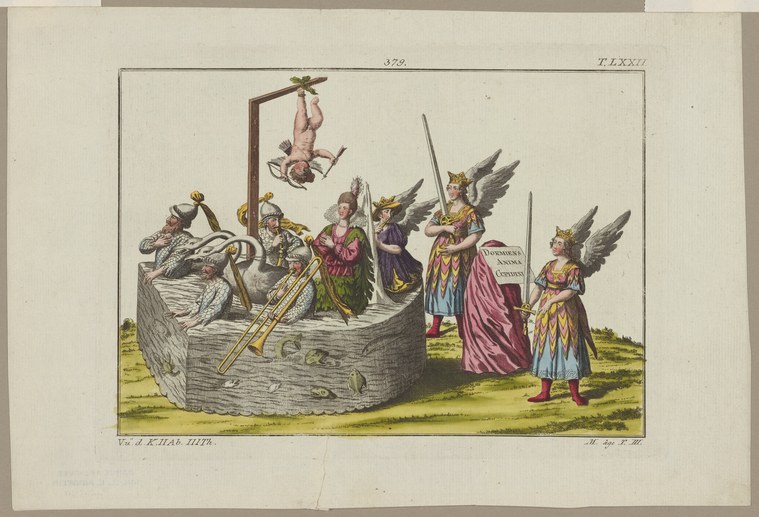
A wooden barrel or tub serves as an improbable stage for an aerial spectacle. Inside, figures writhe and tumble—one hangs upside down from a gallows-like wooden frame set atop the barrel, legs akimbo, suspended in mid-air. Others crouch, cling, and contort within the confined wooden vessel. Outside stand elegantly dressed spectators: three winged figures in classical drapery (pink, blue, and gold robes) with golden wings and long dark hair, flanking a central female figure in pink who gestures toward the scene. A single winged attendant stands to the right in gold and blue. The ground is rendered in flat yellow-green; the sky is blank. The composition reads as a carnival or grotesque entertainment—a deliberate inversion of graceful performance into bodily chaos and acrobatic extremity.
The dancing
The suspended figure demonstrates extreme flexibility and inverted positioning, their body bent backward in near-impossible arc while hanging by the hands from the frame. Inside the barrel, other bodies are compressed, folded, and stacked—one appears to be standing on hands or in a handstand position. The spectators outside stand in formal, static poses: the winged attendants adopt slight contrapposto stances with symmetrical arm gestures, while the central female figure raises one arm in a gesture of presentation or benediction. No recognisable ballroom hold or classical frame is present; the emphasis is on individual bodily extremity and weightlessness rather than partnership.
The dance depicted
This is likely acrobatic performance or circus entertainment rather than social or theatrical dance in the conventional sense. The aerial suspension, extreme flexibility, contortion, and confined-space tumbling suggest what would be classified as acro-dance or carnival acrobatics. The winged attendants (likely allegories or supernatural figures) suggest this is a mythological or allegorical tableau—perhaps depicting the entertainment of gods or the fantastic. The title 'Festivities and spectacles' indicates popular carnival or fair entertainment. No conventional dance vocabulary is visible; instead, the artist is depicting athletic, aerial performance at the boundary between dance, acrobatics, and physical impossibility.
How it was made
This is a hand-coloured engraving, likely 18th century, identifiable by the fine cross-hatching visible in the barrel's shading, the precise line-work defining the figures, and the secondary application of watercolour or ink wash in yellow-green, pink, gold, and blue. Engraving allowed for wide circulation and reproduction; the high finish and allegorical subject matter suggest it was aimed at educated audiences interested in fantastic imagery and popular spectacle. The hand-colouring is consistent but basic—areas of flat colour rather than subtle modelling—typical of commercial prints of the period.
About this work
This hand-coloured engraving depicts an acrobatic or carnival spectacle in which contorted performers execute aerial suspensions and extreme flexibility inside a barrel-shaped stage, observed by elegantly dressed allegorical or supernatural attendants. The print sits at the intersection of dance, acrobatics, and theatrical grotesque—a record of early modern popular entertainment and the culture of curiosity and physical extremity that fascinated 18th-century audiences. It belongs in a dance history collection because it documents a form of performed bodily expertise and spectacle that predates modern circus but shares its investment in gravity-defying, strength-based performance. The winged attendants and mythological framing suggest these acrobats held a place in the educated imagination alongside classical performers.
How to look at it
Focus on the suspended figure first: the artist has chosen the moment of maximum weightlessness and extremity—the body inverted and arched, at the limit of human flexibility. The compression of other figures inside the barrel creates a sense of crowded, chaotic energy. Notice the formal stasis of the spectators outside: they do not move or react dramatically, but observe with calm dignity, which throws the acrobats' active bodies into sharp relief. The winged attendants' classical drapery and formal stance create an odd collision between order and chaos, the mythological and the bodily real.
The period
This engraving likely dates to the 18th century, an era of fascination with natural philosophy, curiosities, and the limits of human bodily capability. Popular prints depicting exotic entertainments, automata, and acrobatic performers circulated widely. Court ballet was becoming increasingly professionalised and theatrical during this period, but this image captures a parallel world of street, fair, and carnival entertainment—less documented but no less important to audiences. The presence of allegorical winged figures suggests learned conceit, the print's audience was likely educated gentry, not merely popular crowds.
Where it lives
This work is held in the New York Public Library's collection of prints depicting dance. It is catalogued as 'Festivities and spectacles' with unknown artist and date, and no medium recorded in the current catalogue entry.
Dance in this work
Questions about this work
Is this actually dance?
Not in the ballroom or theatrical sense, but yes in the broader sense of organised, spectatorial performance of skilled bodily movement. Acrobatics and aerial performance are forms of embodied expertise that share a stage and audience with dance. This print shows the boundary between dance and circus athletics in an era before that boundary was clearly drawn.
What are the winged figures?
They appear to be allegorical attendants—likely representing muses, spirits, or divine witnesses to the spectacle. Their classical dress, wings, and formal posture suggest the artist is elevating these acrobats to the status of mythological or supernatural performance, rather than mere street entertainment.
When was this made?
The style, hand-colouring, and subject matter suggest 18th century, but the catalogue record offers no confirmed date. The engraving technique and the fashion of the spectators' dress are consistent with that era.
Why put acrobats in a barrel?
The barrel likely served both practical and conceptual purposes: it could be a portable stage for street or fair performances, and it creates a visual and spatial frame that contains and showcases the extremity of the acrobats' bodies. It also suggests constraint and impossibility—how do so many bodies fit into so small a space?
More dance artwork





