49 works in this view — arrow keys or swipe to move between them.
Dance in Art
Festivities and spectacles
Unknown artist
- Collection:
- Prints depicting dance
- Source:
- New York Public Library
- Rights:
- Public domain — free to use, share and adapt.
- Recorded as:
- Public Domain
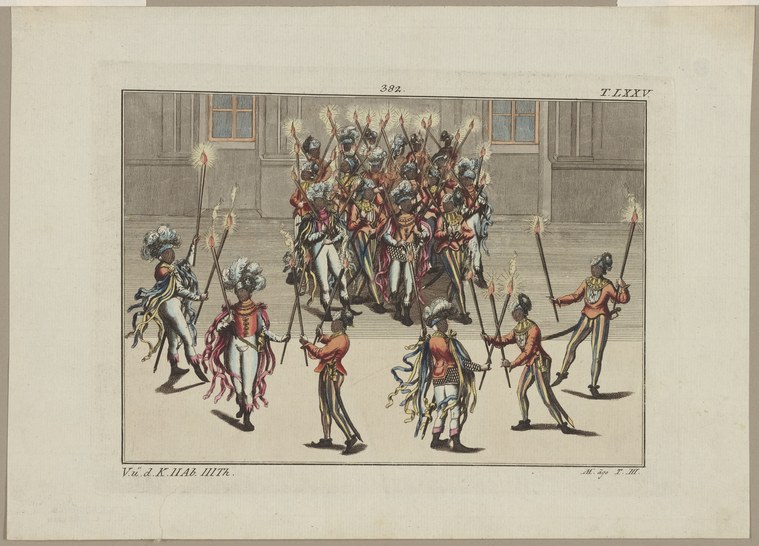
The image preserves a visual record of how baroque aristocratic culture choreographed and displayed power through coordinated spectacle. The practice of combining torchlit procession with dancing was a signature of court festivities from France to Italy, and this print provides concrete evidence of the spatial composition and costume conventions used in such events—information rarely preserved in written descriptions alone.
What you are looking at
A formal indoor celebration or festive gathering occupies a grand hall with tall windows and classical wall paneling. At the center, a large group of figures in rich costume—silks, velvets, plumed headdresses—cluster together in what appears to be a moment of revelry or ceremony. Surrounding them in a loose circle stand individual figures in elaborate court dress, holding aloft long torches or staffs topped with flames. The composition creates a theatrical, processional quality: the torchbearers frame and illuminate the central gathering, their arms raised in unison, while the figures in the middle adopt varied, animated poses suggesting dance, gesture, or social interaction. The style is characteristic of 17th-century court celebration: formal, hierarchical in composition, and designed to record the splendor of aristocratic spectacle.
The dancing
The torchbearers stand in an open formation around the perimeter, their bodies upright and their arms extended high, holding rigid implements aloft. Their posture is ceremonial and static. In contrast, the central cluster of figures adopts varied, dynamic attitudes—some with arms raised, others in profile, suggesting movement or turning. The precise nature of any dance hold is obscured by the crowding and the period convention of showing multiple figures in successive moments rather than a unified ensemble action. The contrast between the disciplined, parallel verticality of the torch-holding figures and the fluid variety of the central group suggests a distinction between attendants or torch-bearers and dancing participants.
The dance depicted
This appears to document a ceremonial or theatrical celebration of the late 17th or early 18th century, most likely a court spectacle combining music, dance, and torch-lit pageantry. The practice of combining dancing with torchlight processions was common in aristocratic festivities of the period, particularly in France and Italy. The image suggests a scripted entertainment rather than social dance, with the torches serving both practical and symbolic purposes—illuminating the dancers while marking the occasion as formal and elevated. The specific style of dance cannot be determined from the figures' positions alone, but the context and costume point toward court dances of the baroque era adapted for theatrical presentation.
How it was made
This is a hand-colored engraving or etching, executed with the fine line work characteristic of 17th- or early 18th-century reproductive print technique. The colored surfaces—particularly the vivid reds, golds, and blues of the costumes and the orange flames of the torches—are applied by hand after printing, a standard practice for prints intended as prestige documentation of court events. The technique allowed such images to circulate widely among the aristocracy and educated middle class, serving as both record and advertisement of spectacular celebrations. The precision of the engraved line and the careful composition suggest this was a professional commission documenting an actual or idealized court festivity.
About this work
This print documents or depicts an aristocratic celebration combining dance with ceremonial torch-bearing, a spectacle typical of late baroque court culture. The image combines theatrical documentation with formal heraldic qualities: it records both the elaborate costume and the coordinated human geometry of elite festivity. As a hand-colored print, it is a reproductive medium designed to commemorate and circulate images of court ceremony beyond those who witnessed it directly. For dance historians, it offers evidence of how baroque court spectacles combined multiple forms of movement—formal dance in the center, ceremonial procession at the periphery—and how such celebrations were visually recorded and valued by the elite.
How to look at it
Note the deliberate geometric contrast between the rigid, parallel stance of the torchbearers—all arms raised, all bodies vertical—and the varied, turning postures of the central group. This contrast is not accidental: it encodes a hierarchy between attendants and performers, and between ceremonial formality and choreographed movement. The artist has chosen to show the moment at its fullest visual spectacle: all torches lit, all participants visible, and the scale and costume of the gathering legible. Observe how the elevated torches frame and direct the eye inward, making the geometric clarity of the composition itself part of the meaning.
The period
This work belongs to the tradition of court spectacle documentation that flourished across Europe in the 17th and early 18th centuries. In France, the court of Louis XIV (r. 1643–1715) pioneered the integration of dance, music, and theatrical machinery into elaborate court ballets and fêtes; similar practices were adopted by courts in Italy, the Holy Roman Empire, and elsewhere. Prints such as this served as instruments of propaganda and prestige, circulating images of aristocratic magnificence to a wider audience. The practice of professional engravers documenting court events was well established by this date, and hand-coloring added to their value as luxury objects.
Where it lives
The print is held in the New York Public Library's collection of prints depicting dance, indicating its value and relevance to the study of dance history and representation. Such prints were typically produced in runs of moderate size for court distribution and sale to collectors and institutions.
Dance in this work
Questions about this work
What are the people holding aloft?
Torches or torch-staffs, lit and flaming. These served both to illuminate the celebration and to mark its formality and splendor. Torchlit celebrations were a prestige form of aristocratic entertainment, combining visual spectacle with music and dance.
What kind of dance is this?
The specific style cannot be identified from body position alone. However, the formal setting, elaborate costume, torch ceremony, and print style suggest a baroque court spectacle of the 17th or early 18th century. This would have combined formal court dances (minuets, pavanes, gavottes) with choreographed procession.
Who made this and when?
The artist is not recorded in the catalogue. The style, costume, and technique suggest a date in the late 17th or early 18th century, and a European court context, most likely France or Italy. The engraved technique and hand coloring are consistent with professional print production for aristocratic or institutional collectors.
How do we know this is a real event and not invented?
We cannot determine that from the image alone. Court celebration prints of this era sometimes documented actual events and sometimes recorded idealized versions or precedent celebrations. What matters is that the conventions and details—costume, torch ceremony, spatial composition—reflect genuine practices of aristocratic spectacle.
More dance artwork





